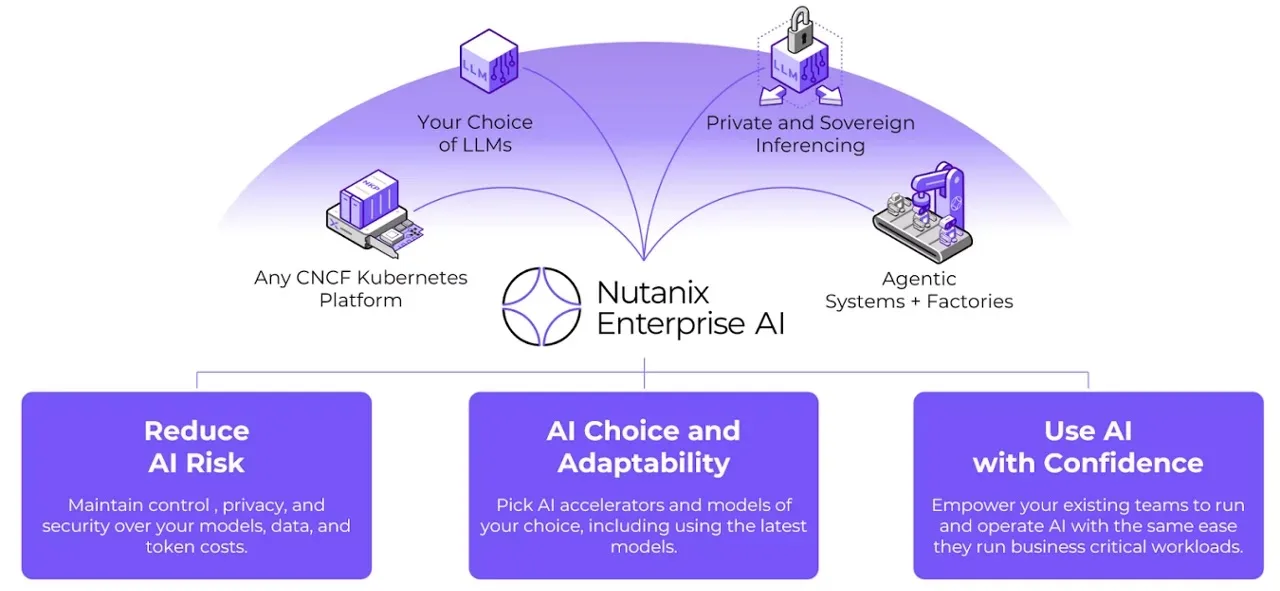
At the recent NVIDIA GTC 2026 event, Nutanix announced Nutanix Agentic AI, a full-stack software solution designed to help enterprises build, operate, and govern AI factories at scale.
The announcement enhances Nutanix’s existing hybrid cloud platform — including its AHV hypervisor, Flow Virtual Networking, Nutanix Kubernetes Platform, and Nutanix Enterprise AI — with features specifically designed for the operational needs of production agentic AI workloads.
Announcement Details
Nutanix Agentic AI is structured around three functional layers: infrastructure orchestration and security, an AI platform-as-a-service layer built on Kubernetes, and foundational data services. These layers integrate upward from the hypervisor through model serving, with NVIDIA technologies woven throughout the stack.
Infrastructure Orchestration and Security
The foundation of the stack is an enhanced version of Nutanix’s AHV hypervisor. Running GPU workloads inside virtual machines rather than directly on bare metal is a deliberate architectural choice, providing stronger multi-tenant security, simplified day-2 operations such as live migration and workload rebalancing, and infrastructure resilience capabilities not available in bare-metal deployments.
Key capabilities include:
- Topology-aware AHV (early access): Automatic workload placement optimization across GPU-dense servers without manual configuration, maximizing GPU utilization.
- Flow Virtual Networking with BlueField DPU offload: Network and security processing offloaded to NVIDIA BlueField DPUs, freeing host CPU and memory resources for inference workloads. This delivers high-throughput networking without degrading CPU performance.
- Integration with NVIDIA Agent Toolkit and OpenShell: The AHV layer connects to NVIDIA’s open-source runtime for autonomous agent coordination, enabling infrastructure-level support for agentic workload management.
- Hardware certification: Validated configurations available on Cisco, Dell, Lenovo, Supermicro, and Fujitsu infrastructure.
Agentic AI Services and Kubernetes Platform
Above the infrastructure layer, the solution offers an AI PaaS built on the CNCF-compliant Nutanix Kubernetes Platform (NKP), enhanced with a catalog of pre-integrated open-source AI tools and the Nutanix Enterprise AI (NAI) service. NAI version 2.6 introduces several key updates.
- AI Gateway: A new unified policy control layer providing standardized access, security enforcement, and usage governance across both cloud-hosted and on-premises LLMs. This allows organizations to apply consistent controls regardless of which model endpoint an agent calls.
- MCP server support: Enables agents to securely connect to enterprise tools and data sources via MCP, expanding integration reach beyond proprietary connectors.
- Fine-tuning support: Extends the existing Model-as-a-Service capabilities with fine-tuning workflows, allowing organizations to adapt base models to domain-specific tasks.
- NVIDIA Nemotron model support: Includes the Nemotron family of open-source models, datasets, and training tools, all designed for multi-step agentic reasoning and safe tool use.
- Open AI developer catalog: NKP now bundles pre-integrated open-source components, including Notebooks, Vector Databases, MLOps workflow engines, and agentic frameworks, alongside NVIDIA NIM microservices deployable on demand.
Foundational Data Services
The data tier is anchored by Nutanix Unified Storage (NUS), which is described as an NVIDIA AI Data Platform-compliant solution and is integrated as part of the NVIDIA STX program. The storage layer addresses two AI-specific challenges: data access latency at scale, and KV cache management for large-context inference.
Key capabilities include:
- NFS over RDMA: Low-latency network-attached storage access for GPU clients. S3 over RDMA is noted as forthcoming.
- KV cache offload: GPU memory freed by offloading key-value cache to storage, enabling larger context windows and higher concurrency without adding GPU capacity.
- Linear scalability: Nutanix NUS scales linearly to thousands of GPU clients.
- GPU-accelerated data processing: Data transformation and vectorization operations run within the storage cluster, reducing data movement overhead between storage and compute.
Analysis
Nutanix’s announcements are a significant escalation in how the company frames its AI relevance. Previously, Nutanix positioned itself primarily as a hybrid cloud infrastructure that could also run AI workloads. Nutanix Agentic AI reframes the narrative.
Nutanix is now (credibly) positioning itself as purpose-built for production agentic AI environments, with an architectural thesis that virtualization and cloud operating models are preferable to bare-metal deployments for multi-tenant, high-concurrency AI factories.
It’s a logical position. Nutanix’s main advantage has always been operational simplicity through software abstraction; the same reason that led to its HCI success now applies to AI infrastructure.
Its relationship with NVIDIA significantly strengthens the narrative; aligning with NVIDIA’s AI factory certification ecosystem and the STX program offers third-party validation that the architecture meets performance standards for serious AI workloads.
Some observations:
- The sovereignty and compliance angle is underdeveloped in this announcement. Nutanix has strong positioning in regulated industries and sovereign cloud environments, but the Agentic AI announcement does not explicitly connect these strengths to the AI factory use case. This is a missed opportunity given the regulatory scrutiny of AI deployment in regulated industries like financial services, healthcare, and government.
- The VMware disruption tailwind remains relevant. Organizations migrating away from VMware are actively re-evaluating their infrastructure stack, and Nutanix’s ability to offer a unified path from general virtualization to AI factory operations strengthens its position in those conversations.
- The cost-per-token thesis is the most commercially important claim in the announcement. If Nutanix can substantiate it with customer case studies, it can convert an architectural preference into a financial argument, which is a more durable differentiator.
Final Thoughts
Nutanix Agentic AI presents a solid response to a genuine market challenge. Enterprises managing production-scale agentic workloads are discovering that the AI infrastructure tools designed for model training do not easily adapt to the operational needs of multi-tenant, high-concurrency inference environments.
Nutanix’s claim that its hypervisor-centric, software-defined approach offers a better operational model than bare-metal options is convincing, especially for organizations already using Nutanix and valuing consistency across their infrastructure.
The deeper significance of this announcement is strategic rather than purely technical. Nutanix is staking its next growth phase on the premise that AI infrastructure complexity, at enterprise scale, favors integrated platforms over best-of-breed assembly. The NVIDIA partnership gives the credibility needed to be taken seriously in AI factory talks alongside Dell, HPE, and Cisco.
It now comes down to execution. Nutanix has the portfolio it needs to turn its credibility into actual AI factory revenue. It’s a strategy that makes sense for a company that has consistently shown it can deliver solutions to match whatever stage enterprises are in, whether replacing VMware or building an AI factory.
I’m sure we’ll hear more at Nutanix’s upcoming .NEXT event in Chicago. We’ll be watching.