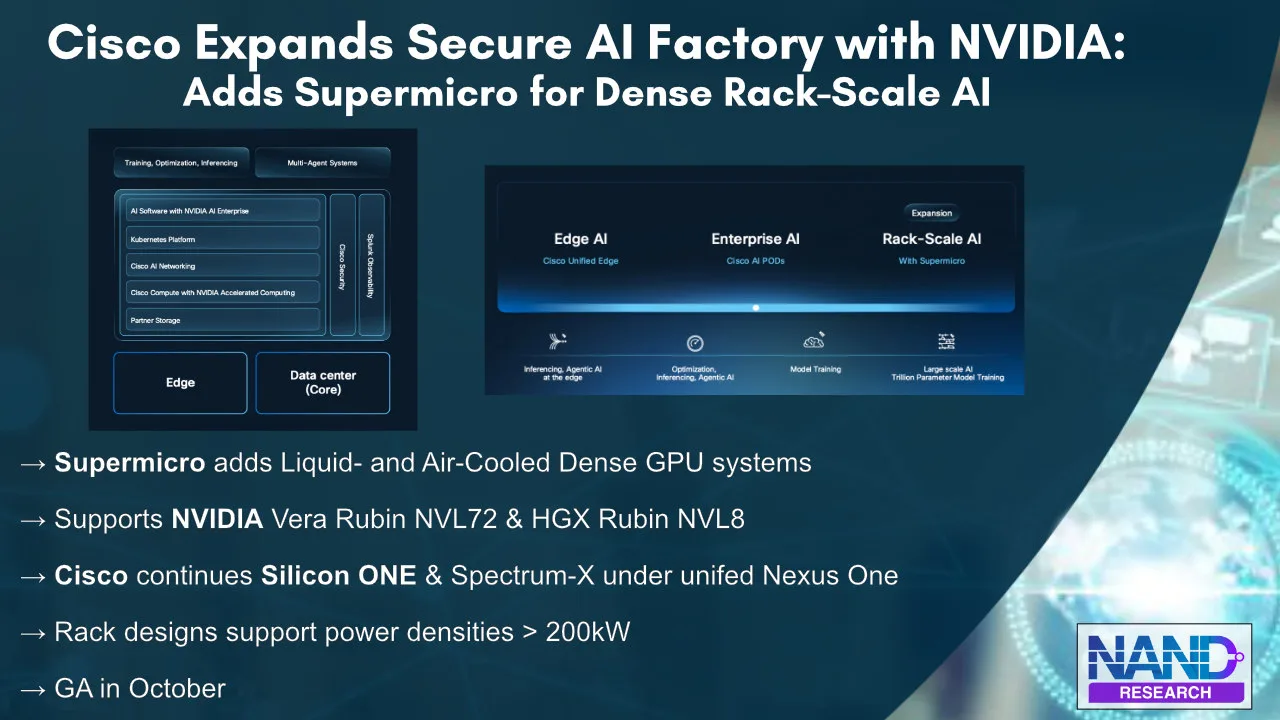
Cisco has added Supermicro as a rack-scale compute partner to Secure AI Factory with NVIDIA, the joint infrastructure framework the two companies introduced in March 2025.
The expansion brings Supermicro’s liquid- and air-cooled dense GPU systems into the program alongside Cisco’s Silicon One and NVIDIA Spectrum-X-based networking, targeting deployments on the NVIDIA Vera Rubin NVL72 and HGX Rubin NVL8 platforms.
This helps bridge the gap between Cisco’s inherent strengths in networking, security, and observability and the physical compute layer that large training and inference clusters now require.
Details
The Supermicro relationship adds a rack-scale compute layer to the existing Secure AI Factory with NVIDIA architecture without changing its underlying security, observability, or management components.
Supermicro supplies the physical GPU systems, while Cisco supplies the networking fabric, validation services, and the security and observability layers that wrap the entire stack:
- Compute: Supermicro offers liquid- and air-cooled server systems based on the NVIDIA HGX and MGX architectures, supporting the NVIDIA Vera Rubin NVL72 and HGX Rubin NVL8 platforms for training and high-throughput inference workloads, with rack designs that support power densities exceeding 200 kW.
- Networking: Cisco Silicon One-based switches handle front-end connectivity, while NVIDIA Spectrum-X-based Cisco N9100-series switches handle the back-end GPU fabric. Both are unified under a single Cisco Nexus One architecture running Cisco NX-OS or SONiC. Cisco is the only NVIDIA technology partner to use its own switches and network operating system in an NVIDIA Cloud Partner (NCP)- compliant solution.
- Cooling: The partnership introduces rack-to-fabric liquid cooling by pairing Cisco’s liquid-cooled networking equipment with Supermicro’s liquid-cooled servers in a single validated design.
- Management and validation: Cisco Cloud Control extends AgenticOps capabilities across the expanded stack, while new Cisco Validated Infrastructure Services (CVIS) certify that deployments align with NVIDIA reference architectures before customers deploy them to production.
- Security and observability: The existing Secure AI Factory layers extend to the new compute layer. Cisco AI Defense, Cisco Hybrid Mesh Firewall with NVIDIA BlueField DPUs, Cisco Isovalent Runtime Security, and Splunk Observability and Enterprise Security provide a consistent security posture from the GPU rack up.
- Support: Cisco and Supermicro coordinate support responsibilities. Cisco handles initial triage (L0/L1), while Supermicro handles component-specific issues.
Customers can order the expanded solution through Cisco’s authorized channel partners, with general availability set for October 2026.
Analysis
Cisco Secure AI Factory with NVIDIA is an important step in Cisco’s evolution from a networking-centric infrastructure provider into a broader supplier of enterprise AI infrastructure. The architecture brings together Cisco networking, UCS compute, security, Splunk observability, infrastructure management, partner storage, and NVIDIA accelerated computing and AI software in a pre-validated stack. Cisco is effectively applying the integrated systems model that helped simplify earlier generations of enterprise infrastructure to the considerably more complex problem of deploying AI at scale.
The offering has grown through a series of additions over the past year and a half, evolving from an initial security and networking framework into a more comprehensive infrastructure stack that now spans storage partnerships with NetApp, Everpure, Nutanix, Hitachi Vantara, and VAST Data. It also includes Kubernetes options via Red Hat OpenShift and Nutanix NKP.
The new Supermicro partnership addresses the layer Cisco had not directly covered: rack-scale GPU server manufacturing at high density, with systems exceeding 200 kilowatts per rack, giving Cisco an infrastructure story that stretches from enterprise inference at the edge to some of the largest AI clusters deployed by enterprises, neoclouds, and sovereign cloud providers.
The announcement follows rack-scale announcements from Dell and HPE earlier this year, both of which paired NVIDIA’s newest GPU platforms with their own or NVIDIA-supplied compute and networking.
Practitioner Impact
Enterprises, neoclouds, and sovereign cloud operators building dense GPU clusters gain a pre-validated reference design spanning rack-scale compute, networking, and cooling, cutting out the integration work of assembling those components independently.
This should reduce integration risk and shorten the path from procurement to production for teams without deep GPU infrastructure expertise.
Competitive Landscape
Every major infrastructure vendor now offers a rack-scale NVIDIA reference design, and the meaningful differences lie less in which GPU platform each supports, since all draw from the same NVIDIA roadmap, and more in how much of the surrounding stack each vendor owns directly.
| Alternative | Model/Approach | Relative to Cisco Secure AI Factory with NVIDIA |
| Dell AI Factory with NVIDIA | Vertically integrated PowerEdge servers (XE9812 with Rubin NVL72, XE9880L/XE9885L/XE9882L liquid-cooled family) plus Dell’s own storage and Lightning File System | Dell controls compute, storage, and rack integration under a single brand, offering tighter vertical accountability than Cisco’s multi-partner model, though without Cisco’s proprietary switching or Splunk-based security stack |
| HPE Private Cloud AI with NVIDIA | HPE ProLiant and Compute XD servers with NVIDIA GB200 NVL72, using NVIDIA Spectrum-X and BlueField-3 networking, HPE OpsRamp for observability | HPE, like Cisco, pairs its compute with an external layer, but builds on NVIDIA’s own Spectrum-X and BlueField-3 networking silicon, gaining tight alignment with NVIDIA’s reference stack while ceding the proprietary switching control Cisco keeps in-house |
| Supermicro direct with NVIDIA | The same NVL72 and HGX Rubin systems sold directly or through other integrators and cloud providers, without Cisco’s security and observability layers | A lower-cost, less-integrated path to identical GPU hardware, undercutting Cisco’s stack for buyers that do not need the added security and observability tooling |
| Lenovo Hybrid AI Advantage with NVIDIA | Liquid-cooled ThinkSystem servers with NVIDIA GPUs, combining Lenovo’s own switching with NVIDIA networking options | Offers build-your-own flexibility like Cisco’s approach, backed by a smaller security and observability ecosystem |
Cisco’s differentiation is strongest when the comparison shifts from hardware to the surrounding networking, security, and observability stack, an area where Dell, HPE, and Supermicro’s direct offerings each rely more heavily on NVIDIA’s components or on their narrower tooling.
It is weakest at the compute layer itself, where Cisco now depends on the same GPU building blocks and the same manufacturing partner that customers can reach through other channels entirely.
Final Thoughts
AI clusters are increasingly defined by the interaction among compute, networking, storage, security, observability, power efficiency, and management rather than GPUs alone. Cisco already has deep enterprise relationships and a large installed base across several of those layers. Secure AI Factory enables the company to turn those individual strengths into an integrated AI infrastructure proposition, while NVIDIA supplies the accelerated computing architecture and software ecosystem that enterprises increasingly expect.
Adding Supermicro to the equation closes a gap in Secure AI Factory with NVIDIA. The program was strong in networking, security, and storage partnerships but lacked a rack-scale, liquid-cooled compute option at the density required by the Vera Rubin NVL72 and HGX Rubin NVL8 deployments. Supermicro brings proven experience shipping dense GPU racks at volume.
Cisco doesn’t need to displace the established GPU server leaders to become a major AI infrastructure vendor. It can instead become the company that integrates, connects, secures, observes, and increasingly delivers the systems surrounding those GPUs. Secure AI Factory with NVIDIA is the clearest expression yet of that strategy.
Ultimately, Cisco is betting that customers will pay a premium for the security, networking, and observability wrapped around that commodity-adjacent hardware.
We think that’s a safe bet.