Silicon One momentum, scale-across routing, and an enterprise path for SONiC
Cisco updated nearly every layer of its AI networking stack at the recent 2026 OCP Global Summit. The company announced production deployments of its Silicon One P200 routing silicon at Microsoft and Alibaba, began shipping the first systems based on its 102.4 Tbps Silicon One G300, and introduced the Silicon One G302, a 51.2 Tbps top-of-rack device with 200G SerDes.
On the software side, Cisco extended Live Protect’s runtime vulnerability shielding to its validated SONiC distribution and introduced the Cisco 8001, a SONiC-based out-of-band management switch for AI clusters.
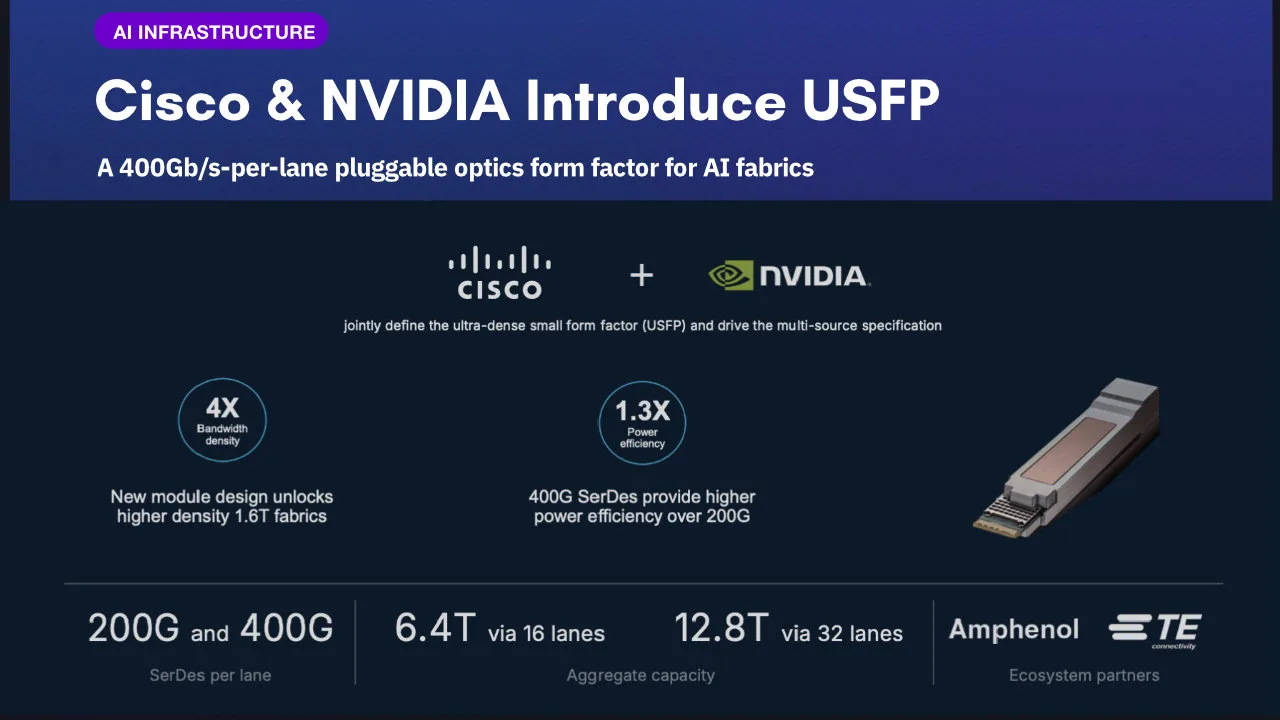
Cisco and NVIDIA also announced plans for a new 400G-per-lane pluggable optics form factor, USFP, which NAND Research covers in a separate note.
Details
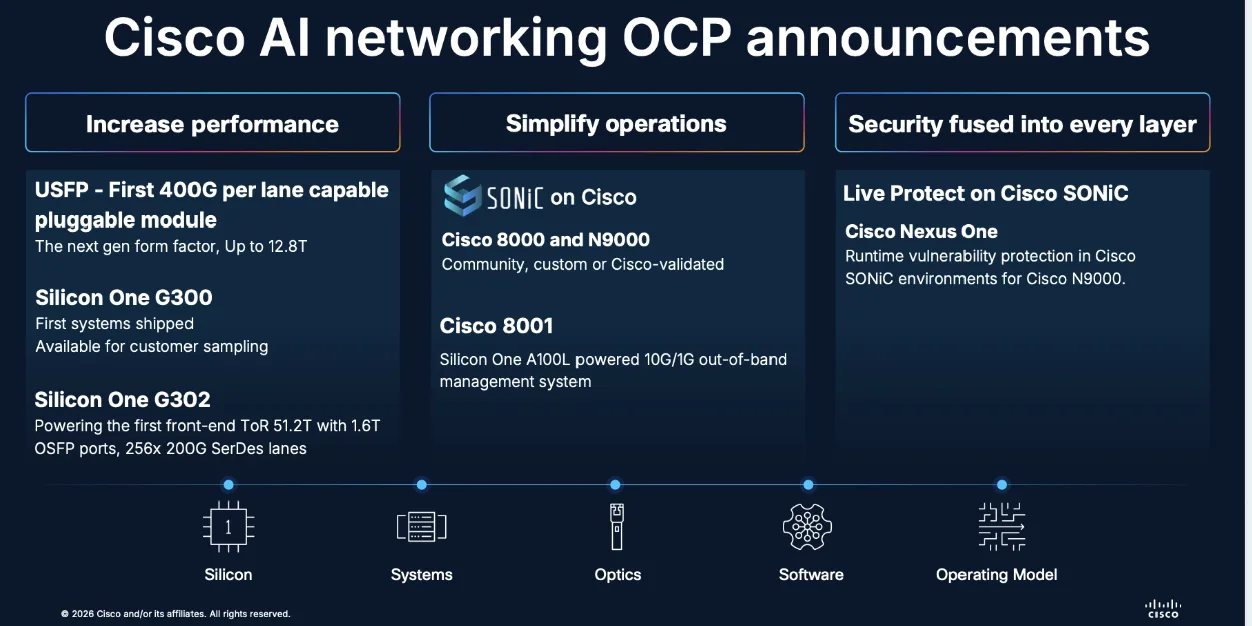
Cisco’s OCP announcements span four areas:
- Routing silicon and systems for multi-site AI fabrics.
- Switching silicon for scale-out and top-of-rack networks.
- Pluggable optics.
- The SONiC software and management layer that ties the hardware together.
All the silicon belongs to the Silicon One family, which Cisco introduced in 2019 and now scales from 100G to 100T on a single architecture.
Scale-Across Routing with Silicon One P200
Cisco first announced the 51.2 Tbps Silicon One P200 and its associated routing systems about a year ago, in October 2025. At OCP 2026, Cisco announced it is the first vendor to have 51.2T systems in production at leading hyperscalers:
- Microsoft: Microsoft has moved P200-powered systems into production, citing the chip’s speed and buffering capacity as its cloud and high-performance services grow.
- Alibaba Cloud: Alibaba deployed its in-house Quantum Cat router, built on the P200, across its eCORE backbone network. Alibaba touted each router’s 51.2 Tbps of routing capacity, a fully shared deep-buffer architecture, and the use of SONiC as the operating system.
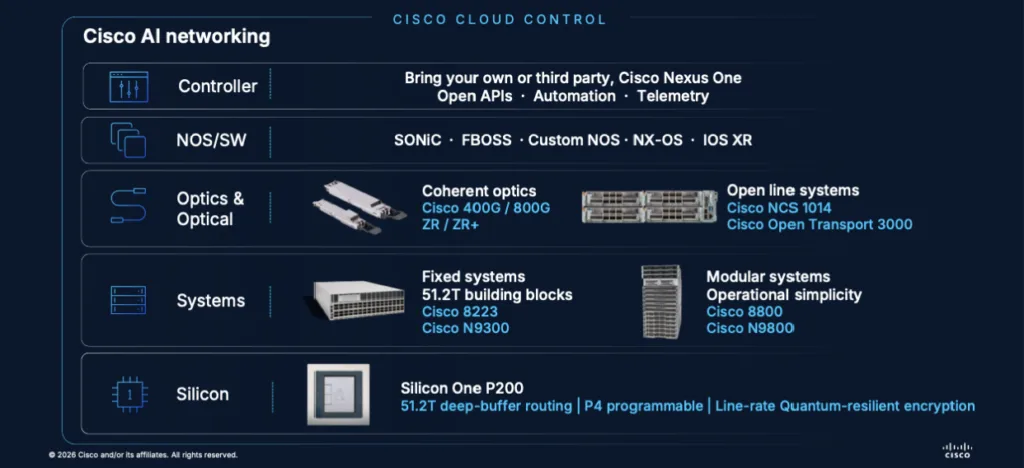
Cisco’s scale-across design combines P200 silicon, deep-buffered systems, and coherent optics so AI fabrics across separate locations behave as a single cluster.
Cisco argues (correctly, we believe) that congestion, latency, and recovery time across sites directly affect GPU utilization when accelerators share a single job. This places these links in a different class from conventional data center interconnect.
Silicon One G300 and G302
Cisco also moved its switching roadmap forward on two fronts, with one aimed at the scale-out spine and one aimed at the rack:
- Silicon One G300: The 102.4 Tbps G300, announced in February 2026, is now available for customer sampling, and the first G300-based systems are shipping to customers.
- Silicon One G302: The new G302 is a 51.2 Tbps device with 200G SerDes, built for top-of-rack switches, an industry first. It supports Cisco 1.6T optics and integrates with direct-to-chip liquid cooling. Cisco will begin shipping the G302 before the end of 2026.
- ESUN participation: Cisco reiterated its membership in OCP’s Ethernet for Scale-Up Networking (ESUN) workstream and said it is working on the 1.0 and later specifications for scale-up workloads.
Pluggable Optics
Cisco and NVIDIA jointly announced plans to develop USFP, an Ultra-Dense Small Form Factor Pluggable module capable of 400Gb/s per lane, and to publish it as an open specification via a community-led multi-source agreement.
The companies claim 4x the bandwidth density and 1.3x the power efficiency of 200Gb/s-per-lane optics. USFP is a specification effort with no announced products.
NAND Research analyzes it in a separate note.
SONiC, Live Protect, and Out-of-Band Management
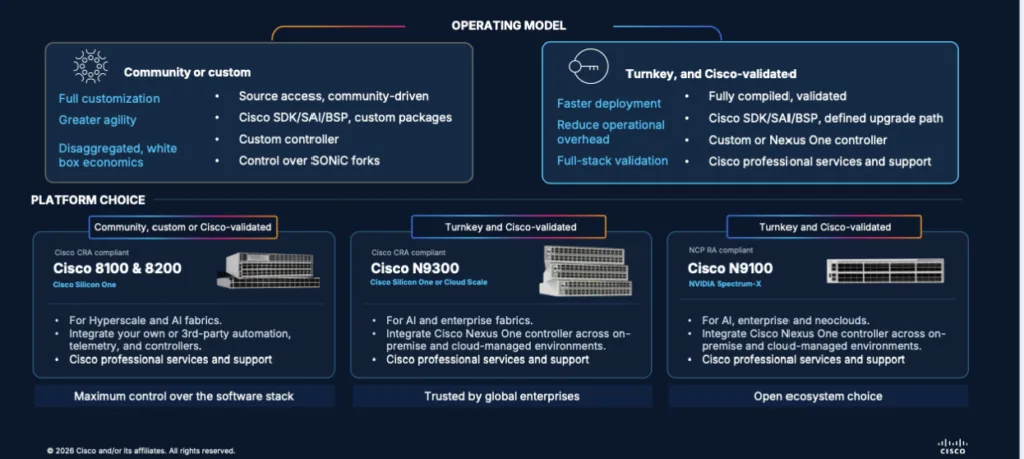
The software announcements focus on making SONiC operable outside hyperscale environments, with Cisco now offering two SONiC paths:
- Build a community distribution on Cisco hardware and own the stack themselves
- Run a Cisco-hardened distribution with validated releases, lifecycle management, and Cisco TAC support.
The validated distribution runs within Nexus One, Cisco’s next-generation data center architecture, on Cisco 8000 and Nexus 9000 platforms.
Here’s what else was announced:
- Live Protect for SONiC: Live Protect uses Cisco runtime technology to protect a running system from a newly disclosed vulnerability until a permanent patch can be installed during a planned maintenance window, without rebooting. It is available today for NX-OS. Cisco will extend it to Cisco-validated SONiC in the second quarter of 2027.
- Cisco 8001: The 8001 is a management switch built on Silicon One A100 and offered in 10G and 1G versions. It runs SONiC on the out-of-band network. Operators can use the same APIs and automation on the management network as on the production fabric.
- Upstream alignment: Cisco holds seats on both the SONiC Governing Board and the Technical Steering Committee. It commits to contributing customer-requested features upstream to reduce the risk of private forks.
Analysis
Cisco’s OCP message is that it can serve every type of AI builder at whichever layer the builder wants to buy. A hyperscaler can buy only Silicon One and build its own boxes, as Alibaba did. An enterprise can buy full Nexus systems with validated SONiC and TAC support.
This tiered model departs from Cisco’s historical practice of bundling silicon, hardware, and NOS into a single proprietary offering, and it gives Cisco exposure to hyperscale spending it would otherwise miss.
The strategy, however, carries both risk and benefit:
- Credible proof points: Named production deployments at two hyperscalers give the merchant-silicon story weight that roadmap announcements cannot.
- Breadth of portfolio: Cisco remains one of the few vendors with in-house switching and routing silicon, coherent optics from its Acacia acquisition, systems, and security. That combination is the foundation of its scale-across pitch.
- Channel tension: Selling silicon to customers who build their own systems competes, at the margin, with Cisco’s own systems business. Cisco appears comfortable with that trade at hyperscale.
- Enterprise uncertainty: Demand for SONiC among mainstream enterprises remains unproven. Many Nexus customers will remain with NX-OS, which already offers Live Protect.
Practitioner Impact
The practical audience divides in two:
- Hyperscalers and large neoclouds already run SONiC and buy silicon directly, so for them the announcements expand supplier choice at the chip level.
- Enterprises and service providers building AI infrastructure are the target for validated SONiC, Live Protect, and the 8001, which together address the operational gaps that have kept SONiC confined to organizations with large network engineering teams.
Several considerations apply to teams evaluating these offerings:
- Scale-across design: Multi-site AI fabrics require careful capacity planning for buffers, optical reach, and failure domains. Cisco’s integrated packet and optical approach simplifies vendor management but deepens dependence on a single supplier across layers.
- SONiC operations: The supported SONiC distribution lowers the barrier to entry, though teams still need to retool automation, telemetry pipelines, and change control processes for an open NOS. The SONiC skills gap remains real across most enterprise network organizations.
- Management networks: The 8001 addresses a common blind spot by bringing out-of-band networks in GPU clusters under the same automation model. This reduces operational overhead during outages and cyber incidents.
Competitive Impact
Broadcom is the primary competitor at the silicon layer and the default supplier for most white-box and OEM AI switches. Its Tomahawk 6 delivers 102.4 Tbps for scale-out and scale-up, and its Jericho4 fabric router, shipping since August 2025, targets the same multi-site AI interconnect problem as the P200, with deep buffering, line-rate MACsec, and lossless RoCE over distances beyond 100 km.
NVIDIA competes with a vertically integrated stack. Spectrum-X Ethernet handles scale-out, and Spectrum-XGS extends the same switches across sites, with CoreWeave as an early adopter.
Arista competes at the systems layer, largely on Broadcom silicon, and has a strong hyperscale installed base.
HPE, which completed its acquisition of Juniper Networks in 2025, is the competitor whose structure most resembles Cisco’s. Like Cisco, it pairs in-house routing silicon with its own systems. Its Express 5-based PTX12000 modular router targets 800G AI data center interconnect and scale-across, with 800GE ZR/ZR+ coherent optics supported on every port, and HPE sells the fixed PTX10002 on the same silicon.
On the switching side, HPE introduced the 102.4 Tbps QFX5250 for scale-out and the SONiC-based QFX5252 for UALink-over-Ethernet scale-up within the AMD Helios rack.
Two differences stand out. HPE does not sell its silicon to third parties, so it has no answer to the Alibaba-style merchant model, and it has disclosed no hyperscale production deployments of the PTX12000 comparable to Cisco’s P200 wins.
HPE’s strength lies in service provider and enterprise routing, where Juniper’s PTX and MX lines have long competed directly with Cisco, and in Mist and Apstra-based operations software that targets the same enterprise AI buyer as Nexus One.
The table below summarizes how Cisco’s OCP announcements compare with the main alternatives.
| Alternative | Model / Approach | Scale-Across Offering | Compared to Cisco |
| Cisco | Merchant silicon, full systems, validated SONiC or NX-OS | Silicon One P200 routers with coherent optics | Production wins at Microsoft and Alibaba; broadest buy-at-any-layer model |
| Broadcom | Merchant silicon sold to OEMs and ODMs | Jericho4 fabric router, shipping since 2025 | Larger merchant ecosystem and earlier scale-across silicon; no systems, optics, or NOS support of its own |
| HPE (Juniper) | In-house routing silicon and systems; Junos, Apstra, and SONiC on select switches | Express 5-based PTX12000 with 800G ZR/ZR+ optics | Closest structural match to Cisco and strong in SP and enterprise routing; no merchant silicon sales and no disclosed hyperscale scale-across deployments |
| NVIDIA | Vertically integrated GPU, NIC, switch, and software stack | Spectrum-XGS on Spectrum-X switches | Tight coupling with GPUs and NCCL tuning; less appeal for operators who want vendor-neutral networks |
| Arista | Systems and EOS, primarily on Broadcom silicon | Deep-buffer routers on Broadcom Jericho | Strong hyperscale incumbency and operational reputation; depends on Broadcom silicon roadmap |
| White-box ODM with community SONiC | Self-built systems on merchant silicon | Varies by silicon choice | Lowest hardware cost and full control; requires in-house engineering that Cisco’s validated SONiC replaces |
Cisco’s differentiation is strongest where it can combine layers. HPE comes closest with Juniper’s Express silicon and PTX routers, but no competitor matches Cisco’s mix of in-house switching and routing silicon sold both as chips and as systems, coherent optics, and a supported open NOS.
HPE remains the most direct threat in enterprise and service provider AI networking, where buyers want a full-stack alternative to Cisco without moving to NVIDIA.
Its position is weakest at the silicon ecosystem level, where Broadcom’s installed base and ODM relationships remain far larger, and in GPU-coupled fabrics, where NVIDIA benefits from owning both ends of the link.
The G302 also enters a top-of-rack market where Broadcom-based designs dominate and switching costs for hyperscalers are high.
Final Thoughts
Cisco arrived at OCP 2026 with deployments to report, distinguishing this round of announcements from the roadmap-heavy updates common at the event. P200 is in production at two hyperscalers, G300 systems are shipping, and a dated plan for the G302 gives Silicon One the commercial footing it needs to be taken seriously as an alternative to Broadcom.
The software story is less mature. Live Protect for SONiC is two to three quarters away, the 8001 has no announced ship date, and enterprise appetite for SONiC is still forming.
The open question is how far beyond hyperscale the merchant-silicon model extends. Neoclouds are the logical next customers, and they will weigh Cisco against Broadcom-based ODM designs and NVIDIA’s Spectrum-X integrated stack on cost, availability, and operational support.
For Cisco, the most important development at OCP 2026 is Alibaba running its own routers on Cisco silicon with an open-source operating system. That deployment confirms that Silicon One can compete purely on silicon merit in the most demanding open networks in the world.
This also gives Cisco a path to capitalize on AI networking spending that would otherwise never pass through its traditional systems business.