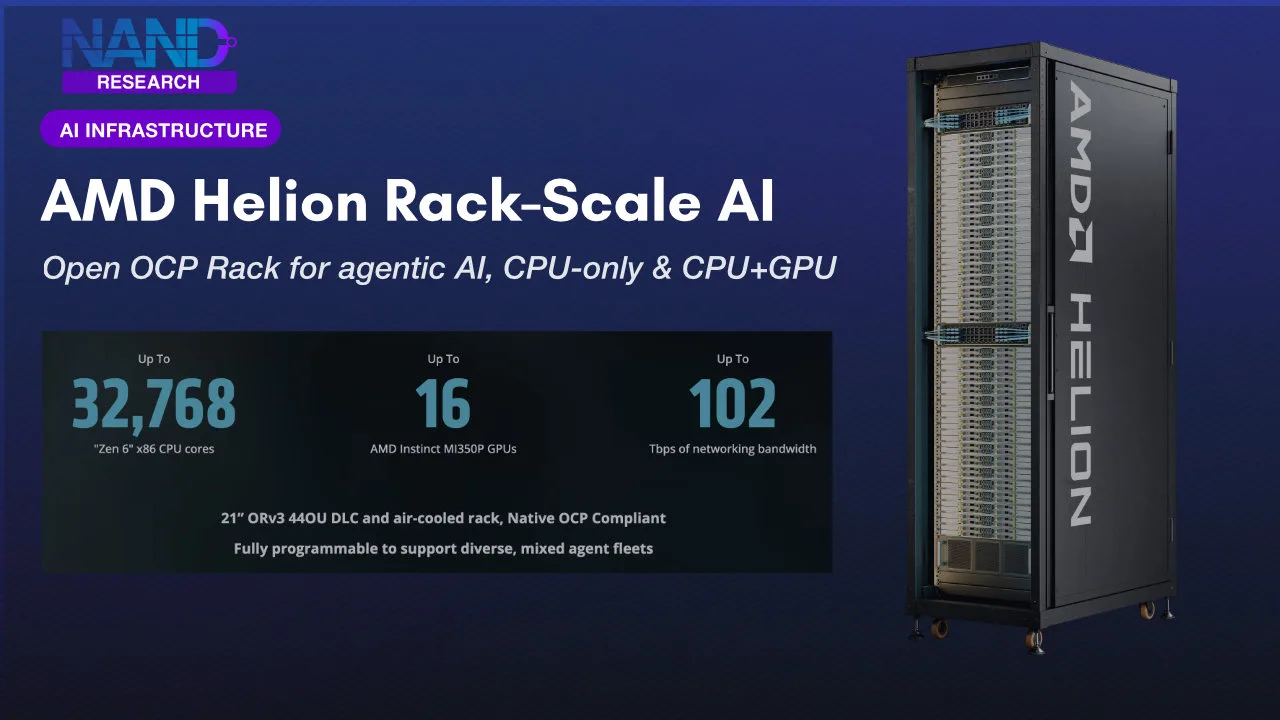
AMD introduced Helion at the 2026 OCP Global Summit, an open-rack reference design for agentic AI built around 6th Gen AMD EPYC “Venice” processors.
Helion comes in two shapes:
- A CPU-only hyperscale configuration packs up to 32,768 Zen 6 cores into a single rack to run agent execution at scale
- An enterprise configuration combines CPU blades, up to 16 AMD Instinct MI350P GPUs, and general-purpose blades for databases and storage in one rack.
AMD will contribute the specification to OCP, and partners such as Cisco, Dell, Foxconn, HPE, Lenovo, QCT, Supermicro, and Wiwynn plan to ship Helion-based systems starting in November 2026.
The announcement extends AMD’s rack-scale strategy, begun with Helios, its 72-GPU system for frontier training and large-scale inference. With Helion, AMD now offers rack-level blueprints for both halves of the agentic AI data center, the accelerator domain that runs models and the CPU domain that runs agents.
It also puts AMD in direct competition with NVIDIA’s Vera CPU Rack, which NVIDIA introduced at GTC 2026 in March, targeting the same workloads.
Technical Details
Helion is a reference design in which AMD publishes the blueprint, and its OEM and ODM partners build, integrate, and sell the systems.
The rack is a 21-inch, 44 OpenU enclosure built to the OCP Open Rack V3 specification. AMD offers both direct liquid-cooled and air-cooled versions.
Operators assemble a rack from a menu of blade types tailored to the agent workloads they expect to run.
Configurations
AMD supports two reference configurations that share the same rack infrastructure but differ in blade mix:
- Hyperscale configuration: A CPU-only rack for hyperscalers, neoclouds, and sovereign AI operators. It holds up to 128 EPYC 9996 processors, delivering 32,768 Zen 6 cores per rack, and connects to separate model inference infrastructure over the network.
- Enterprise configuration: An all-in-one rack integrating CPU blades, GPU inference blades, and general-purpose blades. It supports up to 16 Instinct MI350P GPUs, deployed as two independent 5U servers with eight GPUs each. There is no scale-up GPU fabric between the two GPU nodes, which AMD says aligns with the configuration’s focus on enterprise inference rather than frontier-scale training.
Blade Options
The blade catalog maps CPU characteristics to three agent classes that AMD defines as personal, enterprise, and technical.
AMD lists the following options:
- Dense CPU blades: EPYC 9006 processors with 256 cores at 400W, for maximum agent count per watt, aimed at personal agents.
- Balanced CPU blades: EPYC 9006 processors with 256 cores at 600W, aimed at higher-performing enterprise agents.
- Performance CPU blades: 96-core EPYC 9006 processors running at 5.0 GHz, for latency-sensitive technical compute agents.
- GPU inference blades: Eight Instinct MI350P GPUs in a 5U server, enterprise configuration only.
- General-purpose blades: EPYC 9006 SP7 and SP8 servers for database and storage workloads, and EPYC 9006X SP7 servers for technical computing.
Networking, Standards, and Software
AMD claims up to 102 Tbps of networking bandwidth per rack. Helion implements OCP standards at each layer of the system, which matters for buyers who want to source components from multiple vendors:
- Rack and power: Open Rack V3 for the frame and busbar, and HPR v2 for power shelves.
- Compute modules: DC-MHS for the host processor module and DC-SCM for management and security.
- Networking and trust: OCP NIC 3.0 for network adapters and Caliptra for the silicon root of trust.
On the software side, Helion includes an integrated token router that routes agents’ model calls to frontier models hosted in the cloud and to open-source models running locally on the rack.
| Specification | Hyperscale (CPU-only) | Enterprise (CPU + GPU) |
| Primary target | Hyperscalers, neoclouds, sovereign AI | Enterprise agentic AI |
| CPU | Up to 128 EPYC 9996, 32,768 cores | EPYC 9006 blades, mixed |
| GPU | None; inference runs on separate racks | Up to 16 Instinct MI350P |
| Networking | Up to 102 Tbps | Up to 102 Tbps |
| Rack | 21-inch ORv3, 44 OpenU | 21-inch ORv3, 44 OpenU |
| Cooling | Direct liquid or air | Direct liquid or air |
| Availability | Partner systems from November 2026 | Partner systems from November 2026 |
Analysis
AI Is Pushing Infrastructure to Rack Scale
Helion is the latest example of a structural shift in how AI infrastructure is designed and procured. For most of the past two decades, the server was the unit of purchase, and operators assembled racks from independently sourced nodes, switches, and power gear. AI has moved the unit of design up to the rack.
Power density, liquid cooling, interconnect topology, and serviceability now interact so closely that companies increasingly treat the rack as a single system and supply the silicon.
Four forces are driving this shift, and each shows up in the Helion design:
- Power density: AI racks have climbed from tens of kilowatts to hundreds. Even a CPU-only Helion rack carries a substantial load; at full population, 128 processors at 400W to 600W account for roughly 51 kW to 77 kW of CPU power alone, according to NAND Research’s estimate, before memory, networking, and storage. Busbar power, standardized power shelves, and liquid cooling become requirements at that density.
- Interconnect: Model training and inference depend on fabrics that span every accelerator in a rack, as in Helios and NVIDIA’s NVL72 systems. Agent fleets rely on high-bandwidth, scale-out networking between agent and inference racks, which is why Helion specifies rack-level networking.
- Time to deployment: Hyperscalers and neoclouds measure success by the megawatts brought online per quarter. A validated rack blueprint shortens qualification and enables integrators to build and test complete racks in the factory before shipping.
- Workload specialization: Agentic AI divides the data center into an accelerator domain and a CPU domain, each with distinct optimization targets. Rack-level designs allow operators to scale each domain independently while keeping power, cooling, and management consistent across both.
| Analyst Take Rack-scale design started with GPU training systems and has now reached CPUs. When the two largest merchant silicon vendors both ship CPU-only reference racks for agents within the same year, buyers should plan agent execution capacity as a distinct, rack-level line item in AI infrastructure budgets. |
Practitioner Impact
Helion speaks to two different buyers:
- For hyperscalers and neoclouds already operating large fleets of agent and reinforcement learning sandboxes, the CPU-only configuration provides a standardized, high-density building block they can source from multiple ODMs.
- For enterprises, the all-in-one configuration packages agent execution, local inference, and supporting data services into a single rack, simplifying procurement for organizations that don’t want to set up separate CPU and GPU estates.
Practitioners evaluating Helion should weigh several factors (some of these apply to more than just AMD’s rack-scale solution, but rather any OCP-compliant high-performance cluster):
- Facility readiness: ORv3 racks with 21-inch OpenU trays differ from the 19-inch EIA racks that dominate enterprise data centers. Air-cooled versions ease the transition, but dense configurations will likely require liquid cooling and higher-capacity power delivery than many enterprise facilities can support today.
- Sizing the blade mix: The choice between dense, balanced, and performance blades depends on agent behavior, including sandbox count, per-agent latency targets, and memory footprint. Few enterprises have production telemetry to size this accurately, so early deployments will involve trial and adjustment.
- Inference scope: Sixteen MI350P GPUs across two independent nodes support local inference for open-weight and fine-tuned enterprise models. Organizations that expect to run frontier-scale models locally will still need dedicated accelerator infrastructure.
- Software integration: The value of the token router depends on how well it integrates with agent frameworks, identity systems, and cost governance tools. AMD has not yet detailed the integration, and that will determine how much operational work Helion removes.
- x86 continuity: Agents call existing enterprise applications, most of which run on x86. Helion keeps agent sandboxes on the same instruction set as the systems they interact with, reducing porting and validation work.
Competitive Impact
Helion competes in a market that barely existed a year ago. At GTC in March 2026, NVIDIA defined the CPU-only agent rack category with its Vera CPU Rack and has since delivered Vera systems to AI labs and cloud providers.
Intel, Arm-based hyperscaler CPUs, and conventional OEM server fleets compete for the same agent-execution workloads, even without a dedicated agentic rack blueprint.
The table below summarizes how the main alternatives compare to Helion:
| Alternative | Model / Approach | Compared to AMD Helion |
| AMD Helion | Open OCP reference rack; Zen 6 EPYC CPU blades with optional MI350P inference; built by OEMs and ODMs | Highest disclosed core count per rack (32,768) and broad x86 compatibility; no published agent benchmarks yet |
| NVIDIA Vera CPU Rack | MGX-based, liquid-cooled rack with up to 256 Arm-based Vera CPUs and 64 BlueField-4 DPUs | Fewer cores (over 22,500) but high-bandwidth LPDDR5X and tight coupling to Vera Rubin; NVIDIA claims up to 1.8x over x86; Arm requires software validation |
| Hyperscaler Arm CPUs (AWS Graviton, Google Axion, Microsoft Cobalt) | In-house silicon deployed in each cloud’s own racks | Cost-efficient for cloud-native agents inside one cloud; unavailable for on-premises or neocloud deployments |
| Intel Xeon via OEM servers | Conventional x86 servers in standard racks | Large installed base and x86 compatibility; no rack-level agentic blueprint comparable to Helion |
| NVIDIA Vera Rubin NVL72 / AMD Helios | GPU-dense rack-scale systems for training and inference | Complementary; these racks run the models that Helion-based agents call |
AMD’s differentiation is strongest in openness and compatibility. Helion conforms to OCP standards at every layer, ships through a broad set of OEMs and ODMs, and runs agent sandboxes on x86, which matches the enterprise software agents interact with. Its raw core density also exceeds what NVIDIA has disclosed for the Vera CPU Rack.
AMD is weakest in proof-points. NVIDIA reached the market first, has named production customers for standalone Vera, and has published agent-specific performance claims, even if those claims lack independent validation.
Final Thoughts
Helion applies rack-scale thinking to the CPU side of AI infrastructure. Until this year, rack-scale AI meant GPU racks. NVIDIA’s Vera CPU Rack and now AMD Helion treat agent execution capacity as a distinct rack-scale category, with its own blueprint, partner ecosystem, and efficiency metric.
For AMD, Helion strengthens its argument that it can supply the entire agentic AI data center at rack scale. Helios covers frontier training and large-scale inference, with commitments from Microsoft, Meta, OpenAI, and Oracle. Helion also covers agent execution and enterprise inference.
Together, this gives AMD a complete rack-level story spanning CPUs, GPUs, DPUs, networking, and open software, all delivered through the OCP ecosystem.
The strategy builds on AMD’s strongest asset in AI infrastructure. EPYC holds a leadership position in server CPUs, and the agentic thesis that CPU demand rises alongside agent adoption directly plays to that strength. Since its Advancing AI event in July, AMD has argued that agents create a step change in CPU demand, and Helion turns that argument into a product that hyperscalers can order.
AMD Helion gives the company a rack-level answer for the CPU half of the agentic AI data center, and it arrives with the partner support and OCP alignment that hyperscalers and neoclouds expect.
Helion’s greater significance lies in what it confirms about the direction of AI infrastructure. AI has made the rack the unit of design, and agentic AI has extended that shift from GPU systems to CPU systems.
With Helios and Helion, AMD now competes with NVIDIA, rack for rack, across both domains, and customers who value open standards and x86 continuity have a credible alternative for the fastest-growing segment of the AI data center.
It’s a strong and necessary move by a company that seems to be doing everything right to compete in frontier-class AI.