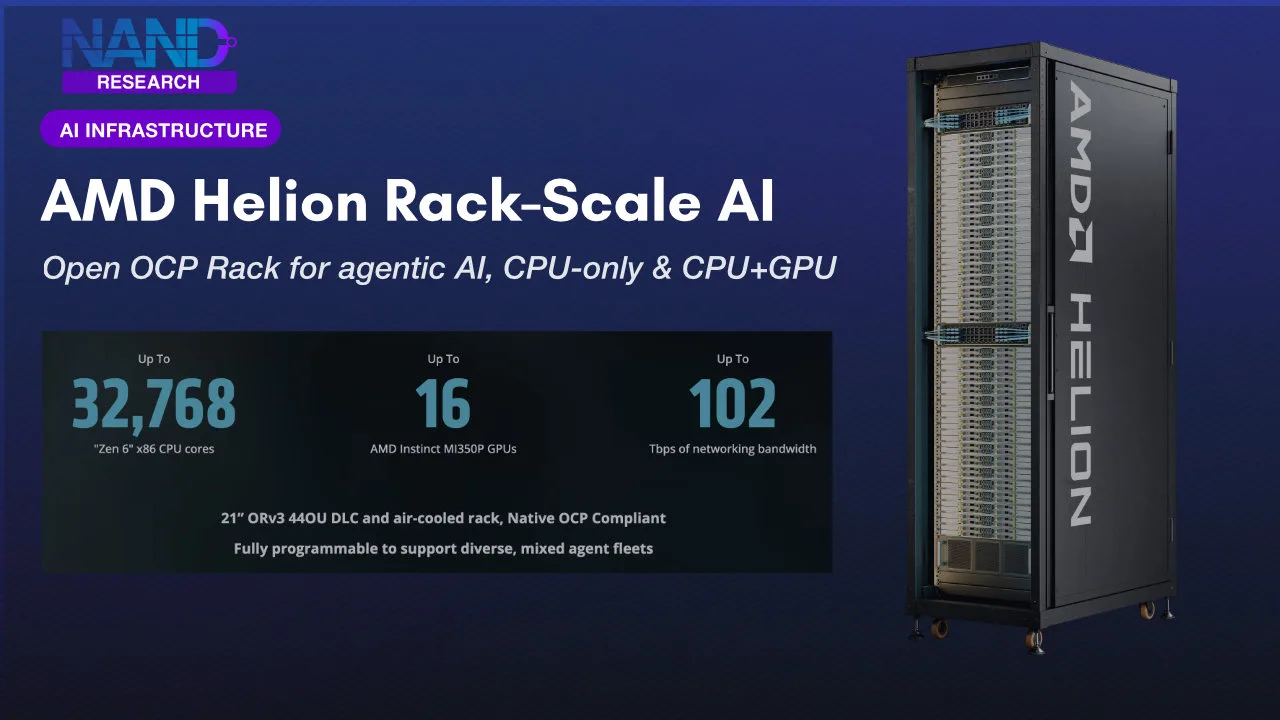
AMD used its Advancing AI 2026 conference in San Francisco on July 22-23 to launch a full-stack of AI infrastructure products spanning silicon, rack-scale systems, and developer software. The centerpiece is AMD Helios, the company’s first fully integrated rack-scale AI system, which combines 72 Instinct MI455X GPUs, 18 sixth-generation EPYC “Venice” CPUs, Pensando networking, and ROCm software into a single liquid-cooled rack rated at up to 2.9 exaflops of FP4 inference performance.
AMD paired the hardware launch with ROCm.ai, a new AI-assisted layer for its open-source GPU software stack, and disclosed a wave of customer commitments, most notably a strategic partnership with Anthropic that includes a planned AMD equity investment of up to $5 billion.
The announcements address AMD’s central strategic challenge of converting several years of Instinct GPU roadmap progress into deployed capacity at the scale NVIDIA already commands. By shipping a complete rack-scale system rather than individual chips, and by securing named commitments from OpenAI, Anthropic, Meta, Microsoft Azure, and Oracle, AMD hopes to move beyond its position as the “alternative choice” and position Helios as a credible first solution for complex AI.
Details
AMD’s disclosures cover four interlocking layers: a new CPU generation, a new GPU generation, a rack-scale system that integrates both, and a software layer designed to make the hardware easier to program. Let’s look at each.
6th Generation EPYC “Venice”
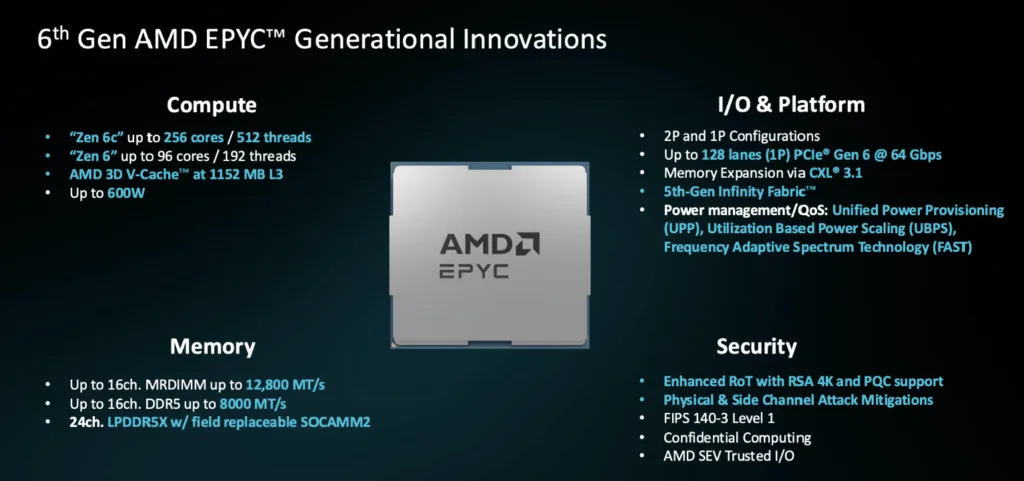
- Venice is built on the Zen 6 core architecture and is the first x86 server CPU to enter volume production on TSMC’s 2-nanometer process node.
- The flagship EPYC 9996 configuration offers up to 256 cores and 512 threads with simultaneous multithreading enabled. AMD states that this is the highest thread count of any publicly disclosed single-socket CPU as of July 2026.
- The platform supports up to 16 channels of 12.8 GT/s MRDIMM memory and PCIe Gen 6 connectivity, with select SKUs boosting to 5 GHz.
- AMD positions Venice as the host CPU for GPU-attached AI nodes, where memory bandwidth and PCIe lane count determine how well accelerators are fed, as well as for general-purpose enterprise and HPC workloads.
Instinct MI400 Series GPUs
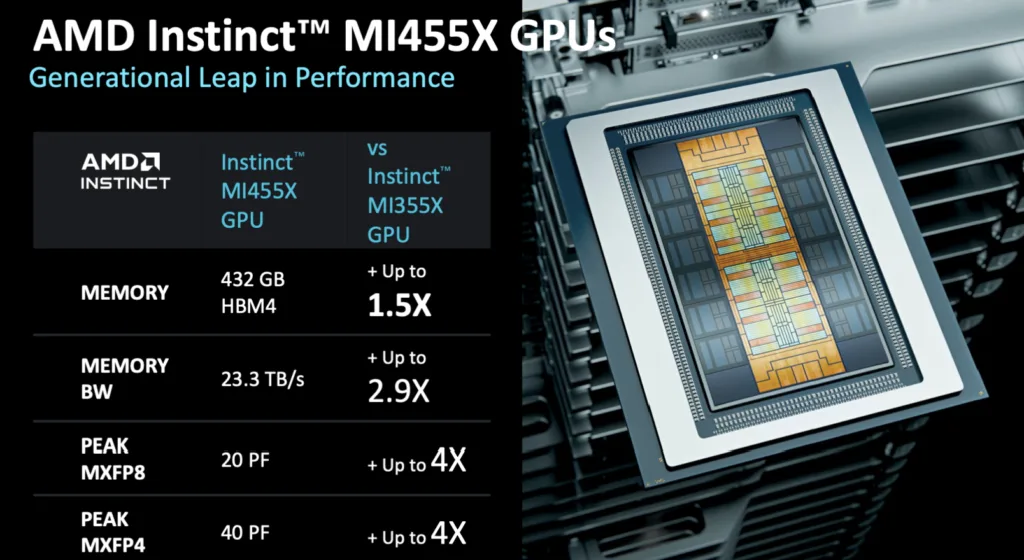
- The MI400 family comprises three SKUs built on the CDNA 5 architecture and equipped with HBM4 memory. The MI455X is the flagship part powering Helios racks at hyperscale. The MI430X targets sovereign AI and HPC customers, delivering up to 288 TFLOPS of hardware FP64 performance. The MI440X packages eight GPUs into an on-premises enterprise server.
- Each MI455X carries 432GB of HBM4 memory and offers nearly 20 TB/s of per-GPU bandwidth. AMD claims the part delivers 34x higher token throughput than the prior-generation MI355X GPU on a DeepSeek V4 Flash FP4 serving workload, based on AMD Performance Labs testing.
- AMD also introduced the Instinct MI350P, a lower-tier GPU designed to extend AI acceleration across existing infrastructure. AMD claims, based on internal testing, that the Instinct MI350P delivers up to 4.2x more tokens per second per dollar than an NVIDIA H200 NVL GPU on a Llama 3.3 70B online serving benchmark.
Helios Rack-Scale System
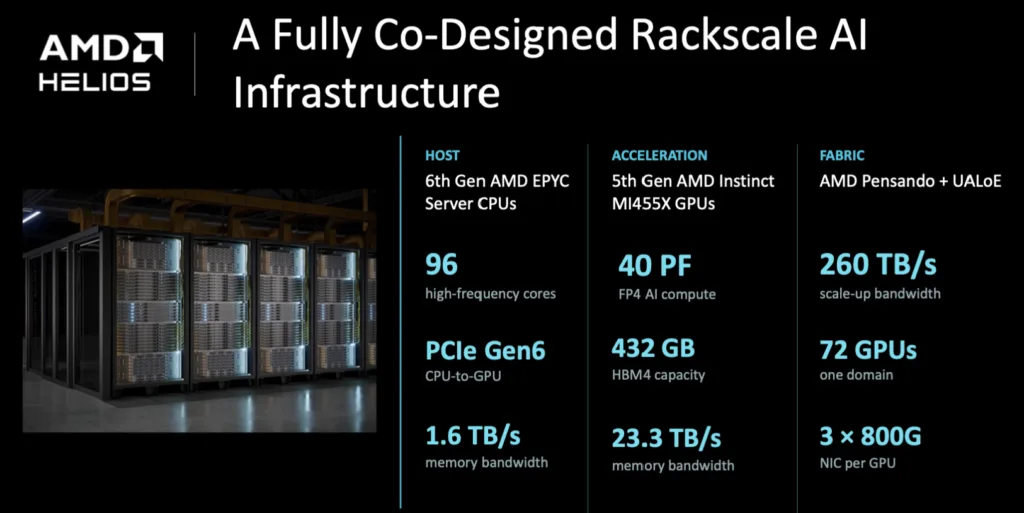
- A full Helios rack integrates 72 MI455X GPUs and 18 Venice CPUs, connected via Pensando front-end, scale-up, and scale-out networking, in a single liquid-cooled chassis based on the Open Compute Project rack design co-developed by AMD and Meta in 2025.
- AMD rates a complete rack at approximately 2.9 exaflops of FP4 inference compute, 1.4 exaflops of FP8 compute, 31 terabytes of aggregate HBM4 capacity, and 1.4 petabytes per second of combined memory bandwidth.
- AMD claims Helios delivers up to 30% more inference tokens per dollar than an NVIDIA Vera Rubin NVL72 rack running the Kimi K2 Thinking workload.
- Reported list pricing for a fully configured rack falls between $5 million and $5.5 million. Systems are now shipping, with OEM availability from Bull, HPE, Lenovo, and Supermicro, along with infrastructure partners Sanmina and Wiwynn.
ROCm 7 and ROCm.ai
- AMD’s open-source GPU software stack, ROCm, adds distributed inference support through frameworks including SGLang, vLLM and llm-d, alongside expanded support for PyTorch and Hugging Face.
- ROCm.ai is a new AI-assisted development layer that lets coding agents, including Claude, Codex and Cursor, work against AMD’s ROCm APIs using AMD-authored “skills” that describe ROCm conventions to those agents natively.
- ROCm.ai includes Hyperloom, a code and performance optimization tool that improved token throughput by 38% in an internal demonstration.
Partnerships and Ecosystem Commitments
AMD paired the hardware and software launches with a set of named commitments spanning frontier labs, hyperscalers and the surrounding data infrastructure ecosystem
Anthropic
AMD and Anthropic announced a strategic partnership to deploy up to 2 gigawatts of Instinct MI450-series GPUs in Helios rackscale solutions, with the first gigawatt beginning deployment in the first half of 2027. AMD committed to a strategic equity investment of up to $5 billion in Anthropic.
The two companies are launching a multiyear engineering collaboration in which Anthropic’s Claude models will optimize workloads for Instinct GPUs and accelerate ROCm software development, while AMD broadens its internal use of Claude across engineering and product teams.
Microsoft Azure
AMD and Microsoft expanded their strategic partnership, announced on July 20, to span GPUs, CPUs, networking, and software on Azure. Microsoft will deploy Helios rackscale solutions to power frontier model inference starting in the second half of 2026.
Microsoft is also introducing two new EPYC “Venice”-powered VM series, HDv2 for agentic AI and data pipelines and HXv2 for semiconductor design, alongside broader deployment of Pensando DPUs and integration with Azure Boost for cloud networking.
VAST Data
VAST Data participated in Advancing AI 2026 as a Catalyst-tier ecosystem partner, aligning its AI data platform, which unifies storage, database, and global namespace management, with AMD’s Instinct and Helios infrastructure to address data-pipeline and GPU-feeding requirements for large-scale training and inference deployments.
Additional partners
Other partners named at the event include OpenAI, Meta, Oracle, HUMAIN, Cerebras, AT&T and Cisco, along with OEM and infrastructure partners Bull, HPE, Lenovo, Supermicro, Sanmina and Wiwynn.
Competitive Landscape
NVIDIA remains the primary reference point for nearly every claim AMD made at Advancing AI 2026, with AMD’s announcements landing just one day after NVIDIA published the full specifications for its Vera CPU.
Vera pairs 88 Olympus cores and 176 threads with 1.2 TB/s of LPDDR5X memory bandwidth and a 250 to 450-watt thermal range. NVIDIA’s own benchmarking claims a slight edge over a dual-socket EPYC 9755 system on SPECrate integer workloads while emphasizing single-thread performance for agentic AI.
AMD counters with core density rather than per-core throughput. The company argues that a 256-core EPYC 9996 fits more than twice as many cores per rack within the same power envelope as Vera-based servers, a distinction that matters differently depending on whether a given agentic workload is thread-bound or latency-bound.
NVIDIA also retains the larger deployed software ecosystem in CUDA, a multi-year lead that ROCm.ai’s agent integrations are designed to narrow but have not yet closed. The near-term test is whether coding agents can port production CUDA workloads to ROCm with the same fidelity AMD demonstrated in isolated benchmarks.
Both companies are also converging on the same customer set: Anthropic, OpenAI, Microsoft, and Meta all hold live commitments to AMD and NVIDIA hardware simultaneously, limiting either vendor’s ability to claim exclusivity and shifting the competitive question toward price-performance and delivery reliability rather than access.
The table below provides a high-level summary of how the principal alternatives compare with AMD’s Helios and Instinct MI400 platform:
| Alternative | Model / Approach | How It Compares to AMD Helios / Instinct MI400 |
| NVIDIA Vera Rubin NVL72 | Integrated rack-scale system pairing 72 Rubin GPUs with Vera CPUs in a single liquid-cooled rack | Direct rack-level competitor with a larger installed CUDA software base and a multi-year production lead. AMD claims a token-per-dollar advantage using its own Kimi K2 Thinking benchmark, a result NVIDIA has not corroborated. |
| NVIDIA Vera (standalone CPU) | 88-core, 176-thread Olympus-core CPU tuned for single-thread performance in agentic AI workloads | Optimized for per-thread speed and memory bandwidth (1.2 TB/s LPDDR5X) rather than core density. EPYC Venice offers substantially higher thread count per rack; which architecture wins depends on whether the workload is thread-bound or latency-bound. |
| Intel Xeon 6 (Granite Rapids / Clearwater Forest) | x86 host CPU for GPU-attached AI servers, sold without a comparable rack-scale AI system | Trails both AMD and NVIDIA on thread density and AI-specific benchmarks disclosed at Advancing AI. Intel has no rack-scale AI platform comparable to Helios or Vera Rubin NVL72 shipping before mid-2027. |
AMD’s differentiation is strongest in its breadth. The company disclosed named commitments across labs, hyperscalers, and neoclouds, and its rack-scale token economics claims demonstrate a solid price-performance argument.
Its differentiation is weakest in independent validation and software maturity. Every headline benchmark in this announcement comes from AMD’s own labs, and ROCm’s practical parity with CUDA remains unproven outside AMD’s demonstrations.
Analysis
The Advancing AI announcements are a shift in AMD’s AI messaging from individual GPU specifications to system-level economics and multi-year supply commitments.
- Named commitments from OpenAI, Anthropic, Meta, Microsoft Azure, and Oracle provide AMD with proof points across model developers, hyperscalers, and neoclouds, a broader customer base than AMD claimed at its prior Advancing AI event.
- The Anthropic partnership extends beyond a purchase commitment. AMD’s plan to invest up to $5 billion in Anthropic and to integrate Claude into its chip and software engineering workflows ties AMD’s product roadmap to a specific frontier lab’s continued success, a dependency that cuts both ways.
- AMD’s roadmap disclosure through 2030, covering Zen 7 EPYC CPUs, Instinct MI500 and MI600 GPUs, and Helios 500 and 600 rack generations, should reassure buyers making multi-year infrastructure commitments that AMD will maintain its release cadence rather than repeat past periods of roadmap uncertainty.
Overall, AMD is bringing a solid set of capabilities to the AI infrastrastructure world:
- Distributed inference support across vLLM, SGLang, and llm-d reduces the custom engineering previously needed for AMD shops to serve mixture-of-experts and long-context models at rack scale.
- ROCm.ai’s agent integration will reduce the porting effort long cited as ROCm’s biggest practitioner complaint relative to CUDA, though the benefit depends on how thoroughly Claude, Codex and Cursor handle ROCm-specific quirks versus generic GPU programming patterns.
- Helios’s fixed 72-GPU, liquid-cooled configuration simplifies capacity planning compared with assembling a custom rack, but it also commits buyers to AMD’s specific power, cooling and networking assumptions, a real constraint for data centers not already built to OCP rack standards.
- Enterprises without hyperscale budgets have a more accessible entry point: the MI440X on-premises server and MI350P GPU offer a lower-cost path to the same ROCm software stack without requiring a full Helios rack purchase.
Final Thoughts
AMD has made the necessary move from simply disclosing competitive GPU specifications to shipping a complete, purchasable rack-scale system backed by named commitments from the largest buyers of AI compute. The breadth of the announcement, spanning CPUs, GPUs, networking, software, and a five-year roadmap, reflects a deliberate effort to close the perception gap with NVIDIA on system-level completeness.
Overall, AMD enters the second half of 2026 with the first rack-scale answer to NVIDIA credible enough that hyperscalers and frontier labs are willing to commit gigawatt-scale capacity alongside their existing NVIDIA purchases.
Whether that commitment meaningfully erodes NVIDIA’s pricing power, or simply adds a second well-funded vendor to the same constrained supply queue, will be determined by 2027 shipment volumes and independent benchmarks. Either way, AMD is competing from a position of strength.