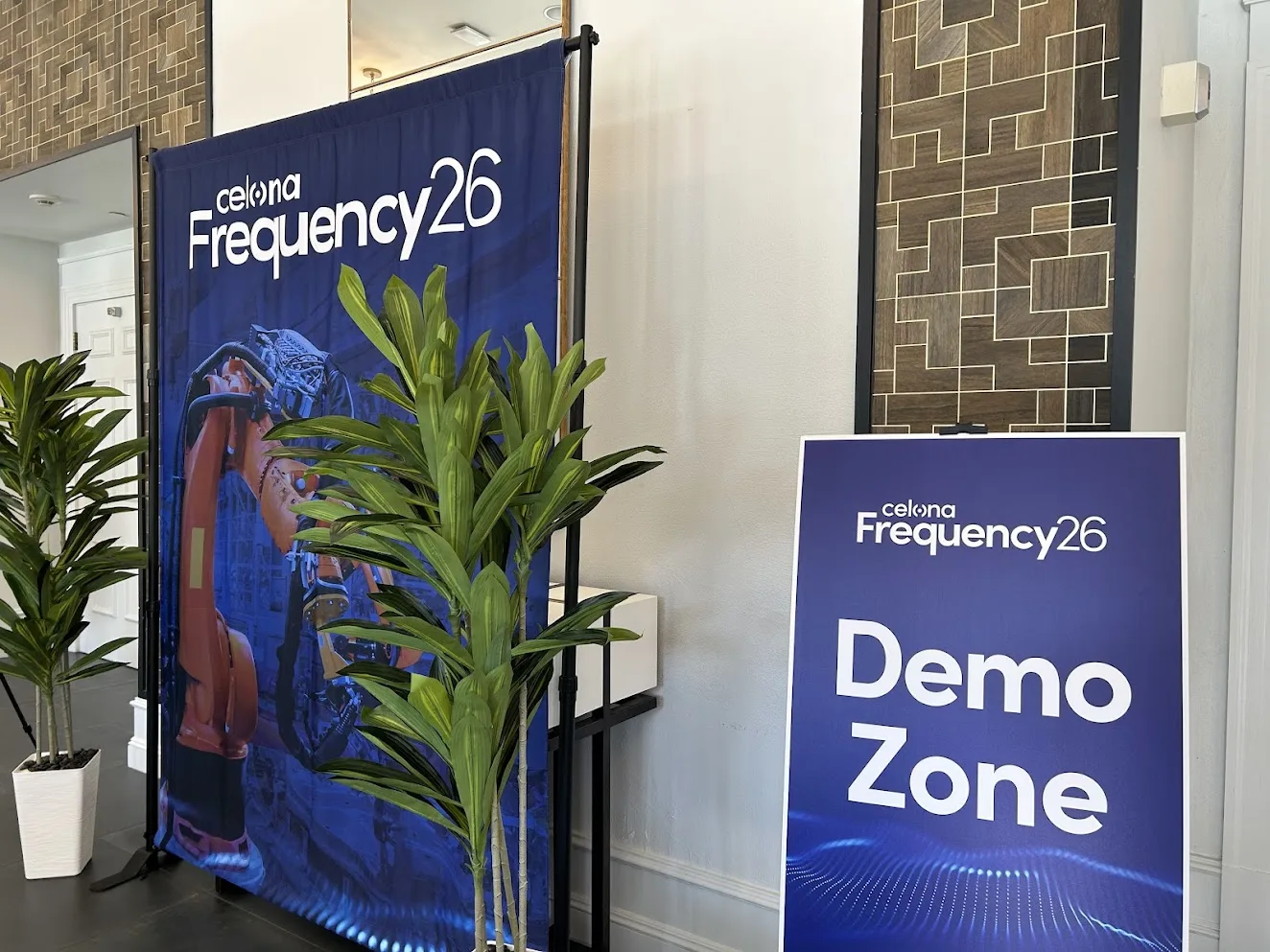
If there was one thing that stood out at Celona’s Frequency event this week, it’s that nobody showed up to be dazzled by a vendor slide deck. The room came ready with blunt, unfiltered feedback — and Celona invited it. That kind of honesty only shows up when customers trust you enough to tell you what’s actually working in the field… and what’s not.
And let’s go ahead and retire the idea that private 5G is still in “pilot mode.” It’s in production, at scale, and customers are now dealing with the kind of real‑world friction that only appears once the network becomes part of daily operations. That’s why the conversations at Frequency mattered. Nobody was talking hypotheticals- they were talking robots, cameras, AGVs, worker safety, and the ecosystem gaps slowing them down.
And to Celona’s credit, they didn’t flinch. They leaned into the feedback, and their roadmap reflects exactly the kind of maturity customers are asking for.
So let’s get into what’s working, where customers are still hitting walls, and why Celona’s shift toward self‑managed, customer‑controlled deployments is the most important signal yet.
What’s Working Today: Real Deployments, Real Wins
Across the room, customers nodded in agreement as others described the same patterns they’re seeing in their own environments. Private 5G is doing exactly what it’s supposed to do, stepping in where Wi‑Fi taps out.
Large data centers dealing with brutal EMI have already hit the ceiling of what Wi‑Fi can deliver. Connected‑worker tools, AR headsets, and smart glasses, all the stuff that looked great in a demo but died instantly in the real world, suddenly works on private 5G. Google even walked through how they proved this out in their own data centers, which tells you everything you need to know.
On the industrial side, ports are using Celona to keep hundreds of OCR cameras online while containers are literally moving underneath them. Nestlé Purina quickly lit up “cost‑prohibitive” parking‑lot cameras after a security incident. Private 5G made it trivial. Another customer justified refreshing their rugged tablets because private 5G finally gave them access to next‑gen mobile apps. These are real operational wins, not theoretical slideware victories.
And one theme kept coming up: Celona is simply more IT‑friendly than the other private 5G players. That matters. Enterprise IT teams want something that behaves like the rest of their infrastructure (predictable, observable, manageable). They think in Wi‑Fi terms because that’s the world they’ve lived in for 20 years. If private 5G doesn’t feel familiar, it’s already a problem.
These customers weren’t shy about sharing what’s working, and what isn’t, and they were genuinely excited to talk about the wins they’ve had with Celona.
What Customers Want Next: The Ecosystem Is the Bottleneck
If the network is no longer the limiting factor, the device ecosystem absolutely is. Once the network stops being the bottleneck, everything around it gets exposed.
It sounds unbelievable, but several customers said their device vendors don’t even know if their own products support private 5G. Compatibility issues are everywhere, and embedded private 5G options are too limited. OT teams are hesitant to deploy a private 5G solution because the device story is still messy.
And perhaps the biggest surprise: more customers want self-managed deployments than anyone expected. They want control. They want APIs. They want to run the core on their own VM infrastructure. They want long lifecycle support. They want to own their destiny.
The customer needs list was concise and achievable:
- Access to performance metrics via APIs
- The ability to run the core on their own VM infrastructure
- 10-year lifecycle support
- Global repeatability
- Neutral host options
- Lower OpEx
- Better orchestration for robots and AGVs
These aren’t wish list items. They’re blockers.
And this is where Celona’s roadmap gets interesting.
The Rakuten Symphony Signal: Celona Is Scaling Up
Among the preview announcements, one stood out because it wasn’t subtle:
Celona’s collaboration with Rakuten Symphony.
This is the clearest indicator yet that Celona is preparing for scale. Not just “industrial P5G,” but global, repeatable, high‑performance deployments.
The partnership brings high‑power radio units (RUs) into the Celona ecosystem, which directly addresses the pain point raised by industrial customers: Coverage gaps in large outdoor or mixed‑use industrial sites, and the need for fewer radios with more reach.
The Rakuten partnership isn’t just cosmetic. It’s a structural one. Their combined offering is aimed directly at customers needing to extend the reach and performance of their private 5G infrastructure. The partnership is also indicative of how the private 5G market is maturing. High‑power RUs aren’t a luxury, they’re what you deploy when the pilot phase is long dead.
Celona’s Roadmap: A Direct Response to Customer Reality
Celona’s strategic direction is shifting from “industrial private 5G solution provider” to something broader: an enabler of physical AI. Not the buzzword version — the real one that shows up in robotics, computer vision, automation, and edge inference. They’re positioning themselves exactly where industrial intelligence meets the wireless edge, because that’s what customers are actually building.
This shift toward physical AI is where the Rakuten Symphony collaboration becomes critical. It provides the high-performance ‘heavy lifting’ required for data-dense OT operations that standard enterprise radios might struggle to cover.
It also signals stronger coverage and throughput for large‑scale environments, and a clear push toward giving customers more control over how they deploy and operate networks. The emphasis on reliability and seamless updates shows that private wireless has officially crossed from “interesting” to mission‑critical.
Celona shared its next moves under the usual “please don’t tweet this yet” guidance, so I won’t spoil the details, but the themes weren’t exactly hard to decode:
- More self‑managed options
- More programmability
- More open interfaces
- More lifecycle control
- More global deployment tooling
- More ecosystem alignment
- And yes — more reach and performance, reinforced by the Rakuten Symphony collaboration
It’s a roadmap built from customer experiences, not branding workshop. And the reliability story (higher availability, seamless updates, operational transparency) makes it clear that private wireless is now core infrastructure.
Private 5G Is Maturing — and Customers Are Shaping the Roadmap
While the private 5G news cycle is often dominated by isolated product announcements, Celona’s Frequency event provided a much-needed reprieve from this trend. Rather than a standard, top-down showcase, Celona presented a suite of advancements that felt like a direct conversation with its users. They presented a roadmap built entirely from the friction and successes of the previous year. The candor in the room made it clear that Celona has cultivated one of the healthiest vendor-customer dynamics in the market, proving that radical transparency, and full customer engagement is now a core company value.
And Celona clearly understands what comes next: the network alone won’t unlock the next wave of value. A strong, diverse partner ecosystem is now more important than ever. From device vendors to SI’s to edge platform providers, Celona is leaning into those partnerships at exactly the right moment.
Celona’s strategy reflects a vendor that listens, prioritizes, and executes, with a clear focus on real use cases, real operational challenges, and the ROI behind them.
Private 5G is maturing, and Celona is positioning itself at the center of an ecosystem built to scale it.