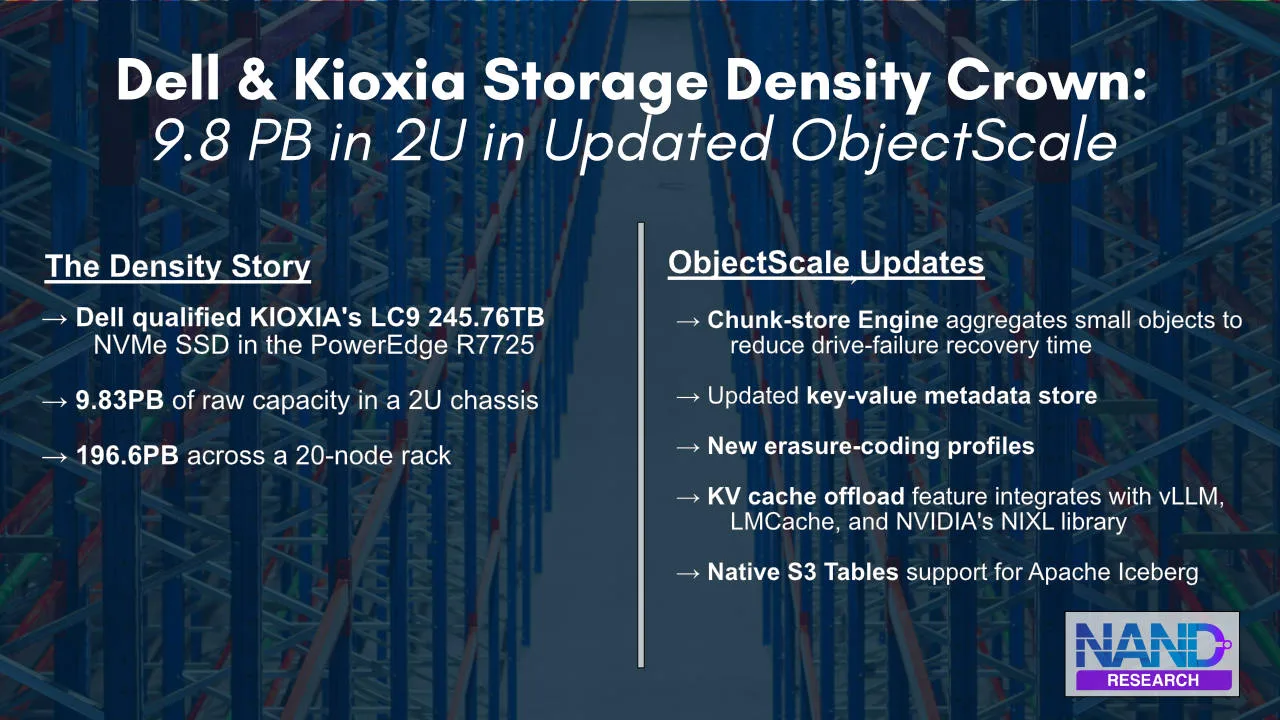
Dell Technologies and KIOXIA have paired the KIOXIA LC9 series 245.76TB NVMe SSD with the Dell PowerEdge R7725 server running Dell ObjectScale software, creating a 2U storage node with 9.83PB of raw flash capacity.
Twenty of these nodes, assembled into a single rack, yield approximately 196.6 PB of raw capacity, which Dell has rounded to roughly 200 PB when describing the configuration.
This makes ObjectScale the first object storage platform to qualify KIOXIA’s 245.76TB drive, which KIOXIA introduced in July 2025 as the industry’s highest-capacity NVMe SSD.
The move addresses a specific problem facing LLM training, RAG, and inference deployments: unstructured data volumes are growing faster than the physical footprint, power budget, and operations staff available to house them.
By combining the highest-density SSD on the market with a 2U server chassis and object storage software tuned for S3 semantics, Dell is positioning ObjectScale as infrastructure for the data layer beneath AI factories rather than as a general-purpose archive tier.
The company paired the density claim with a set of ObjectScale software updates across versions 4.2 and 4.3, including S3 over RDMA networking, a key-value cache offload feature for inference serving, and Apache Iceberg table support, which extend the platform’s relevance beyond raw capacity to AI pipeline performance.
Technical Details
The announcement combines a hardware density milestone with a software release.
- Hardware: Dell qualified KIOXIA’s LC9 245.76TB NVMe SSD in the PowerEdge R7725 platform running ObjectScale, reaching 9.83PB of raw capacity in a 2U chassis and approximately 196.6PB across a 20-node rack.
- Software: Dell shipped ObjectScale updates adding networking, metadata, and inference-serving capabilities aimed at AI pipelines rather than at backup and archive workloads alone.
Let’s look at each.
Hardware
- Platform: Dell PowerEdge R7725 server running Dell ObjectScale, configured with 40 EDSFF NVMe bays in a 2U chassis.
- Drive: KIOXIA LC9 series 245.76TB NVMe SSD, built on KIOXIA’s eighth-generation (BiCS8) 218-layer 3D QLC NAND with a 32-die stack per package.
- Density: 9.83PB of raw capacity per 2U node; a 20-node rack reaches approximately 196.6PB raw, the basis for Dell’s roughly 200PB rack figure.
- Interface: PCIe Gen 5, which KIOXIA and Dell cite as supporting the platform’s claimed node-level throughput figures.
Performance
- In internal testing, Dell claims a per-node read throughput of up to 40GB/s, an eightfold increase over its prior-generation platform.
- In laboratory testing, Dell measured sustained throughput above 300GB/s across an internal NVMe pool and 160GB/s over NVMe-oF RDMA.
- S3 over RDMA networking delivers up to 230% higher throughput, 80% lower latency, and up to a 98% reduction in CPU utilization compared with S3 over TCP.
ObjectScale 4.2/4.3:
- A chunk-store engine aggregates small objects, typically more than 10,000 10KB objects, into unified 128MB chunks, reducing drive-failure recovery time.
- An updated key-value metadata store cuts memory consumption by approximately 4x and reduces on-disk metadata footprint by 30% to 60%.
- New erasure-coding profiles, 24+2 and 24+4, cut write amplification by up to 75%, per Dell’s published figures.
- A KV cache offload feature integrates with vLLM, LMCache, and NVIDIA’s NIXL library to accelerate inference serving. Dell claims up to a 19x improvement in time-to-first-token and up to 5.3x higher token throughput compared with standard vLLM.
- Native S3 Tables support for Apache Iceberg works with Trino, Starburst, Spark, and Flink. Dell claims up to 2x faster ingestion and up to 4.5x faster queries compared with traditional data warehouse configurations.
- ObjectScale supports Snappy, LZ4, ZSTD, and Deflate compression, as well as FinOps telemetry to track storage costs.
Analysis
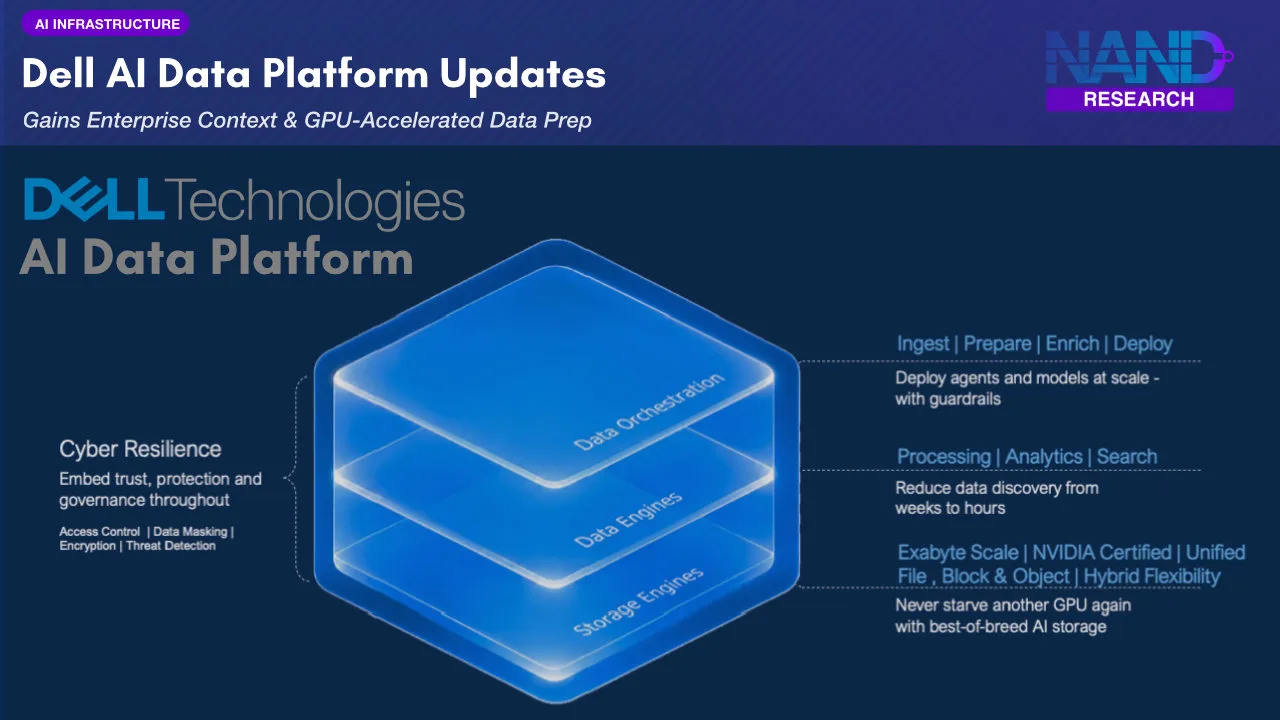
The announcement extends Dell’s existing AI Data Platform strategy, pairing the highest-density components KIOXIA can supply with PowerEdge hardware and differentiating through the ObjectScale software layer.
Density leadership is also a marketing asset Dell can leverage in AI infrastructure deals where floor space and power are binding constraints. Qualifying the LC9 drive first gives Dell a temporary advantage in those conversations. The risk is that density leadership is inherently transient: it depends on KIOXIA’s SSD roadmap and on Dell continuing to win first-qualification slots ahead of other server OEMs. j
If Solidigm, Samsung, SK hynix, or Western Digital ship a comparable or larger QLC drive and a competing OEM qualifies it first, Dell’s density claim resets.
Impact to IT Practitioners
For storage and infrastructure teams building AI data pipelines, this configuration primarily changes the physics of a data center buildout: fewer racks, fewer network ports, and lower power and cooling overhead per petabyte stored. A single rack of R7725 nodes running ObjectScale can replace several racks of prior-generation object storage hardware at equivalent capacity, with implications for facility planning and total cost of ownership.
At the same time, the configuration concentrates a large amount of data across a comparatively small number of physical nodes, which raises the operational stakes of any single node or rack failure and requires practitioners to validate erasure-coding, replication, and rebuild-time assumptions at this density before committing production data to the configuration:
- Rebuild and recovery times become more critical at 245.76 TB per drive. The chunk-store engine and 24+4 erasure coding are direct responses to this, but organizations should validate recovery-time objectives against their own workload mix rather than against Dell’s published figures.
- Write Endurance: QLC NAND has narrower write endurance than TLC, so write-intensive workloads are a weaker fit for this configuration than the read patterns Dell targets for AI training, inference, and analytics.
- Performance across Fabric: Realizing the claimed S3 performance gains over RDMA and NVMe-oF requires end-to-end RDMA-capable networking and an additional investment in infrastructure and skills for organizations not already running RoCE or InfiniBand fabrics.
- KV Cache Offload: The KV cache offload capability integrates with specific inference frameworks, namely vLLM, LMCache, and NIXL. Teams using other serving stacks will not see inference-acceleration benefits without additional engineering work.
Final Thoughts
Dell and KIOXIA have achieved a genuine density milestone. Holding 9.83PB in 2U and nearly 200PB in a single rack represent a meaningful reduction in physical footprint for organizations building large-scale AI data infrastructure. Qualifying a 245.76TB drive ahead of competing server vendors gives Dell a real, if likely temporary, marketing advantage.
While the 200PB rack density figure is the headline grabber, the real story is more about what Dell chose to bundle around it. By pairing record flash density with S3 over RDMA, KV cache offload for inference, and native Iceberg support, Objects Cale is now infrastructure built for the AI data pipeline.
It’s a strong move by Dell, one that plays directly to its successful AI Factory strategy.