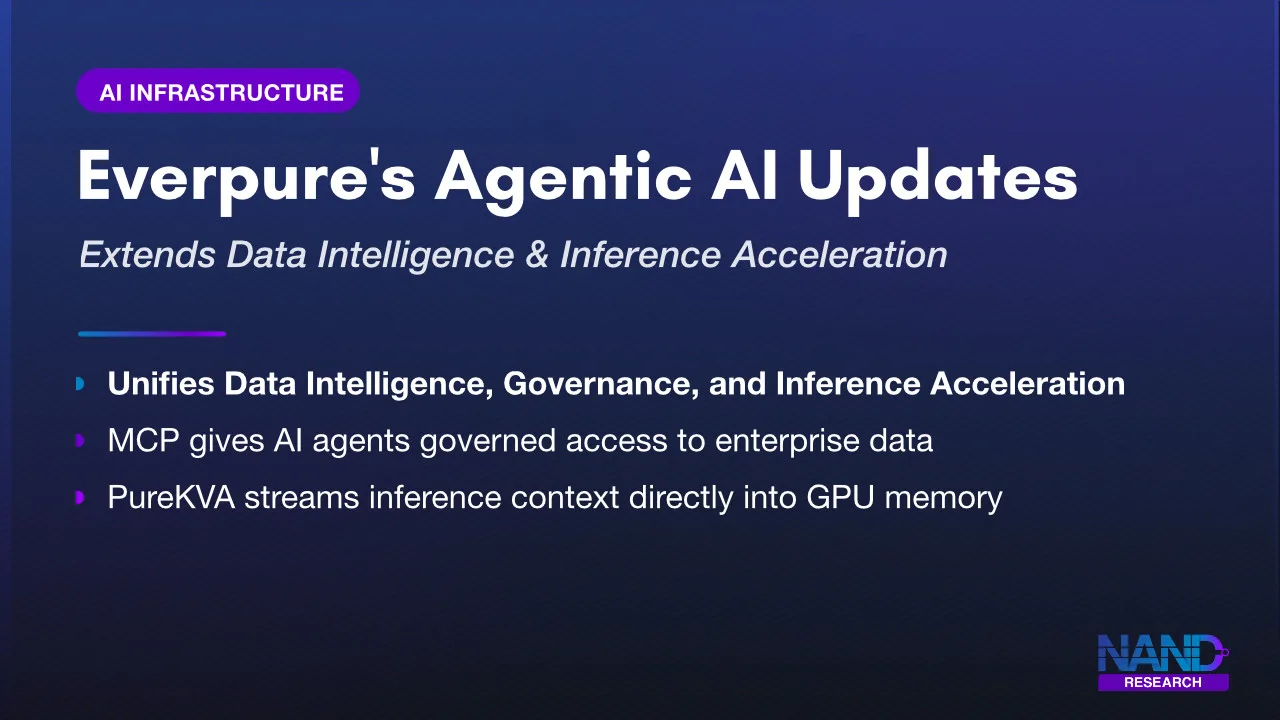
Everpure announced a new set of platform capabilities at Pure//Accelerate London, aimed at enterprises moving AI agents and inference workloads from pilot to production. The updates fall into two broad groups.
The first extends Everpure Data Intelligence, the data discovery and classification service built on the company’s acquisition of 1touch, with native MCP support, turnkey deployment through the Pure1 console, and metadata-only reporting on file-share exposure.
The second group targets FlashBlade inference performance and capacity efficiency through a GPU-direct evolution of the Key-Value Accelerator (PureKVA), an always-on DeepReduce compression, and a reference architecture for running open-weight models on customer infrastructure.
Everpure expects the capabilities to be available in October.
The release advances Everpure’s Data Primacy strategy and matures two threads the company has pursued for more than a year, namely persistent KV cache on FlashBlade and data intelligence embedded in the storage platform.
The broader significance extends beyond Everpure. Agentic AI changes what enterprises require from storage. Agents need governed, machine-readable access to enterprise data, and multi-turn inference produces context state that is too large for GPU memory and too expensive to recompute.
Every major storage vendor now builds toward these requirements, and Everpure’s announcement is a clear indicator of how quickly enterprise storage architecture is adapting to them.
Announcement Details
The announcement introduces no new hardware. Instead, Everpure delivers these capabilities as software and data services on the existing Everpure Platform, primarily through the Pure1 management plane and FlashBlade.
Everpure divides the release into data management capabilities, which provide agents and administrators with governed access to enterprise context, and performance and efficiency capabilities, which deliver inference acceleration and capacity savings for data where it already resides.
Data Intelligence and Agent Access
Everpure Data Intelligence discovers, classifies, and contextualizes enterprise information at its source across the Everpure Platform, public clouds, SaaS applications, and third-party storage.That reach comes from 1touch.
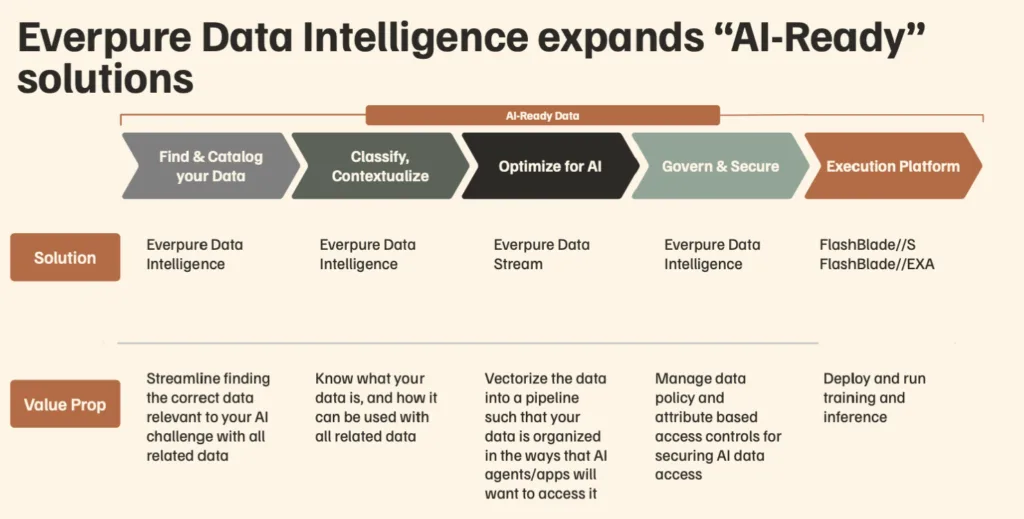
The new capabilities build on that foundation in three ways:
- Native MCP integration: Data Intelligence implements the open Model Context Protocol, enabling AI agents and security tools to query live data catalogs using natural language. Agents receive the location of relevant data and its sensitivity classification, which they use as input to agent workflows, AI pipelines, and analytics.
- Turnkey deployment: Customers deploy Data Intelligence through the existing Pure1 console, with no separate management servers and no professional services engagement.
- Privacy-first file intelligence: The service reports who can access each file share and how stale it is, without reading file contents. Administrators use this output to remediate overexposed shares and reclaim capacity before opening those shares to AI agents.
Inference Performance and Efficiency
The performance updates concentrate on FlashBlade and extend capabilities Everpure first shipped under the “Pure Storage” name in 2025.
PureKVA launched as a persistent KV cache accessible over NFS and S3 and later integrated with NVIDIA Dynamo and vLLM. DeepReduce, Everpure’s enhanced compression technology, came to FlashBlade in the same period.
This release changes how both operate:
- PureKVA GPU pre-staging: FlashBlade now pre-stages cached context directly in GPU memory, building on a GPUDirect Storage data path that bypasses host memory. Everpure claims up to 20x faster TTFT and says that PureKVA supports multi-tenant deployments without relocating datasets.
- Always-On DeepReduce: DeepReduce now continuously scans storage blocks across FlashBlade systems, identifying sub-block similarities that conventional deduplication misses, including in pre-compressed content. Usable capacity increases without affecting write performance or requiring manual scheduling.
- Intelligent Token Optimization Reference Architecture: Everpure now offers a reference architecture for running open-weight models on customer-controlled infrastructure. The architecture shifts inference workloads away from external model APIs to reduce token spend and keep enterprise data in place.
Everpure also ties the release to cyber resilience. The same classification data that tells an agent which information is sensitive also tells protection and recovery tooling which data to prioritize.
Analysis
Since its February 2026 rebrand, Everpure has worked to redefine itself as a data management company built on a storage foundation. This release shows the 1touch acquisition reaching product within five months of closing and connects Data Intelligence to the Pure1 operating model that Everpure customers already use.
That delivery path is Everpure’s most practical advantage because it lowers the barrier to adopting a governance product in accounts where Everpure is already trusted.
Here’s how we look at Everpure in this environment:
- Installed-base leverage: Everpure reports roughly 80% logo overlap between 1touch customers and its large enterprise accounts, providing Data Intelligence with a ready distribution channel.
- Reach beyond Everpure storage: Data Intelligence spans public clouds, SaaS applications, and third-party storage. That scope makes the product relevant to data and security buyers who would dismiss a catalog limited to a single vendor’s arrays.
- A crowded category: Data catalogs and DSPM are established markets with vendors that already sell to CDOs and CISOs. Everpure must win buyers outside its traditional storage relationship, and it competes there with a product set that is newer than most alternatives.
- Incremental technical substance: MCP support and file intelligence are practical, useful additions. The PureKVA and DeepReduce updates mature existing capabilities. The release supports Everpure’s Data Primacy narrative through steady execution, though it lacks a single capability that leapfrogs competitors.
The most recent announcements also directly support Everpure’s Data Primacy framework where:
- Enterprise Data Cloud is the foundation, a unified data plane spanning FlashArray and FlashBlade
- Fusion and Purity form a control plane that orchestrates policy across that estate.
- Data Intelligence sits on top, classifying data and mapping it to business meaning for applications and agents.
Each part of the London release aligns with one of those layers:
- Data plane: Always-On DeepReduce and PureKVA’s GPU pre-staging extend it. Data stays in its system of record while capacity efficiency improves, and inference context moves straight from FlashBlade into GPU memory with no dataset relocation.
- Operating model: Turn-key Data Intelligence deployment through Pure1 ties the new data management layer to the fleet management customers already run.
- Intelligence layer: Native MCP support makes Data Intelligence reachable by agents, so the catalog and sensitivity context built across the unified estate becomes something agents can query directly.
An Industry-Wide Shift in Storage Architecture for Agentic AI
Everpure’s announcement reflects a broader architectural shift across the storage industry. For two decades, enterprise storage competed on capacity, performance, availability, and data protection. Agentic AI changes the game, introducing new requirements that traditional arrays were never built to meet, and each major vendor is now reworking its platform to meet them.
Four requirements define the shift:
- Context memory for inference: Multi-turn agents and long context windows generate KV cache states that quickly exceed the capacity of high-bandwidth GPU memory. Discarding and recomputing that state wastes GPU cycles and inflates latency. Persisting it on shared flash and reloading it on demand turns storage into an extension of the inference memory hierarchy. NVIDIA formalized the approach at CES 2026 with its Inference Context Memory Storage platform, now called CMX, which defines a pod-level flash tier managed by BlueField-4 DPUs. Nearly every enterprise and AI storage vendor, including Everpure, has aligned with it.
- Machine-readable data context: Agents must locate data, understand its contents, and determine whether they are permitted to use it. That requirement transforms storage metadata from an internal file-system concern into a queryable service. MCP is quickly becoming the standard interface for that service, with NetApp, VAST Data, and now Everpure all exposing data services to agents via MCP.
- Governance at the source: Copying data into separate AI pipelines creates duplicates that bypass existing access controls and retention policies. Vendors are responding by moving classification, access analysis, and, in some cases, vectorization into the storage layer so data remains in its system of record. NetApp’s zero-copy data activation, announced at INSIGHT the day before Everpure’s London event, aligns with Everpure’s in-place approach.
- Capacity efficiency under supply pressure: AI pipelines multiply data volumes at a time when flash costs are rising. Everpure reported earlier this year that its average product prices had risen by roughly 70% since the start of 2026. Data reduction that runs continuously, without administrator scheduling, becomes an economic requirement for AI-scale capacity.
Taken together, these requirements broaden the enterprise storage platform’s role. The array remains the system of record and now also serves as a context memory tier for inference and as a governed metadata service for agents.
Vendors differ in emphasis:
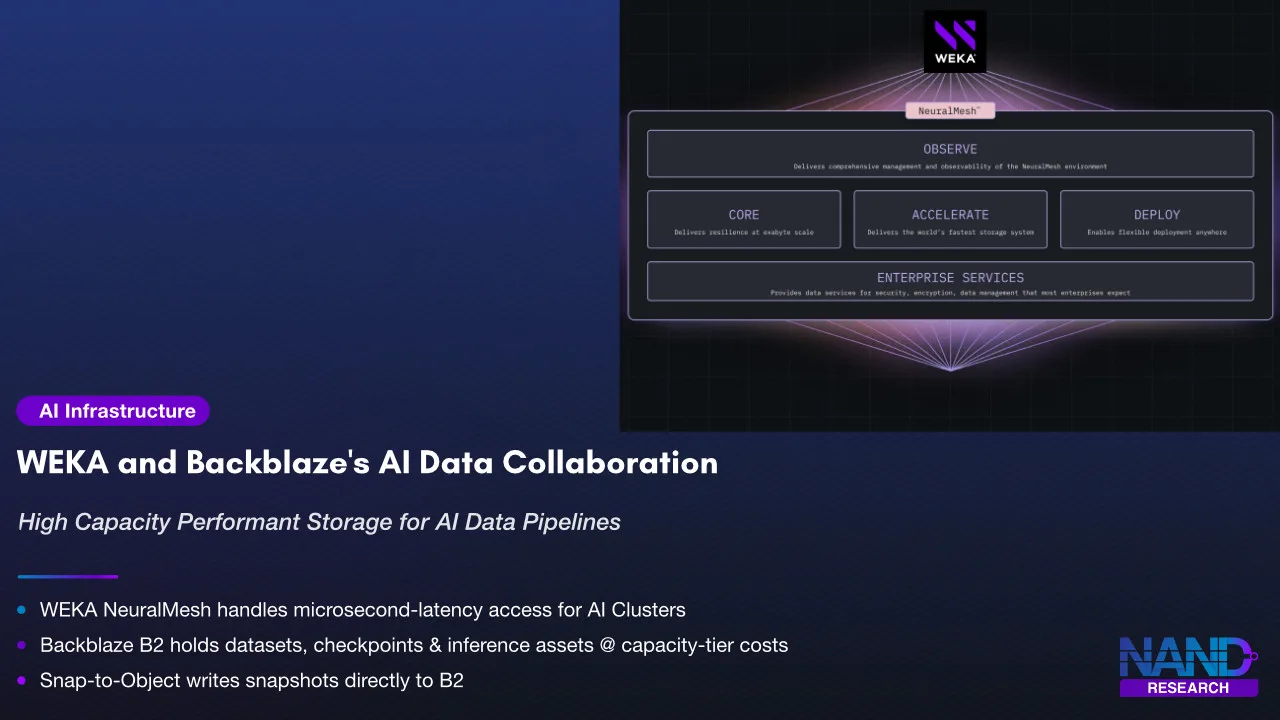
- VAST Data and WEKA lead with inference memory at AI-factory scale
- NetApp with metadata services layered on ONTAP data management
- Everpure with data intelligence tied to its installed base and its Pure1 operating model.
The requirement set is converging across all of them, giving enterprise buyers clear criteria for evaluating any vendor’s agentic AI story.
Practitioner Impact
The release touches three groups inside an enterprise:
- Storage administrators gain continuous data reduction and a faster path to deploying Data Intelligence.
- Data and security teams gain a catalog and exposure view that agents can query directly.
- AI platform teams gain an inference cache that integrates with Dynamo and vLLM on storage they already operate.
Each group faces practical considerations the announcement does not fully address (and which are not unique to Everpure):
- MCP creates a new access path to govern: Standard MCP access shortens integration work for agent developers, who no longer need custom API integrations to access catalog and sensitivity metadata. It also introduces a new interface that security teams must bring under existing authentication, authorization, and audit policies before exposing it broadly. This is a challenge with MCP more broadly, not unique to Everpure.
- File-share exposure is a common deployment blocker: Permission sprawl on file shares often stalls enterprise AI assistant rollouts. A metadata-only report on access and staleness provides teams with a low-risk first step toward remediation and avoids the privacy concerns that content scanning raises.
- KV cache gains are workload dependent: TTFT improvements from KV cache reuse scale with context length and prompt overlap. Workloads with long, repeated context, such as agents operating on shared documents or codebases, benefit most, while short, unique prompts see little gain. Teams should measure cache-hit rates on their own traffic before sizing infrastructure based on any vendor’s claims.
- Data reduction varies by data type: Always-On DeepReduce requires no administrator action, but reduction on AI datasets, such as compressed media and model checkpoints, varies widely. Capacity plans should rely on observed ratios.
- Ownership questions arise early: Data Intelligence brings chief data officers and CISOs into what has traditionally been a storage purchase. Organizations that already run a data catalog or a DSPM tool need to decide where a storage-originated catalog fits and which team owns it.
Competitive Landscape
Everpure competes on two fronts with this release:
For data intelligence and agent access, its most direct competitor is NetApp, which updated its AI Data Engine at INSIGHT the same week as Everpure’s announcements, alongside standalone catalog and DSPM vendors.
In the inference context memory market, it competes with VAST Data, WEKA, Dell Technologies, DDN, HPE, and IBM, nearly all of which support NVIDIA’s CMX architecture and publish their own KV cache results.
The table below summarizes the most relevant alternatives.
| Alternative | Model / Approach | Agentic AI Capabilities | Compared to Everpure |
| NetApp (AFX, AI Data Engine) | Disaggregated ONTAP with an integrated metadata engine and AI data pipeline | Metadata discovery across ONTAP, StorageGRID, and non-NetApp storage; RAG API through an MCP server; zero-copy data activation | Closest enterprise competitor with a larger ONTAP installed base; full AIDE functionality is tied to AFX, while Everpure brings deeper DSPM heritage from 1touch |
| VAST Data (AI OS) | Disaggregated shared-everything platform with integrated database, vector, and agent services | InsightEngine for automatic indexing; AgentEngine with MCP; CMX KV cache running on BlueField-4 | More complete AI-native stack and strong KV cache momentum at neocloud scale; less emphasis on enterprise data governance across third-party sources |
| WEKA (NeuralMesh) | Software-defined parallel file system for AI training and inference | Augmented Memory Grid for persistent KV cache, generally available with published results on OCI and Nebius | Most mature dedicated KV cache offering with third-party cloud benchmarks; no comparable data intelligence or governance layer |
| Dell Technologies (PowerScale, ObjectScale, Lightning FS) | Broad storage portfolio bundled with Dell AI Factory servers | KV cache offload via LMCache and NIXL across three storage engines; CMX support | Wins on portfolio breadth and server bundling; data intelligence is less integrated with the storage layer |
| Standalone catalog and DSPM vendors (e.g., Microsoft Purview, BigID, Varonis) | Storage-independent data governance and security posture software | Classification, access analysis, and growing agent-facing integrations | Broader governance depth and existing CDO and CISO relationships; lacks Everpure’s storage-native deployment and inference acceleration |
Everpure’s differentiation is strongest where storage and governance converge within its own accounts. No competitor combines storage-native deployment, DSPM-grade classification across third-party sources, and an inference cache on the same platform and management plane.
Its position is weakest at the AI-factory scale, where VAST Data and WEKA hold a head start in KV cache, backed by published results and dedicated designs, and in governance breadth, where standalone vendors own the CDO relationship. Competitors Dell Technologies and Hewlett Packard Enterprise also offer full-stack solutions, while Everpure relies on partners to build the full solution.
NetApp remains the competitor to watch most closely because it offers a nearly identical combination of enterprise data management and agent-facing metadata services, and it announced its latest updates the same week, though NetApp isn’t going as deep into DSPM as Everpure.
Final Thoughts
Everpure delivered a practical, well-scoped release aligned with both its updated strategy and the evolving needs of enterprise agentic AI. MCP support, turnkey deployment, and file-share exposure reporting address real obstacles enterprises face when they open data to agents, and the speed with which 1touch technology reached the Pure1 console reflects disciplined integration.
Its inference updates extend the capabilities Everpure has shipped for more than a year, giving customers a maturing product with an established integration path to NVIDIA Dynamo and vLLM.
Open questions remain. Everpure published no methodology behind its 20x TTFT claim, no expected DeepReduce ratios, and no licensing details for the new Data Intelligence capabilities.
Its biggest challenge is also a key growth opportunity. Everpure’s data intelligence ambitions put it in front of buyers who already own governance tooling. Winning them requires proof that a storage-originated catalog adds value beyond what those tools provide. This will push Everpure out of its comfort zone as it brings its value prop to a new customer base – something the company has successfully navigated before after its Portworx acquisition.
The larger story, however, belongs to the entire industry. Agentic AI is redefining enterprise storage as context memory for inference and as a governed data service for agents, and every major vendor is rebuilding its platform around those roles. For customers, the evaluation now hinges on how well a vendor delivers all of them together using the data they already have.
Everpure’s September release makes it a powerful contender on exactly those terms.