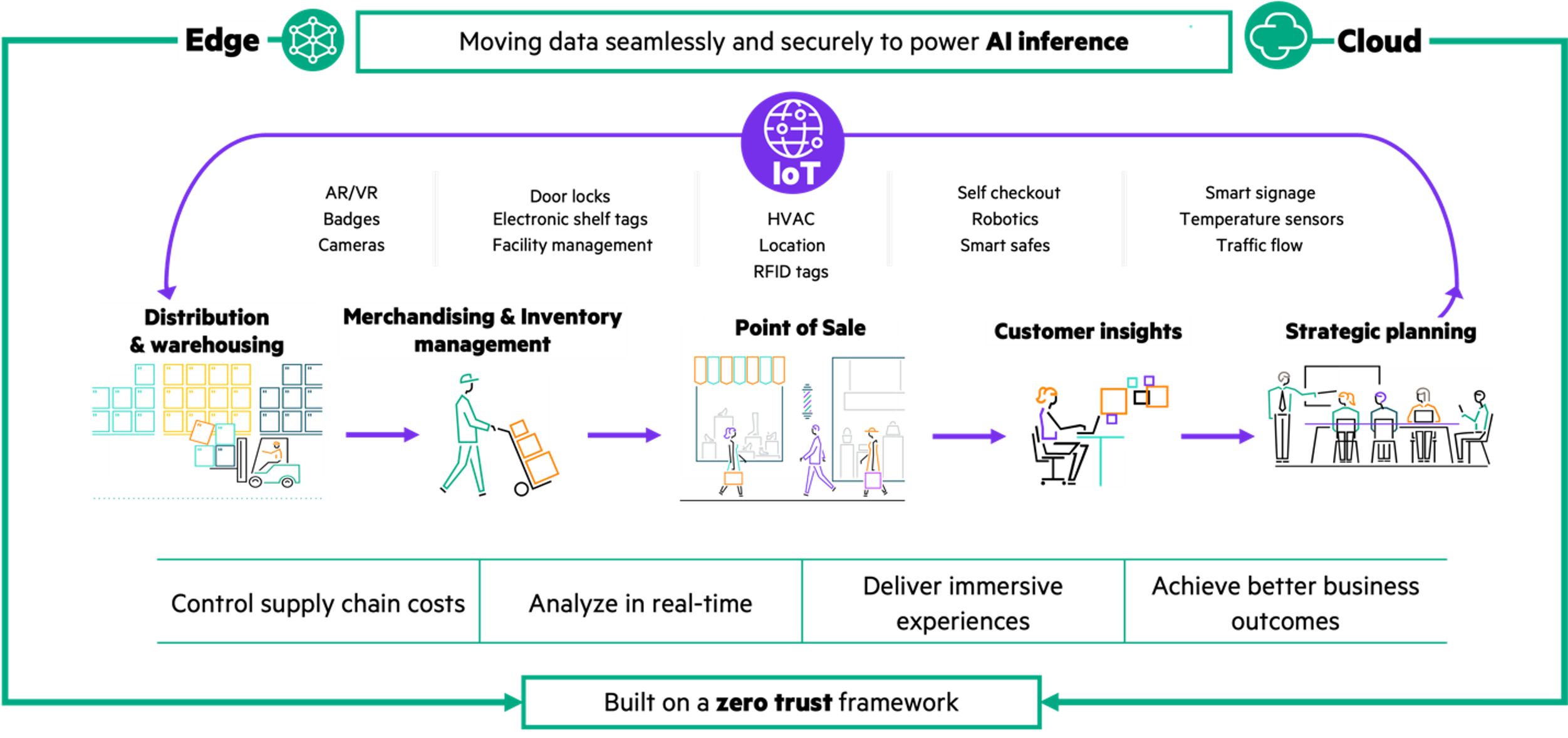

In retail, operational success increasingly depends on the reliability of the network that ties together every transaction, sensor, and workflow. At NRF 2026: Retail’s Big Show in New York, Hewlett Packard Enterprise (HPE) announced an expanded portfolio with updates aimed squarely at the environmental and uptime realities of modern storefronts and warehouses. HPE’s message was that the “always‑on” store is now an engineering requirement.
HPE’s decision to debut these offerings at NRF fits a long‑standing pattern. The company routinely unveils industry‑specific platforms at the trade shows where those industries gather. Manufacturing solutions at Hannover Messe, telco platforms at MWC, healthcare innovations at HIMSS, and now retail focused networking at NRF. It’s a deliberate strategy, and one that I very much like: meet practitioners where they are, speak their language, and solve the problems they’re actively discussing on the show floor.
By aligning product launches with the retail calendar, HPE avoids generic “horizontal” messaging and instead addresses the issues retailers face daily. Think peak‑demand transaction failures, constrained store layouts, and the growing need for resilient edge compute.
HPE’s updated portfolio bridges edge connectivity with fault‑tolerant compute, giving retailers a more predictable foundation for both customer‑facing and back‑office operations.
On the switch side of things we have the new 8‑port HPE Aruba Networking CX 6000 Switch Series that are purpose-built for tight, noise‑sensitive spaces like checkout counters, kiosks, and overhead crawl spaces. Their compact, fanless design keeps them quiet in customer‑facing areas while still delivering the PoE capacity required for cameras, POS terminals, sensors, and other IoT devices that now define the modern store.
Next up is compute, where HPE introduced NonStop Compute NS9 X5 and NS5 X5 systems. These look to be the heavy hitters coming out of the NRF press release. The two platforms are engineered for environments where downtime simply isn’t an option. Their fault‑tolerant architecture ensures that high‑volume payment processing, inventory synchronization, and real‑time analytics continue uninterrupted even during hardware failures. Internal HPE benchmarks show up to a 15% performance uplift, giving retailers headroom for increasingly data‑intensive applications.
We can’t have press releases without a mention of AI. Foot traffic surges, inventory gaps, or unexpected congestion all have an impact on the customer experience. HPE is addressing this by integrating Mist AIOps with Juniper Networking Premium Analytics, enabling richer insights through the Marvis virtual assistant.
But wait! There is more AI coming from HPE. With natural‑language queries, retail teams can now surface occupancy trends, location intelligence, and network health without digging through dashboards. Using these tools, IT and operations teams can proactively optimize layouts, staffing, and customer flow.
To safeguard revenue during updates or configuration changes, HPE expanded its User Experience Insight (UXI) Sensors, now with Wi‑Fi 7 support. Acting as a “secret shopper” for the network, UXI continuously tests real user journeys and flags issues before they affect customers or staff. I have seen this in real time operation and it is quite impressive.
HPE’s announcements are timely for retailers beginning to adopt AI‑native workflows, robotic inventory systems, and high‑density wireless applications that demand consistent, low‑latency connectivity.
Retail budgets fluctuate with seasons and foot traffic. HPE’s decision to offer these new switching and compute platforms through HPE GreenLake gives retailers a way to scale infrastructure based on actual business outcomes rather than large upfront investments. It’s a model that aligns technology consumption with revenue cycles.
HPE’s presence at NRF 2026 shows a broader industry shift toward “always‑on” retail. By combining ruggedized edge switches, fault‑tolerant compute, and AI‑driven telemetry, the company is building a practical foundation for stores that must operate continuously and intelligently. These product developments reflect the industry specific alignment that we have come to expect from HPE, especially coming out of the Juniper acquisition. For retailers navigating the transition to more automated, data‑rich environments, HPE’s updates offer a clear, actionable path toward predictable operations and better customer experiences.