
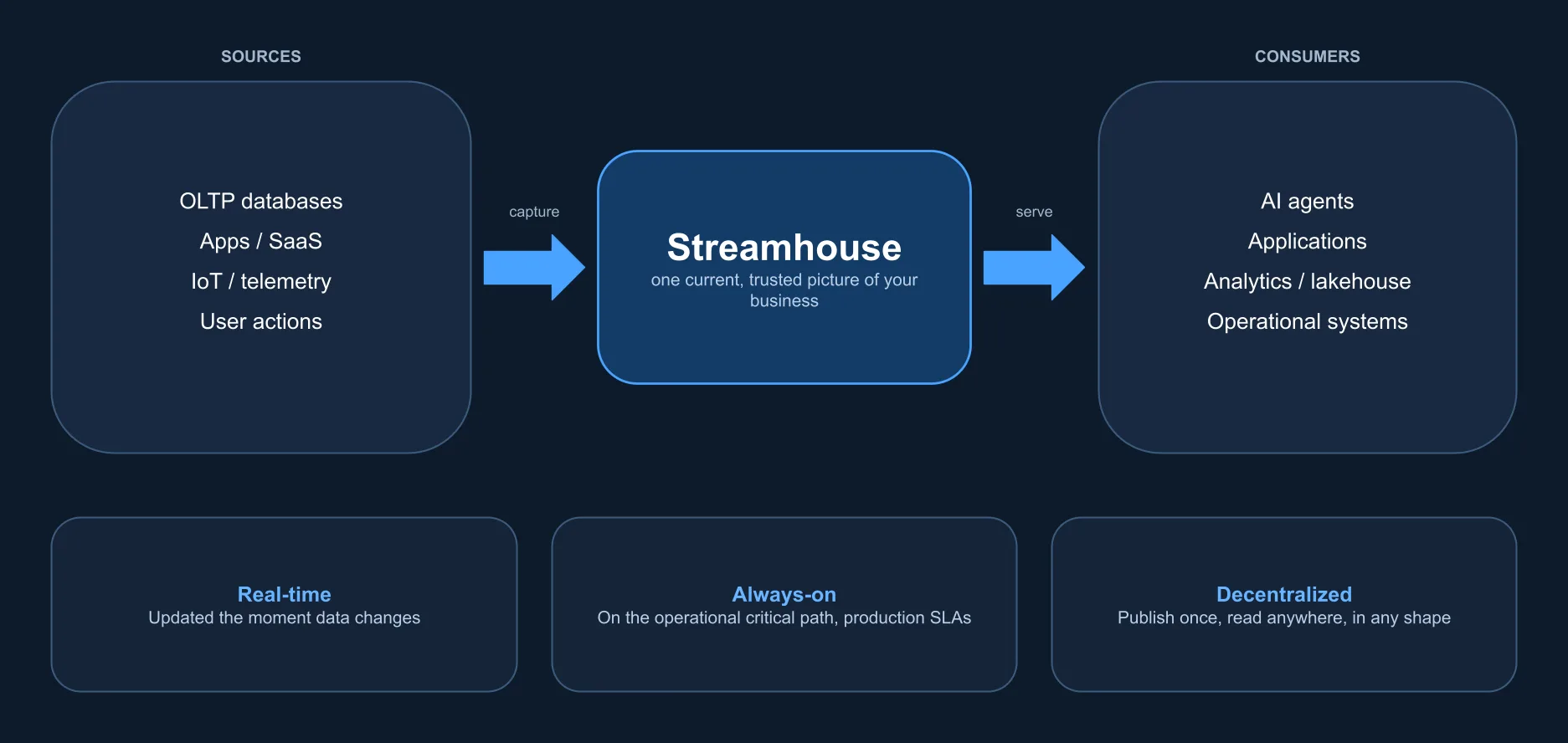
At its recent Current 2026 conference in San Francisco, IBM Confluent introduced Streamhouse as the architecture for its Data Streaming Platform. The company also announced the general availability of Lightning Tables on AWS.
Lightning Tables is a read-only serving layer that materializes Apache Kafka topics as tables, which applications, analytics tools, and AI agents query via SQL, an API, or MPC. It becomes the platform’s fifth pillar, Query, alongside Stream, Connect, Process, and Govern.
Confluent addresses the problem of conflicting state. AI agents act on information spread across systems that update at different times, and the lakehouses and warehouses built for reporting and batch work don’t reflect the business’s current state. Confluent proposes a continuously updated, governed view that sits alongside the lakehouse.
Streamhouse is also an industry category. Aiven, Confluent, Redpanda, StreamNative, and Ververica formed the Streamhouse Working Group in September 2026 and published a vendor-neutral definition, so the term does not belong to any single company.
Details
The announcement covers one new product, a restructured platform narrative, and additions to several existing pillars.
Confluent describes Streamhouse as an architecture built on three principles: current, mission-critical, and decentralized. Confluent maintains a continuously updated business context, runs at production service levels, and meets data where it lives without requiring consolidation first, working alongside existing warehouses and lakehouses.
The Data Streaming Platform now breaks down into five pillars, each with its own scope:
- Stream: Built on Apache Kafka and the Kora engine. Confluent reports sub-millisecond latency in internal testing and notes that actual latency varies with configuration and workload.
- Connect: More than 150 fully managed and custom connectors, plus hybrid connector management (in early access).
- Process: Apache Flink combines, enriches, and derives business context as data changes. New batch execution capabilities initialize streaming workloads using existing data.
- Govern: lineage, catalog, quality, encryption, schema, and access control capabilities.
- Query: Tableflow publishes streams to lakehouses and warehouses as open table formats. The Real-Time Context Engine serves current context to agents via MCP. Lightning Tables serves applications via SQL and an API.
Lightning Tables
Lightning Tables, generally available on AWS, durably store Kafka data and materialize it into read-only tables that remain current as changes arrive. Confluent provided the following metrics for the offering:
- Roughly 100 milliseconds from data creation to serving.
- Query latency of 10 to 100 milliseconds and throughput above 1,000 queries per second.
- SQL and direct API access, with schemas, lineage, and access policies applied from capture through serving.
- Schema evolution management, and a feature store capability that computes features in Flink for machine learning uses such as real-time personalization.
IBM Integration
The IBM connection appears in three places. Confluent adds three IBM Granite Time Series models to Flink on its self-managed platform to enable SQL-based forecasting and anomaly detection. The models don’t require pretraining, run on CPUs alone, and keep data within the customer’s environment.
IBM Z extends event streaming to mainframe transactions. IBM watsonx.data, integrated on the day the acquisition closed, queries Tableflow’s Iceberg tables without a second copy of the data.
Analysis
IBM completed its acquisition of Confluent on March 17, 2026, at $31 per share, roughly $11 billion. IBM said at closing that Confluent serves more than 6,500 enterprises, including 40 percent of the Fortune 500, and announced day-one integrations with watsonx.data, IBM MQ, IBM webMethods Hybrid Integration, and IBM Z.
Streamhouse extends that position in three important ways:
- Category ownership: Confluent claims the vocabulary for how enterprises feed agents, with a Kafka installed base as the entry point.
- Budget expansion: Query moves Confluent from transport, where pricing is tied to throughput, to serving, where it competes for database and lakehouse spend.
- IBM alignment: Confluent sits at the center of IBM’s data strategy.
Competitive Impact
Confluent competes on two fronts:
- Streaming vendors, including its own working group partners, offer Kafka-compatible or Flink-based platforms that cover the Stream and Process pillars.
- Lakehouse and cloud platforms offer serving and streaming ingestion that overlap with Query.
The table below summarizes the alternatives.
| Alternative | Model and Approach | Where It Holds an Edge | Where Confluent Holds an Edge |
| Redpanda | Kafka-compatible streaming platform with a single-binary architecture and a managed cloud service | Operational simplicity and cost positioning for Kafka workloads | Managed Flink, 150+ connectors, governance suite, and a serving layer in one platform |
| Aiven | Managed open-source services including Kafka, Flink, and databases across multiple clouds | Multi-cloud footprint and open-source breadth | Integrated governance and the Query pillar as a first-party product |
| Ververica and StreamNative | Ververica commercializes Apache Flink and coined the Streamhouse name. StreamNative commercializes Apache Pulsar | Deep stream processing specialization and open-source community standing | Kafka installed base, enterprise reach, and IBM distribution |
| Lakehouse platforms (Databricks, Snowflake) | Unified analytics platforms with streaming ingestion and open table format support | Analytical depth, existing data gravity, and governed access for BI and machine learning | Subsecond freshness from the event stream and a decentralized posture that leaves data in place |
| AWS native services | Managed Kafka, Kinesis, managed Flink, and object storage with table formats | Native integration and one billing relationship on AWS | Multi-cloud streaming, hybrid connectors, and a governance layer spanning environments |
Confluent’s differentiation is strongest in installed base and breadth. No competitor combines Kafka at Fortune 500 scale, managed Flink, a large connector catalog, and governance in a single managed service, and IBM adds distribution and consulting reach.
Final Thoughts
Confluent presents a coherent story and a credible first product. The five-pillar framework explains how a streaming platform becomes the source of current context for agents, and Lightning Tables fills the one gap that previously forced customers to use a separate serving database.
For customers running Confluent Cloud on AWS, Lightning Tables belongs on the shortlist of serving options for agent workloads this quarter, pending validation against their own data. Confluent has set the reference design for streaming-based agent context, and every streaming and lakehouse vendor now has to address it.