For most of the last decade, Nokia has lived in a very specific mental box: the telco vendor. Great at RAN. Great at transport. Great at anything involving fiber, towers, or people in reflective vests. But as we move deeper into 2026, Nokia is showing up somewhere unexpected: the data center; specifically the AI‑era data center.
They’re not replacing Cisco, Arista, or Juniper. They’re not “winning” the switching market. But they are carving out a lane the incumbents didn’t see coming: a clean‑sheet, software‑first fabric designed for automation, NetOps, and AI‑scale operations. And the timing is not an accident.
Flashback to the 2020 Pivot: Nokia Quietly Enters the Data Center
Nokia officially entered the data center switching market on July 10, 2020 with three foundational pieces:
- SR Linux, a microservices‑based NOS built from scratch
- 7220 IXR and 7250 IXR data center platforms
- Fabric Services Platform, a full automation and lifecycle toolkit
The Nokia switch launch wasn’t a “me too” moment. Not at all. It was a clean‑sheet architecture co‑developed with hyperscalers like Apple. This was a model‑driven, programmable environment built for NetOps teams who live and breathe automation.
Since then, Nokia has been recognized as a Leader and Outperformer in GigaOm’s Data Center Switching Radar for five consecutive years, specifically for innovation, automation depth, and AI‑scale readiness. Translation: they entered the market with a point of view.
The NVIDIA Factor: A Strategic Alignment, Not a Side Quest
In October 2025, NVIDIA took a $1 billion stake in Nokia, acquiring a 2.9% equity position. Most headlines focused on AI‑RAN and 6G, but buried in the details was something far more interesting for the data center: Nokia and NVIDIA are collaborating on AI‑native networking infrastructure.
A couple of the collaboration highlights:
- Integrating SR Linux with NVIDIA’s Spectrum‑X Ethernet platform
- Co‑developing AI‑optimized fabric management and telemetry
- Exploring Nokia switching and optical tech inside future NVIDIA AI infrastructure
- Field trials with operators like T‑Mobile beginning in 2026
The collaboration between the two companies is a solid strategic alignment between a GPU superpower and a clean‑sheet networking vendor. Despite their current stock price, NVIDIA doesn’t take billion‑dollar equity stakes lightly.
Why Nokia’s Architecture Fits the Moment
1. A Software‑First Fabric for AI‑Scale Operations
SR Linux is microservices‑based, model‑driven, and built for automation (not retrofitted for it). GigaOm highlights Nokia’s strengths in Day‑0/1/2 automation, NetDevOps workflows, and deep telemetry.
2. Hardware Built for Modern DC Fabrics
The 7220/7250 IXR families support 400G/800G, high‑density leaf/spine designs, EVPN/VXLAN, containerlab digital twins, and event‑driven automation. This is data center hardware informed by telco‑grade reliability.
3. A Foot in Both Worlds: IT and OT
IT teams get a Linux‑native, open, programmable fabric.
OT teams get deterministic, hardened infrastructure.
The dual‑persona appeal is rare and increasingly relevant as AI workloads move from cloud → edge → physical environments.
Where EDA Fits Into This Story
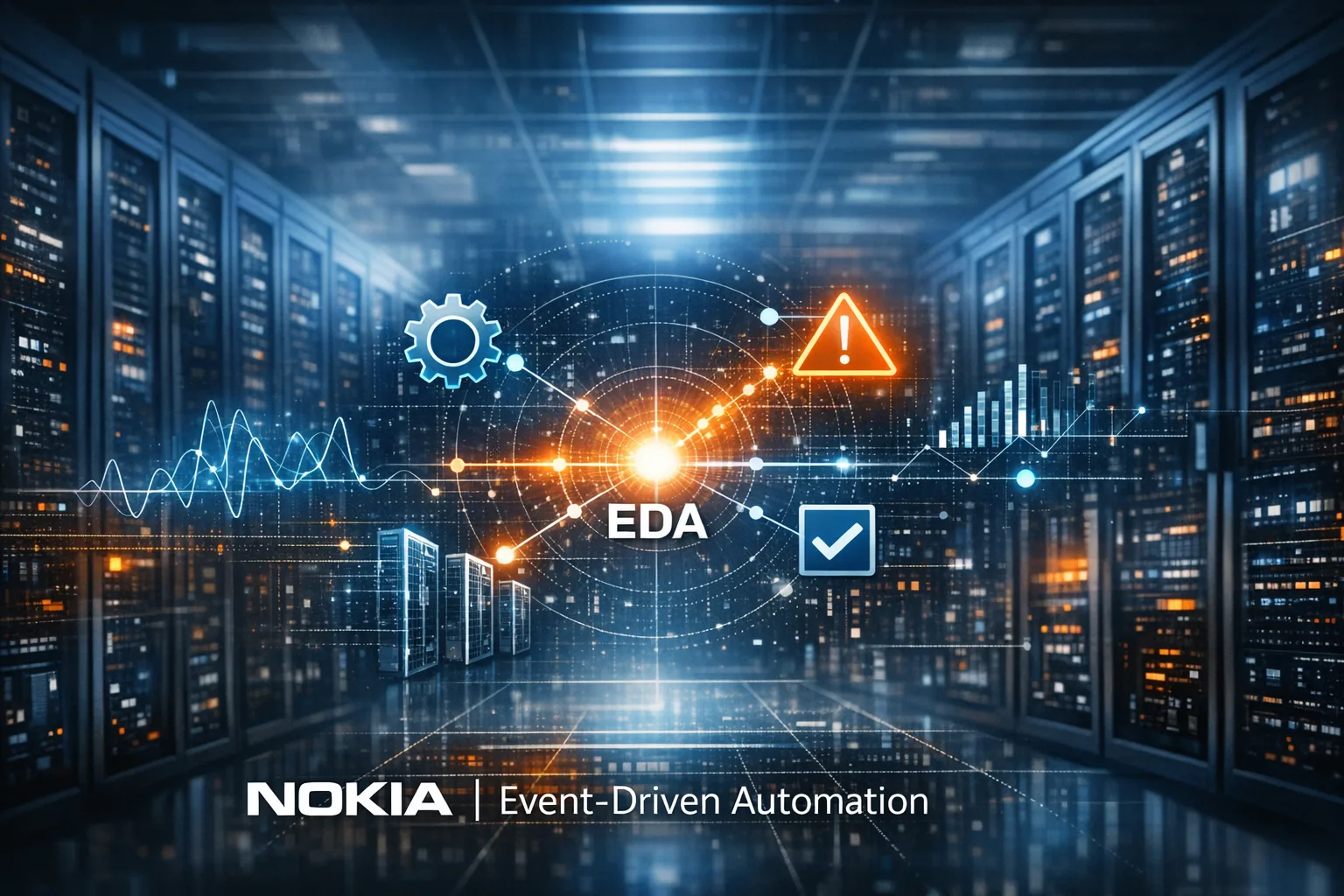
The architecture is solid, but the operational layer is what pushes Nokia into a different category. Nokia’s Event‑Driven Automation (EDA) platform is essentially the antidote to the manual, error‑prone workflows that still dominate most network operations. Instead of waiting for maintenance windows or relying on static configs that drift the moment real traffic hits the fabric, EDA runs as a continuous feedback loop. It watches the network in real time and triggers the right corrective or investigative actions the moment something deviates from intent.
Because EDA is built on a microservices architecture and tightly coupled with SR Linux, NetOps teams can finally step away from CLI‑driven babysitting and move toward a predictable, intent‑based operational model. With digital‑twin validation through containerlab and a declarative approach to configuration, EDA helps ensure the fabric stays in its desired state without constant human intervention, which is exactly what you want in environments where reliability, and consistency, aren’t negotiable.
That’s the operational backbone, now here’s where it’s translating into real deployments.
Where Nokia Is Actually Winning: Two High‑Value Use Cases
Use Case #1 — Edge Data Centers for “Physical AI”
AI is leaving centralized cloud DCs and moving into factories, utilities, logistics hubs, and energy sites. These environments need:
- deterministic networking
- hardened hardware
- automation for remote operations
- low‑touch lifecycle management
Nokia’s telco DNA + DC architecture is a perfect fit for:
- computer vision at loading docks
- robotics coordination in warehouses
- real‑time inference for quality control
- predictive maintenance pipelines
- drone inspection networks
This is where Nokia’s “IT + OT” dual persona becomes a differentiator. The incumbents built their offerings for cloud data centers; Nokia built for physical environments where AI interacts with the real world.
Use Case #2 — Private 5G Core + MEC Integration
Enterprises deploying Private 5G often need a local data center fabric to host:
- UPF (User Plane Function)
- MEC applications
- analytics pipelines
- industrial control workloads
Nokia’s IXR platforms + SR Linux provide:
- EVPN/VXLAN segmentation for P5G slices
- deterministic east‑west traffic for MEC apps
- automation for Day‑0/1/2 lifecycle
- integration with Nokia DAC or third‑party P5G cores
This is a natural adjacency to Nokia’s existing P5G footprint and a place where Cisco and Arista simply don’t have the same OT credibility.
Bottom Line
Nokia isn’t dethroning Arista or Cisco. But they are becoming the vendor you call when:
- you’re building AI‑native infrastructure
- you need deep automation and a programmable fabric
- you want a clean‑sheet NOS
- you need telco‑grade reliability in a data center footprint
- you’re preparing for “Physical AI”
In a market full of incumbents modernizing legacy systems, Nokia is the rare vendor starting from zero, and that’s exactly why they’re gaining traction.