NVIDIA has become a staple of the CES lineup, and this year Jensen Huang followed the familiar script of bringing big-iron energy to the Vegas stage. His presentations are always highly anticipated, and this one was no exception with attendance predictably exceeding the arena’s capacity. In fact, the demand was so high that an estimated 3,000 attendees were redirected to watch the keynote from the Fontainebleau patio, standing in the desert air to catch a glimpse of a roadmap that has little to do with traditional consumer gadgets.
CES is traditionally the land of TVs, earbuds, and smart toasters. NVIDIA hasn’t made a play for those gadgets just yet but they did roll in with a keynote that felt more like a briefing for the future of the global compute stack. It was an interesting contrast watching ultra‑enterprise, high‑end AI infrastructure being showcased at a consumer show, especially when many enterprises are still figuring out how to integrate this level of power. But for NVIDIA, that contrast is exactly the point.
Jensen used the stage to argue that the world is shifting from CPU‑centric computing to AI‑driven, GPU‑first platforms, and the shift isn’t just for hyperscalers. He framed it as a modernization of the entire computing stack, sending the message that AI is the new baseline for everything from consumer apps to industrial systems.
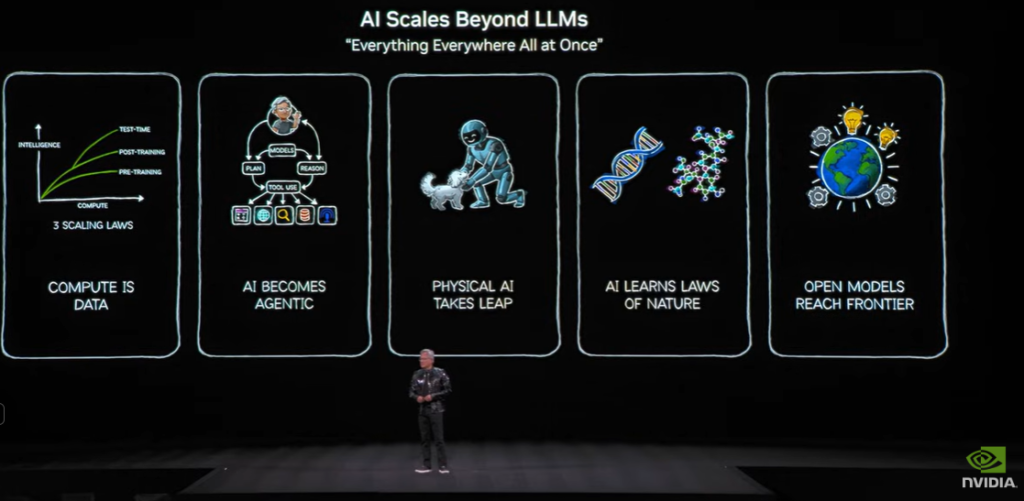
A big part of the keynote focused on open ecosystems. Jensen highlighted Alpamayo, the first open “chain-of-thought” reasoning model for autonomous systems, and the Nemotron family, positioning them as major steps in democratizing agentic AI. NVIDIA has always wanted to be the company accelerating the momentum of open models, and CES provided the mainstream spotlight to reinforce that intent to the entire tech world at once.
Then came the physical AI angle. Jensen walked through NVIDIA’s roadmap for robotics and embodied AI, powered by simulation and synthetic data. The Cosmos world-foundation model, which enables advanced reasoning and simulation for robots, was a centerpiece here. While this isn’t consumer tech in the traditional sense, presenting it here signals that physical AI, from factories to logistics, is moving toward everyday life faster than many expect.
He also gave updates on the Alpamayo autonomous vehicle program, with deployment timelines tightening to Q1 of this year. The platform was on full display with a stunning video of a Mercedes-Benz CLA hitting the roads of San Francisco. The level of compute behind Alpamayo is miles beyond what most automakers are used to. Jensen reinforced the narrative that the future of transportation is now inseparable from massive AI infrastructure.
And of course, Jensen confirmed that the Vera Rubin compute architecture is now in full production. It’s the kind of system that sets new performance benchmarks for the entire industry, yet here it was, being discussed at a show where people are comparing Bluetooth speakers.
The challenges he acknowledged, like the need for extreme co‑design across chip types and complex partner integration, made the vision feel grounded. Because the Rubin platform is a “full-stack” system rather than a standalone component, it requires a massive level of integration with partners. NVIDIA knows the industry isn’t fully ready for this shift, but they’re pushing it forward anyway. The message was essentially signaling that the infrastructure is moving faster than the average company’s ability to adopt it.
So why CES for NVIDIA? Because NVIDIA isn’t just selling hardware; they’re selling a vision of where computing is headed. And if you want the world to understand that future, you don’t wait for them to catch up. You go to the biggest stage you can find, even if some of the audience has to watch from the patio.