During the NVIDIA GTC 2026 conference Jensen Huang casually announced Vera Rubin and that the data center is now an AI Factory. Mike Rowe has been warning tech workers for years that we’d all end up as factory workers, and apparently he was right. Tokens are the new oil, and networking is the only thing keeping the whole rig from catching fire.
Following the keynote, I fully expected to talk about the latest NVIDIA InfiniBand and Ethernet updates. Instead, NVIDIA dropped something bigger. Something that forces us to rethink how AI infrastructure actually works.
Because here’s the truth: NVIDIA is making it nearly impossible to separate networking from compute and memory. In AI, networking isn’t just about connecting machines. It’s about merging them. Two computers aren’t talking, they’re becoming one. A mind‑meld. And if you’re a network engineer, it’s time to skill up.
So let’s break this down.
Ten years ago, NVIDIA stuffed eight GPUs into a single chassis and introduced NVLink to glue them together. That was fine until someone asked for more power. NVLink v2 arrived, letting 16 GPUs behave like one supercomputer. For a brief moment, life was good.
Then someone said, “Actually, we need the entire data center to behave like one machine.” NVLink wasn’t built for that kind of social life, so NVIDIA acquired Mellanox and brought InfiniBand into the fold. Quantum‑2 switches gave us scale‑out supercomputing, and suddenly we had a fabric that could keep up with whatever GPU monstrosity we assembled.
And yes, Ethernet fans, you’re still invited. Mellanox had Spectrum switches, and by 2023 NVIDIA had turned them into AI‑optimized Ethernet. The guidance became simple: InfiniBand for training, Spectrum‑X Ethernet for inference. Two networks, two jobs.
That brings us to this week.
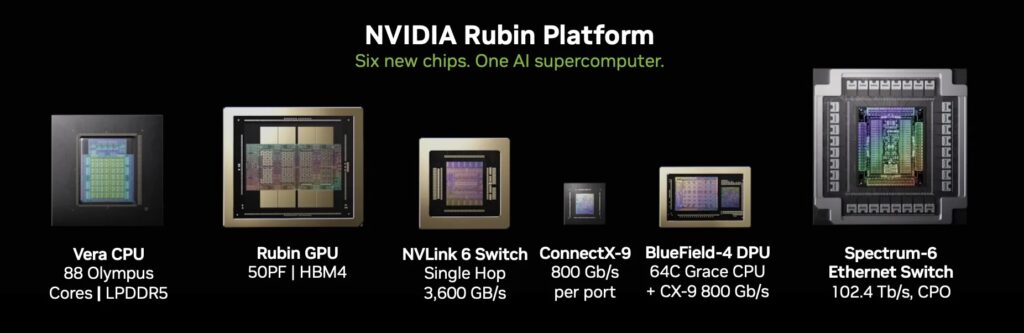
NVIDIA announced the Vera Rubin platform, and while the compute trays and STX servers are interesting, the real story is the connectivity. We’ve officially entered the Rubin era, where GPUs are no longer the bottleneck. The real choke point is how fast those chips can gossip with each other, and gossip needs to move fast.
NVIDIA now has a three‑layer interconnect strategy:
- NVLink 6 inside the rack
- InfiniBand for training clusters
- Spectrum‑X Ethernet for AI data centers and inference
Each layer maps to a different part of the AI Factory.
NVLink 6 delivers 260 TB/s of bandwidth inside a single Vera Rubin rack. Seventy‑two GPUs behave like one giant, angry super‑chip. Angry in a productive way.
Spectrum‑6 Ethernet is where things get spicy. NVIDIA introduced co‑packaged optics, literally baking lasers into the switch silicon. That eliminates power‑hungry transceivers and gives us a 5x efficiency boost. Ethernet just got a personal trainer.
ConnectX‑9 SuperNICs handle RoCE traffic and keep the CPU from crying. And yes, it’s pronounced “Rocky.”
BlueField‑4 STX powers the new CMX (Context Memory) platform, offloading KV cache so inference doesn’t have to fetch memory across the entire factory. Massive efficiency gains.
Together, these components make a rack behave like a single system instead of a collection of servers held together by hope and bailing wire.
And then there’s Scale‑Across. Spectrum‑XGS is stitching clusters together across regions. A global AI nervous system where context can live in multiple buildings and inference doesn’t care. It’s the cloud, but optimized for reasoning instead of cat videos. Stop with the videos. As a society, we’re better than that. Mostly.
So what actually matters?
- Networking is the multiplier. The biggest gains now come from the fabric, not the FLOPS.
- Vertical integration is complete. NVIDIA owns the entire data path—CPU to optics.
- Ethernet is being dragged into the future. Deterministic, accelerated, disciplined.
- Inference is the new battleground. With Groq 3 LPUs and CMX memory, latency is king.
Most of this tech lives squarely in the AI data center today. This isn’t your typical enterprise network refresh, and nobody is ripping out office switches to install co‑packaged optics next quarter. But the pattern is clear: what starts in hyperscale eventually permeates everything else. Deterministic fabrics, accelerated Ethernet, memory‑aware networking, and GPU‑centric design principles will all trickle down into mainstream infrastructure. Maybe not this year, maybe not next, but it’s coming. If you work in networking, infrastructure, or operations, now is the time to pay attention. The AI Factory may be born in the data center, but its influence won’t stay there for long.