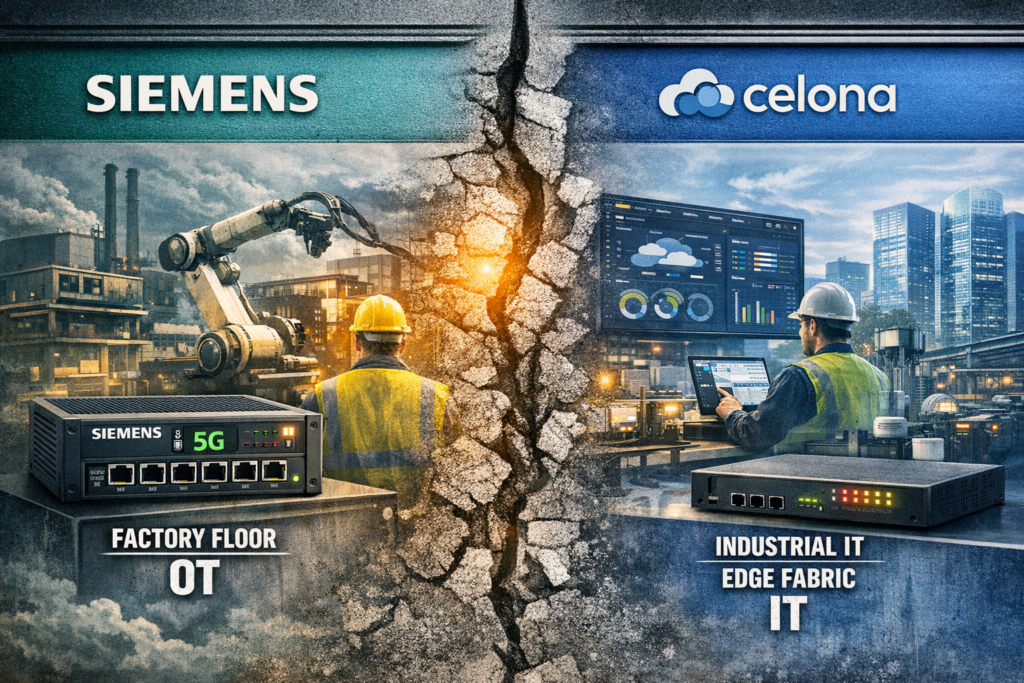
Private 5G has officially entered its grown‑up era. The pilot projects are fading, the PowerPoints are getting shorter, and the procurement teams have stopped asking whether Wi‑Fi 6E can “do the same thing but cheaper.” As we move deeper into 2026, the real story goes beyond the hardware coming out of MWC and the latest spectrum allocation. It’s the widening strategic divide between IT and OT, and the vendors who are unintentionally fueling it- Celona and Siemens.
This year, two very different philosophies are colliding on the industrial edge. And depending on which building you’re standing in, the office or the plant, you’re probably convinced your side is the reasonable one.
Siemens and the OT Mindset: 5G as an Industrial Bus
Let’s start on the factory floor, where Siemens is preparing its U.S. industrial 5G expansion for 2026. Their CBRS‑aligned radio units aren’t being pitched as “networks” in the IT sense. Siemens is selling something far more familiar to OT teams: a wireless extension of the PLC cabinet.
This is the genius of their approach. They’re not asking OT to learn telecom. They’re making 5G behave like PROFINET, just without the cable tray and the 200‑meter limit. With PROFIsafe‑validated 5G in the mix, Siemens is addressing the one thing OT cares about more than uptime: safety‑critical determinism. If a robot arm is going to move, it needs to move exactly when it’s told, not when the scheduler feels inspired.
To OT, 5G isn’t a “network transformation.” It’s just another Tuesday.
Celona and the IT Mindset: 5G as a Unified Fabric
Now walk across the parking lot into the corporate office, and the conversation changes. IT doesn’t want a machine controller. They want visibility, policy, and a network that doesn’t require a telecom priesthood to operate.
This is where Celona’s “5G LAN” model resonates. They treat cellular like a high‑performance SSID that plugs directly into the existing security stack. No mystery boxes. No new tribal knowledge. No “call the integrator because the forklift lost connectivity again.”
For IT, the dream is simple: one fabric, one dashboard, one operational model. If it can’t be monitored, logged, and governed, it doesn’t belong in the building.
The Real 2026 Challenge: Not Technology – Alignment
Here’s the analyst’s reality: neither Siemens nor Celona is wrong. They’re just solving different problems for different people.
- Siemens is optimized for environments where milliseconds matter and safety protocols rule the universe.
- Celona is optimized for environments where governance, segmentation, and cloud integration are non‑negotiable.
The danger isn’t choosing the wrong vendor. It’s letting the internal divide between IT and OT harden into a permanent architectural fault line. Because once that happens, your Private 5G deployment becomes less of a network and more of a diplomatic incident.
Bridging the Carpet and the Concrete
If you’re leading a P5G initiative in 2026, you have challenges beyond spectrum, radios, or vendor selection. You also need to include a tight focus on stakeholder alignment. The teams that win this year will be the ones who get IT and OT in the same room early, and preferably before the first radio is mounted and definitely before someone utters the phrase “shadow network.”
I have said it before– Private 5G is no longer a science experiment. It’s infrastructure. And infrastructure succeeds when the people who depend on it agree on what “success” actually means.
Welcome to the new reality of the industrial edge.