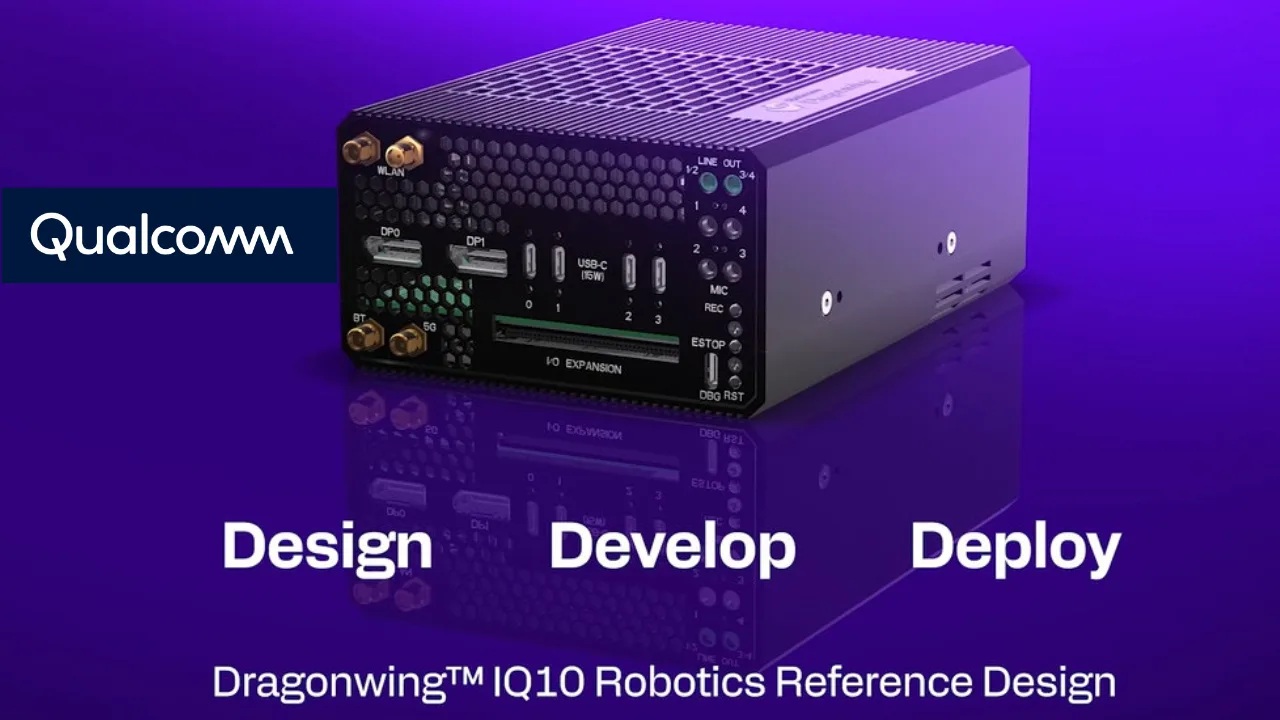
At the recent Computex 2026, Qualcomm introduced the Dragonwing IQ10 Robotics Reference Design (RRD), the company’s most concrete commitment to the physical AI market to date. The new platform consolidates compute, sensor interfaces, deterministic I/O, networking, and a layered software stack into a single enclosed reference design for autonomous mobile robots (AMRs), industrial robotics, and humanoid platforms.
It will be available in early access starting in June 2026, with global commercial availability scheduled for September 2026.
By removing the integration burden that has historically separated prototype development from production deployment, Qualcomm is running the playbook it defined to penetrate the automotive market. It’s delivering a certified, scalable silicon platform with an end-to-end software stack built in.
Details
The Qualcomm Dragonwing IQ10 RRD integrates heterogeneous compute, sensor-ingestion hardware, multi-domain networking, real-time control interfaces, functional safety infrastructure, and a modular robotics software stack into a production-hardened, enclosed unit.
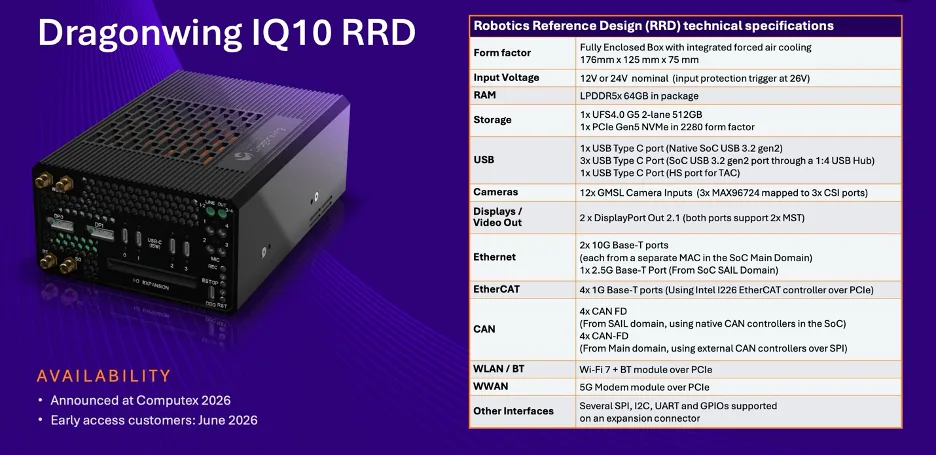
Out of the box, the platform supports core functional building blocks for robotics:
- Perception for vision, depth, and environment understanding.
- Navigation and localization for autonomous movement.
- Planning and control for motion execution.
- Manipulation for robotic arms and end effectors.
- Task planning and orchestration for higher-level autonomy.
- Natural language interaction for human-robot interfaces.
The reference design covers the full robotics development lifecycle, from initial prototyping through fleet-scale OTA management.
Key capabilities of the platform include:
- Native multimodal sensor ingestion: Up to 12 GMSL2 high-speed camera inputs are natively supported, alongside LiDAR, Time-of-Flight (ToF), IMU, and other sensors, without separate bridging hardware. This approach synchronizes sensor data streams directly, reducing latency between sensing and processing.
- Deterministic real-time I/O: PCIe Gen5, Time-Sensitive Networking (TSN), 10GbE, EtherCAT, CAN-FD, and USB interfaces support precision motion control and timing-critical actuation loops.
- Connectivity: Integrated Wi-Fi 7 and 5G support, plus 10GbE for infrastructure connectivity, enabling both local robot control and cloud-connected fleet operations.
- Functional safety and security: An integrated safety island and platform-level OS security services support functional safety requirements and system integrity in production industrial deployments.
- Environmental hardening: The fully enclosed unit operates across -40 to 70 degrees Celsius with integrated forced-air cooling and supports 12V/24V nominal power inputs with over-voltage protection triggering at 26V.
- Software stack: A layered architecture spanning on-device AI runtimes for low-latency perception and decision-making, ROS2 middleware for hardware abstraction, platform services for sensing, planning, and actuation, and cloud-connected fleet management via Qualcomm AI Hub. MLOps and DevOps tooling support AI model development, deployment, validation, and OTA lifecycle management.
- OS: Ubuntu Linux, providing compatibility with the broader robotics software ecosystem.
The platform is also tightly integrated with an end-to-end robotics software stack that provides several key capabilities:
- On-device AI runtimes supporting low-latency perception and decision-making.
- ROS2 support decouples hardware from application logic, simplifying integration by leveraging the robotics ecosystem.
- Platform services that support core robotics capabilities such as sensing, planning, and actuation.
- Cloud-connected lifecycle management for deployment, monitoring, and iterative improvement through the Qualcomm AI Hub.
Analysis
Qualcomm’s entry into robotics is an extension of the platform strategy the company has executed in the automotive sector, applied to a market at a comparable stage of maturity.
The Snapdragon Digital Chassis playbook followed a consistent arc: enter with connectivity and cockpit compute, expand into safety-critical subsystems, build a software stack and OTA infrastructure, accumulate design wins, and generate long-duration revenue through software content per vehicle.
It’s a strategy that transformed Qualcomm’s automotive business from a connectivity component supplier into a $4+ billion annual-revenue platform business with a $45 billion design-win pipeline across BMW, Stellantis, and other major OEMs. The IQ10 RRD is the opening move in the same arc for robotics.
Robotics and automotive operate within the same continuum of what we now call “physical AI.” This framing makes sense as both domains require systems that perceive the physical world in real time, reason under latency constraints, execute deterministic actions, and update continuously through cloud-connected model pipelines.
The technical requirements also overlap in sensor fusion, functional safety, low-latency inference, and lifecycle management.
Qualcomm’s Nakul Duggal, EVP of Automotive, Industrial and Embedded IoT, explicitly described Qualcomm’s robotics platform as building on the company’s foundational low-latency, safety-grade technologies developed for automotive applications. This cross-domain asset reuse is a cost and credibility advantage that pure-play robotics silicon vendors cannot replicate.
Impact to Practitioners
Robotics OEMs and development teams working on AMRs, industrial automation, and humanoid platforms consistently face the challenge of transitioning from prototype to production-grade deployment. Building robots requires stitching together discrete subsystems for computing, sensing, safety, networking, and software that aren’t always designed to operate as a coherent stack.
The IQ10 RRD addresses that bottleneck directly by providing a validated, enclosed reference design with defined integration boundaries and pre-tested component relationships.
For practitioners, the platform’s most immediate operational benefits are:
- Reduction in time-to-production: Native sensor interfaces, pre-integrated middleware, and a layered software stack compress the integration engineering phase. Teams building on fragmented component sets spend substantial time resolving timing synchronization, sensor driver compatibility, and data pipeline latency issues that the IQ10 RRD addresses at the platform level.
- Lower validation complexity: Well-defined platform boundaries and a safety island reduce the scope of functional safety validation. This matters particularly for industrial deployments subject to machine-safety requirements.
- Fleet lifecycle management: OTA updates and cloud-connected model management via Qualcomm AI Hub enable continuous post-deployment improvement, reducing the field update burden that has historically required physical access to the robot.
- Developer accessibility: ROS2 support and Ubuntu Linux lower the barrier to entry for development teams already working within the robotics software ecosystem. Hardware abstraction through middleware keeps application logic portable.
Final Thoughts
Qualcomm’s Dragonwing IQ10 Robotics Reference Design is a well-crafted entry into a market Qualcomm has been building toward since it validated its safety-grade compute and sensor-fusion capabilities in automotive applications.
The platform is also technically credible. Native GMSL2 sensor ingestion, deterministic I/O, functional safety architecture, 5G/Wi-Fi 7 connectivity, and an integrated software stack all address real-world production deployment requirements.
For enterprise teams evaluating robotics compute platforms, the Dragonwing IQ10 RRD offers a credible alternative to competitive solutions, particularly in power-constrained mobile deployments, 5G-connected fleet operations, and regulated industrial environments, where Qualcomm’s safety-certification background carries weight.