
Dell Technologies recently released PowerStore OS v4.3, introducing higher-capacity QLC flash drives, expanded replication capabilities, and file system operational improvements:
- Addresses critical enterprise challenges: data center space constraints, power costs, and disaster recovery requirements
- Brings PowerStore to feature parity with established competitors in replication and file services
- QLC capacity leadership provides meaningful TCO advantages for read-heavy and capacity-optimized workloads
- Multi-party authorization and expanded replication strengthen PowerStore’s enterprise cybersecurity posture
The News
Dell Technologies recently released PowerStore OS v4.3, introducing higher-capacity QLC flash drives, expanded replication capabilities, and file system operational improvements. The update addresses three primary areas:
- Storage density through 30TB QLC SSDs that double rack capacity to 2PB effective per 2U enclosure
- Data protection via new replication options including synchronous block replication over Fibre Channel and metro-area synchronous file replication with automated failover
- File operations through NFSv4.2 feature support and resource consumption visibility via the new Top Talkers capability
The v4.3 release continues Dell’s positioning of QLC-based models as viable alternatives to traditional TLC systems for organizations prioritizing capacity density over absolute performance requirements.
PowerStore competes in the enterprise all-flash array market against NetApp’s AFF systems, Pure Storage FlashArray, and HPE Alletra 6000/Storage MP platforms.
Technical Details
PowerStore employs a dual-controller design supporting both unified file and block protocols across disk, hybrid, and all-flash configurations. Dell introduced the 3200Q variant in 2024 as its first QLC-based model, using 4-bits-per-cell NAND in contrast to the TLC (3-bits-per-cell) flash deployed in the 500T through 9200T model family.
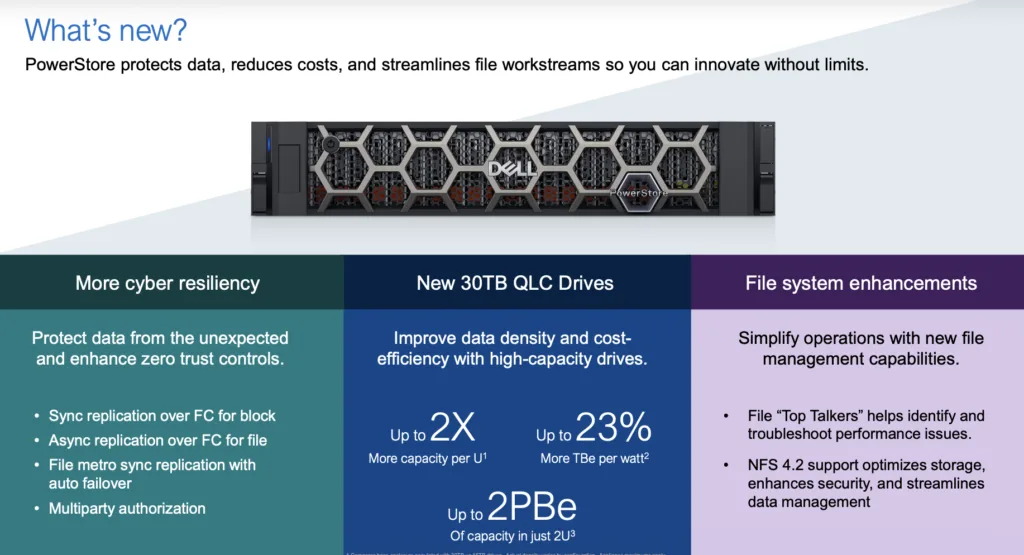
Let’s look at what’s new/changed:
High-Capacity QLC Storage Hardware
New 30TB QLC SSDs allow a doubling of capacity from the previous 15TB drives while maintaining QLC’s four-bit-per-cell architecture:
- Capacity: Up to 2PB effective per 2U enclosure (assumes 5:1 data reduction ratio)
- Power efficiency: Dell claims up to 23% improvement, likely reflecting reduced drive count rather than per-drive efficiency gains
- Mixing capabilities: Organizations can combine 30TB and 15TB drives within the same array
- Interface: NVMe with sub-millisecond latency for read operations
- Performance considerations: Write performance remains subject to QLC’s inherent limitations around sustained write workloads and endurance compared to TLC alternatives
Expanded Replication and Data Protection
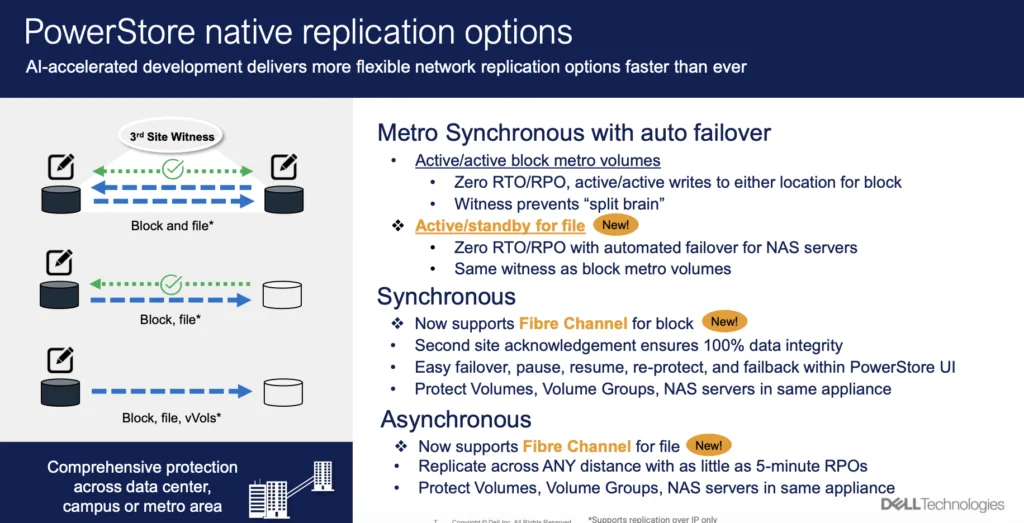
PowerStore OS v4.3 adds three distinct replication capabilities addressing different recovery requirements:
Synchronous replication over Fibre Channel for block workloads
- Eliminates traditional IP networking requirements for synchronous protection
- Enables zero RPO configurations using existing FC fabrics
- Provides users with existing FC infrastructure an alternative to IP-based replication while maintaining zero data loss guarantees
Asynchronous replication over Fibre Channel for file systems
- Delivers granular 5-minute RPOs for NAS workloads using FC connectivity
- The 5-minute interval represents a practical balance between data currency and replication overhead
Metro synchronous replication for file systems with automated failover
- Supports distances up to 60 miles with zero RPO and zero Recovery Time Objective (RTO)
- Automated failover reduces manual intervention during failures
NFSv4.2
PowerStore v4.3 implements three specific NFSv4.2 capabilities:
Server-Side Copy
- Enables NFS clients to instruct the storage array to perform file copy operations locally
- Reduces network bandwidth consumption and client CPU utilization for file duplication and movement
- Benefits scale proportionally to file sizes and copy frequencies
Sparse Files support
- Addresses storage efficiency for virtual machine disk images and HPC checkpoint files containing significant allocated-but-unused space
- Uses metadata to describe zero-filled regions rather than transferring them during copy operations
- Reduces both transfer times and bandwidth requirements
Labeled NFS
- Implements Mandatory Access Control (MAC) through file labels specifying applicable security policies
- Labels travel with files across the environment, enabling consistent security policy enforcement
- Addresses security requirements in environments handling classified or regulated data
- Requires compatible client systems and applications that understand labeled NFS semantics
Analysis
PowerStore OS v4.3 delivers meaningful enhancements across capacity density, data protection, and file system operations that expand the platform’s enterprise capabilities and competitive positioning.
IT organizations evaluating PowerStore should focus on specific use cases where its strengths align with requirements:
- Capacity-optimized workloads benefiting from high-density QLC storage with claimed TCO advantages
- Unified file and block consolidation scenarios reducing infrastructure complexity
- Deployments with existing FC infrastructure that can leverage expanded replication options
- Organizations prioritizing capacity efficiency over absolute performance maximums
Dell’s continued investment in PowerStore shows its commitment to the platform’s enterprise roadmap, with its latest enhancements bringing substantive improvements that expand PowerStore’s addressable market and competitive viability against established platforms from NetApp, Pure Storage, and HPE.
The release strengthens PowerStore’s position in the enterprise all-flash array market by addressing previous capability gaps and expanding deployment flexibility, making it a more competitive option for organizations seeking to consolidate workloads while managing capacity growth efficiently.
Competitive Positioning & Advice to IT Buyers
These sections are only available to NAND Research clients and IT Advisory Members. Please reach out to [email protected] to learn more.