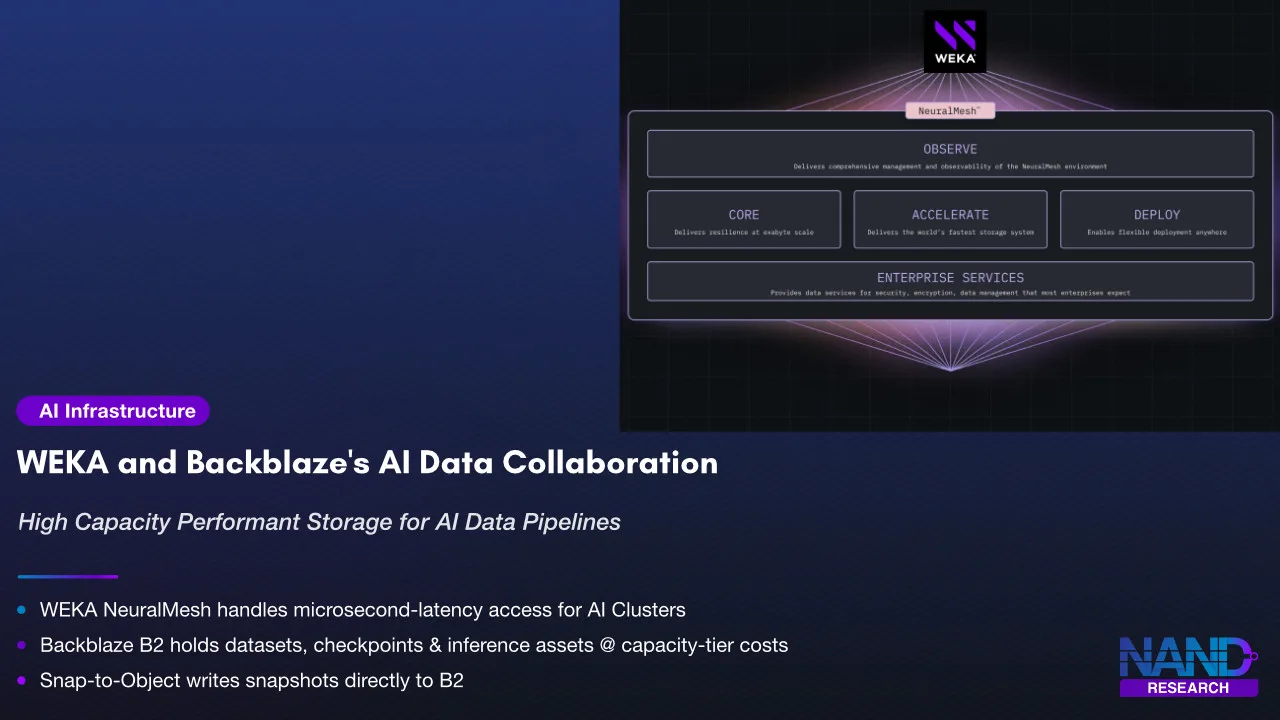
WEKA and Backblaze recently announced a validated two-tier storage architecture for AI workloads. The solution pairs WEKA NeuralMesh, a high-performance parallel file system designed for GPU-fed workloads, with Backblaze B2 Cloud Storage, an object storage service for large-scale data retention.
The announcement addresses a structural tension in AI infrastructure. Training and inference workloads require microsecond-level data access to keep GPU clusters fully utilized, while the datasets, checkpoints, and derived outputs those workloads generate are growing toward exabyte scale.
WEKA and Backblaze are delivering a pre-built solution to that tension, allowing customers to deploy a tested reference design instead of independently assembling and validating the performance and capacity layers.
Details
The joint architecture assigns each tier a distinct role in the AI data lifecycle:
- WEKA NeuralMesh operates as the performance tier, sitting close to GPU clusters and serving data at microsecond latency.
- Backblaze B2 operates as the capacity tier, holding raw datasets, media libraries, and source files that are not actively in use.
Data moves between tiers as workloads change. When a training or inference job begins, raw data is staged from B2 into NeuralMesh, and checkpoints, outputs, and completed datasets return to B2 once performance-tier access is no longer needed.
NeuralMesh’s Snap-to-Object capability writes consistent filesystem snapshots directly to B2, allowing checkpoint recovery and inference-data archival to use existing B2 capacity rather than a separate, dedicated snapshot destination.
NeuralMesh can tier to any S3-compatible object store, so the pipeline’s tiering mechanism isn’t exclusive to B2; the collaboration adds vendor-completed validation on top of an existing capability.
The design aligns with the two-tier storage model referenced in NVIDIA’s Cloud Partner reference architecture, which separates GPU-adjacent performance storage from bulk capacity storage.
The collaboration is structured as a validated design that partners can deploy rather than a jointly packaged product with its own SKU or published price list.
Analysis
The impact is different for each company. Let’s look at each in-turn.
WEKA
For WEKA, the arrangement extends a pattern of partnering NeuralMesh with multiple capacity-storage vendors instead of building or acquiring its own object storage layer, keeping WEKA focused on the performance tier while its partners compete on capacity economics.
WEKA’s core capability, an in-place, GPU-adjacent parallel file system, remains unchanged by the Backblaze arrangement, and NeuralMesh already supports tiering to any S3-compatible object store as an existing product capability (in fact, WEKA struck a similar two-tier arrangement with Scality earlier this year 6).
That widens WEKA’s practical addressable market among customers who require a validated design before committing budget, but it does not add a technical capability WEKA previously lacked.
Backblaze
For Backblaze, the effect runs the other way. B2 is object storage, suited to archival and infrequent access but not to feeding GPUs at inference latency, so Backblaze had no independent way to compete for the active portion of an AI pipeline.
The WEKA arrangement gives Backblaze a credible answer to that gap, letting the company market B2 as the capacity layer of a complete AI serving pipeline rather than a backup destination sitting outside it.
That distinction matters more as AI infrastructure spend shifts toward inference. Inference workloads generate an ongoing stream of model versions, embeddings, retrieval-augmented generation corpora, and serving logs that need cheap, durable retention.
The partnership expands Backblaze’s addressable market more directly than it expands WEKA’s, since Backblaze is entering the AI-infrastructure conversation as element of a validated pipeline for the first time, while WEKA is adding a partner to a tiering capability it already had.
Practitioner Impact
Infrastructure teams operating GPU clusters for AI workloads gain a pre-tested path to pairing high-performance and high-capacity storage without independently qualifying both layers.
The benefit is most pronounced for organizations already running or evaluating WEKA NeuralMesh that need an economical destination for the datasets and checkpoints their clusters produce:
- Sizing and performance tuning that would otherwise fall to the customer’s own infrastructure team has been completed and documented by the two vendors.
- Snap-to-Object removes the need to provision and manage a separate destination for filesystem snapshots, simplifying checkpoint recovery workflows.
- Sustained throughput when large datasets move between B2 and NeuralMesh will determine whether the architecture holds up under real production load; that performance has not yet been validated.
Final Thoughts
As inference workloads scale past training’s current share of AI infrastructure spend, both companies gain from being named together in a single reference architecture:
WEKA reinforces NeuralMesh as a default performance layer for inference-serving deployments, where low-latency access to model weights and cached context is the binding constraint.
Backblaze establishes B2 as a recognized capacity destination within that same architecture, well-positioned to hold the growing volume of checkpoints, fine-tuned model variants, and retrieval corpora that inference at scale produces, rather than competing as a general-purpose alternative brought in after the fact.
The collaboration lets Backblaze build on its long history in hosted capacity storage, leveraging its infrastructure to address the emerging storage challenges driven by enterprise AI. It’s a natural play for the company and opens the door to significant growth.
Overall, the collaboration sees WEKA and Backblaze packaging a storage pattern that AI infrastructure teams have already been assembling on their own, pairing a high-performance parallel file system with lower-cost object storage for data that does not require constant GPU-adjacent access.
It’s a compelling approach that will simplify the work required by enterprise AI teams.