If you want to understand Cisco’s silicon strategy in the AI era, look at where they choose to build and where they choose to buy. Cisco’s Wi‑Fi access points rely heavily on Qualcomm radio silicon, while their data‑center switching platforms are powered by Cisco’s homegrown Silicon One architecture. That split isn’t a contradiction; it’s a deliberate expression of how Cisco allocates R&D, where differentiation matters, and where the physics simply favor a very specific solution.
As someone who’s deployed these systems in the real world and now analyzes the industry, I see this as one of the clearest examples of Cisco’s “use the right silicon for the right domain” philosophy.
Why Cisco Uses Qualcomm in Wi‑Fi
Wi‑Fi is fundamentally a radio engineering problem. Everything that determines real‑world performance (spectral efficiency, PHY/MAC behavior, interference handling, and multi‑band coexistence) lives deep in the RF silicon. Qualcomm has spent decades optimizing these layers, and they ship Wi‑Fi chipsets at a scale Cisco could never match.
There’s also a deeper strategic advantage: client alignment. Qualcomm silicon powers the vast majority of premium Snapdragon‑based smartphones, tablets, and the emerging wave of Snapdragon X Elite PCs. That means Cisco’s access points and the clients connecting to them share a common engineering lineage. When a Cisco AP and a Snapdragon client communicate, they’re speaking a dialect both sides were optimized for. The result is better Target Wake Time behavior, smoother roaming, and more stable 6 GHz performance. Qualcomm handles the RF physics and client ecosystem; Cisco layers on the enterprise experience.
Why Cisco Uses Silicon One in the Data Center
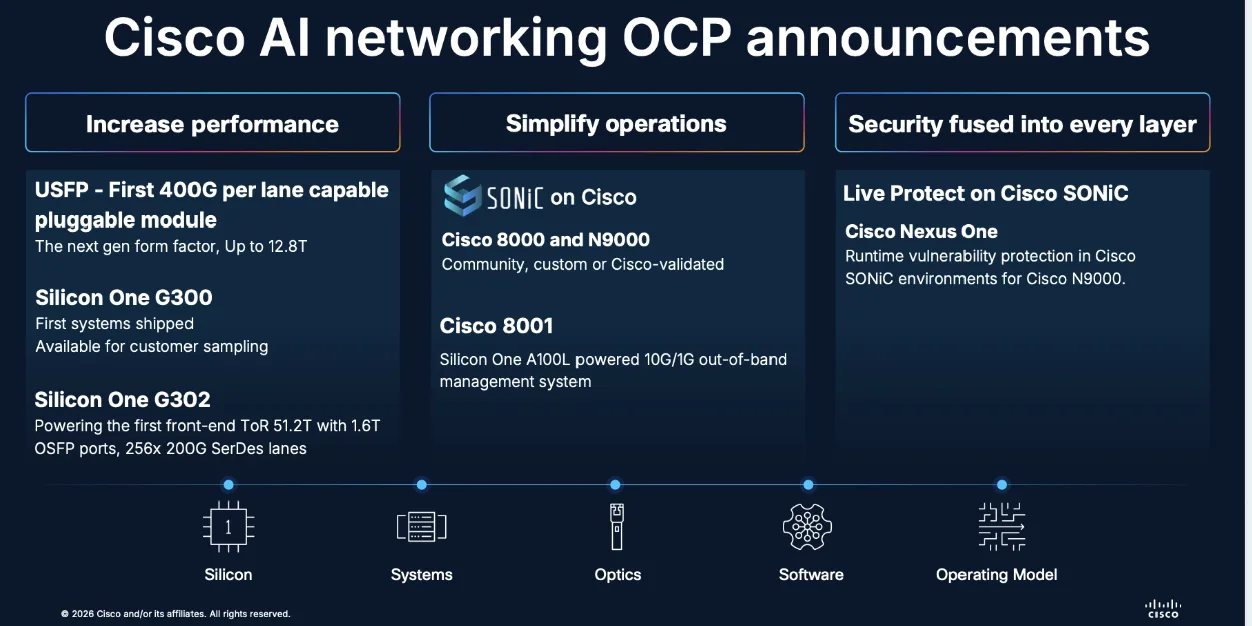
Shift to the data center and the physics change completely. Radios have no place in the AI fabric. These fabrics are about deterministic latency, congestion control, SerDes density, and thermal envelopes that can survive 100 kW racks. Cisco’s Silicon One architecture, including the new G300 102.4 Tbps ASIC, is designed to give Cisco full‑stack control over these variables.
In the AI era, networking requires more than a best‑effort transport layer. As we move into what many are calling the Agentic Era where AI agents, multi‑model orchestration, and continuous inference pipelines dominate, the network becomes a performance multiplier. Cisco’s G300‑powered Nexus 9000 and 8000 systems reflect this shift. They’re built for liquid‑cooling from day one, not as an afterthought. The cooling strategy is a critical part of the silicon design envelope. By owning both the ASIC and the thermal architecture, Cisco can push higher GPU utilization while reducing system energy consumption dramatically.
This is Cisco positioning itself as a silicon competitor in AI‑era switching. In Wi‑Fi, differentiation happens above the silicon. In the data center, differentiation starts at the silicon and extends all the way to the cooling manifold.
Two Markets, Two Physics Problems, One Strategy
The physics dictate the strategy. Wi‑Fi is a radio problem, and Qualcomm is the best radio company in the world. AI fabrics are a switching and thermal‑engineering problem, and Cisco wants full‑stack control to support agentic workloads.
In Wi‑Fi, Qualcomm gives Cisco a proven RF foundation so they can differentiate in software and operations. In the data center, Silicon One gives Cisco the architectural and thermal control they need to compete in the AI‑era fabric race.
Two domains. Two silicons. One intentional strategy.