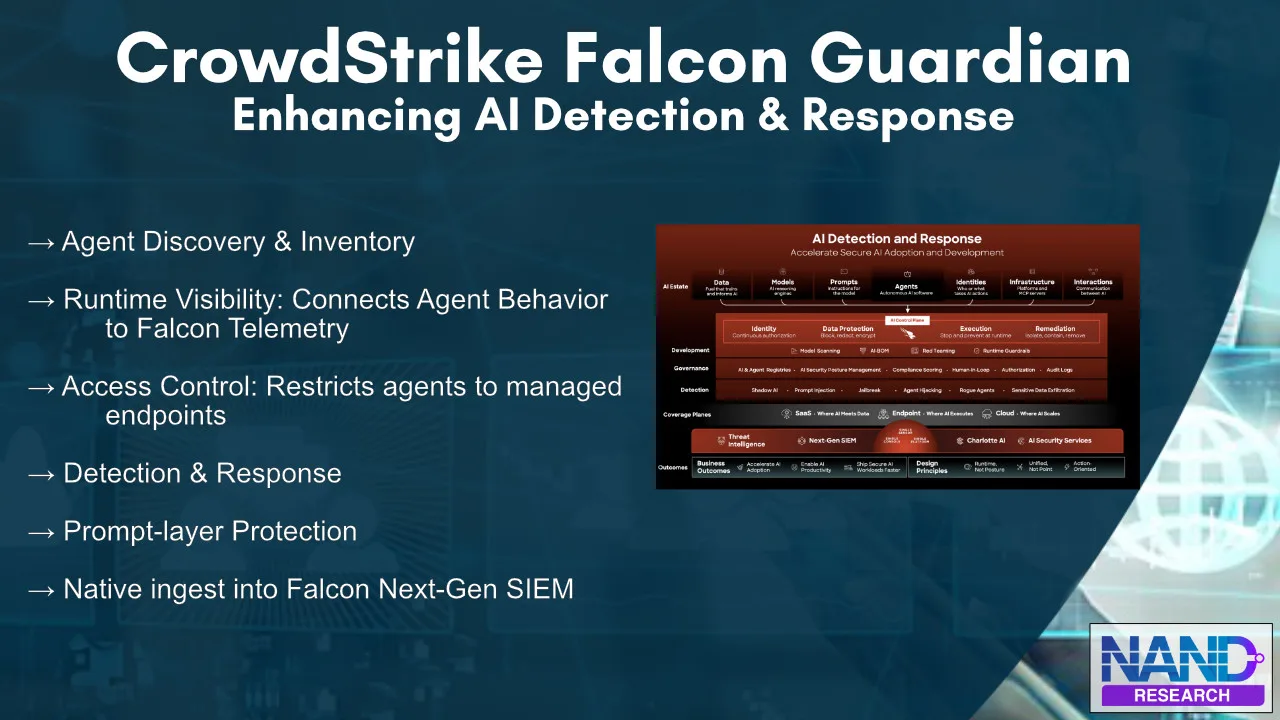
CrowdStrike announced its new Falcon Guardian at Fal.Con 2026 in Las Vegas, extending its Falcon platform to secure AI agents on managed endpoints. The offering adds AI agent discovery, runtime visibility, access controls, and detection and response to CrowdStrike’s existing AI Detection and Response (AIDR) product line.
Technical Details
Falcon Guardian uses the same lightweight Falcon sensor that CrowdStrike already runs across its endpoint install base. While the initial AIDR release focused on monitoring AI usage in the workforce and blocking prompt-layer attacks, Falcon Guardian builds on that foundation by adding autonomous AI agents that run locally on Windows and macOS endpoints.
Capabilities include:
- Discovery and inventory: identifies known and shadow AI agents across managed Windows and macOS endpoints and tracks their deployment details and security status.
- Runtime visibility: connects AI agent behavior to Falcon endpoint telemetry, establishing a causal chain from user prompts to downstream system actions and showing the agent’s full execution graph.
- Access control: restricts which AI agents are permitted to run on managed endpoints, translating written governance policy into enforceable runtime controls.
- Detection and response: identifies attacks on agents and malicious agent behavior, reconstructs full execution chains, and determines blast radius in real time, with automated containment actions.
- Prompt-layer protection: blocks prompt injection and jailbreak attempts across more than 200 known attack techniques. CrowdStrike claims 99% detection efficacy against prompt attacks with response latency under 100 milliseconds.
- Native ingestion into Falcon Next-Gen SIEM as first-party data, allowing AI agent telemetry to sit alongside existing endpoint, identity, and cloud detections.
Three announced components were not available at launch and remain forthcoming:
- AI Gateway for centralized control of enterprise AI traffic
- Falcon Complete for Guardian as a 24/7 managed detection and response service
- Falcon Adversary OverWatch for Guardian for dedicated AI-focused threat hunting.
CrowdStrike did not disclose pricing or a general availability date for Falcon Guardian’s endpoint-focused capabilities in the announcement.
Analysis
Falcon Guardian extends CrowdStrike’s long-standing argument that the endpoint is the most reliable control point for stopping attacks, applying that logic to software that operates with more autonomy than the applications CrowdStrike’s EDR business was originally built to monitor.
The new capabilities align with CrowdStrike’s broader platform consolidation pitch by adding AI agent security to a Falcon console that already spans endpoint, identity, cloud, and exposure management, giving CrowdStrike another lever for consolidation with its existing customer base.
Practitioner Impact
For security operations teams already running Falcon, Falcon Guardian integrates AI agent monitoring directly into their console, rather than introducing a separate tool for AI-specific alerts. Because it runs on an already-deployed sensor, activating Falcon Guardian requires no new agent rollout, lowering the operational lift compared with adopting a standalone AI security product.
That convenience comes with a trade-off. Teams will become increasingly dependent on a single vendor for an expanding set of security functions, and much of the near-term value depends on features CrowdStrike has not yet shipped.
Competitive Landscape
The AI agent and AI runtime security category is crowded and rapidly evolving, with vendors approaching the problem from different starting points across network, cloud, identity, and endpoint infrastructure.
The table below summarizes the main alternatives to Falcon Guardian and how their approach compares:
| Alternative | Model / Approach | Relative to Falcon Guardian |
| Palo Alto Networks Prisma AIRS | AI runtime security delivered through Palo Alto’s network and SASE infrastructure, scanning models, applications and agent traffic at the API and network layer. | Broader reach across network and cloud traffic, but without a native endpoint sensor, it cannot observe agent execution on the device the way Falcon Guardian does. |
| Cisco AI Defense | AI security built into Cisco’s networking and security fabric, focused on model validation and runtime guardrails. | A strong fit for organizations standardized on Cisco infrastructure, with less visibility into endpoint-level agent behavior than Falcon Guardian. |
| Microsoft Defender and Security Copilot | AI security embedded in the Microsoft 365 and Azure stack, tied to Copilot and Entra identity. | Deep integration for Microsoft-centric environments, with limited applicability to heterogeneous or non-Microsoft agent deployments that Falcon Guardian can still cover through the endpoint. |
| SentinelOne | Endpoint-native detection and response with its own AI-driven analytics, extending toward AI workload protection. | The closest architectural parallel to Falcon Guardian, endpoint-first and telemetry-driven, though SentinelOne has not announced an equivalently scoped AI agent runtime product. |
| Specialized AI/LLM security platforms | Purpose-built prompt and model-layer defense platforms focused narrowly on generative AI risk. | Often more mature on prompt injection detection specifically but lack the endpoint telemetry and existing enterprise install base Falcon Guardian inherits from CrowdStrike’s EDR franchise. |
CrowdStrike’s differentiation is strongest in its ability to directly link AI agent behavior to endpoint telemetry it already collects at scale, a data set that network- and cloud-focused competitors such as Palo Alto Networks and Cisco struggle to replicate.
Its differentiation is weakest against SentinelOne, whose endpoint-first architecture mirrors CrowdStrike’s own approach, and against specialized AI security vendors whose prompt and model-layer defenses have had a longer run in market.
Final Thoughts
Falcon Guardian is a logical extension of CrowdStrike’s endpoint franchise into a category the company is rapidly shaping. Its core technical premise, that the endpoint provides a vantage point for observing what an AI agent does during execution, is sound and consistent with how CrowdStrike built its EDR business into a market leader.
For CrowdStrike customers already standardized on the Falcon platform, Falcon Guardian is likely to become the default way to extend security coverage to AI agents because it requires no new sensor and integrates directly with tools their teams already use.
Whether it becomes the default choice for the broader market depends on how quickly CrowdStrike turns Falcon Guardian’s roadmap into a shipped product, and on whether its efficacy claims hold up when independent security teams test them against real attacks.
Overall, it’s a strong and compelling offering worth evaluating, regardless of the endpoint protection you’re currently deploying.