
Oracle released the APEX AI Application Generator as the centerpiece of Oracle APEX 26.1, a GA release of its low-code development platform for Oracle Database. The release pairs generative AI with APEXlang, a structured, human-readable specification for an APEX application.
AI agents can create or modify the specification, while APEX remains responsible for validating and executing the application in its managed runtime.
This design creates two related governance layers:
- Development governance covers how AI-generated changes can be inspected, diffed, validated, versioned, reviewed, and approved before deployment.
- Runtime governance covers how the resulting application executes within APEX and the controls applied to its behavior and data access.
Together, these layers give Oracle a structured audit path for AI-assisted development and execution.
Technical Details
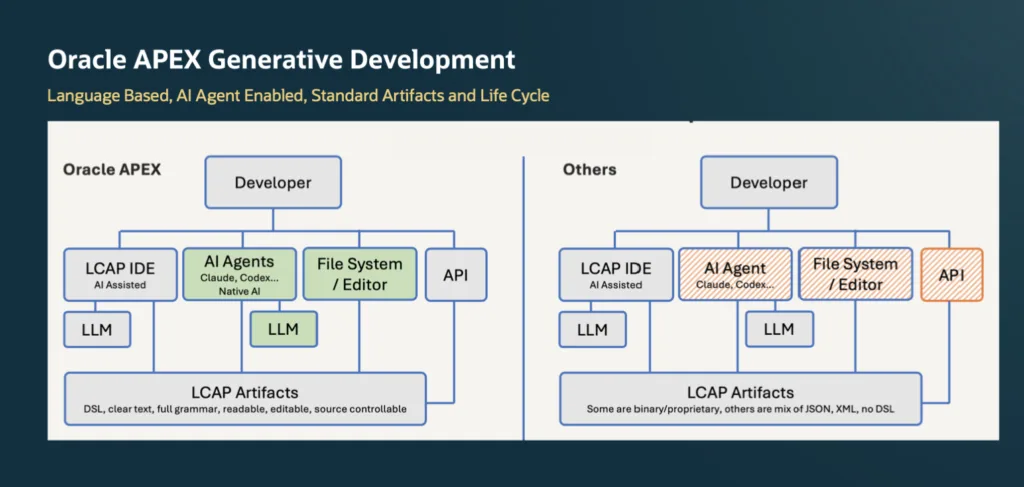
APEXlang effectively serves as a text-based representation of an APEX application. It resembles application metadata or an intermediate specification more closely than conventional implementation source code: developers and AI agents manipulate the application definition, and APEX translates that definition into an executable application.
Development Model
- Application specification: APEX applications can be exported as structured .apx text files. These files can be diffed, merged, and managed in version control using standard developer tools.
- Validation and inspection: SQLcl version 26.1.2 or later can validate APEXlang before import. Oracle SQL Developer for VS Code provides a real-time APEXlang View in Page Designer, allowing developers to inspect definitions as they change.
- Development lifecycle: Oracle organizes AI-assisted creation into five phases: Requirements, Data Modeling, Specifications, Generation, and Refinement. During Generation, AI agents produce APEXlang files, and during Refinement, developers iterate.
AI-Assisted Development
- Three development paths: The release supports a low-code, AI-assisted App Builder with drag-and-drop tools and wizards; native AI agent integration, including support for OpenAI’s Codex; and a VS Code extension for reviewing AI-generated diffs before applying them.
- Conversational changes: Developers and business users can request changes in natural language, such as adding a chart or translating an application. The system converts these requests into APEXlang updates.
- Skills and external agents: An APEXlang Skills repository on GitHub offers reusable prompts and workflows. An SQLcl MCP server enables external AI agents to interact programmatically with APEX applications.
AI Inside Applications
- AI Interactive Reports: End users can use natural language to filter, group, chart, or pivot existing reports. Oracle states that requests are translated into native Interactive Report settings, preserve existing data-access rules, and appear as visible, editable, and removable “chips.”
- AI Agents and Tools: Developers can build conversational agents that use tools defined within an application, including data retrieval, execution of PL/SQL or JavaScript, and client-side interactions. Oracle states that a model can call only the tools explicitly attached to its agent, creating a tool-level permission boundary.
Analysis: Why APEXlang Matters
APEX is well suited to AI-assisted development because it already represents applications declaratively. An AI system can work with a structured application definition while the platform retains responsibility for validation and execution.
General-purpose coding assistants, on the other hand, operate on implementation code whose structure, dependencies, and runtime behavior can vary more widely. APEXlang gives the model a narrower, more explicit target.
Several potential benefits follow from that architecture:
- A structured representation may reduce the context an AI system requires
- Limit some forms of structurally invalid output
- Support deterministic validation
- Produce smaller and more meaningful diffs
- Improve reproducibility
- Clarify the boundary between an AI-requested change and runtime implementation.
The same architecture also separates development governance from runtime governance. Text-based APEXlang files support review and version-control practices prior to deployment. The APEX runtime then enforces the platform’s execution and data-access controls.
Direct source-code generation can also be governed through code review, CI/CD, security testing, and policy controls. Oracle’s contribution is to make the application representation and the managed runtime part of a unified governance model.
The release also aligns with Oracle’s broader effort to integrate AI capabilities into its database and cloud infrastructure portfolio, including Autonomous AI Database.
Enterprise Implications
The clearest near-term opportunity lies within Oracle’s installed base. Existing APEX teams and Oracle Database customers may be able to add AI-assisted scaffolding, application changes, and documentation while retaining familiar development, database, and security practices. Text exports also enable teams to incorporate proposed changes into Git-based workflows and established review processes.
For these organizations, the evaluation may focus on extending an existing Oracle and APEX environment rather than introducing a new development platform and governance model. The approach is relevant to departmental applications, internal workflows, modernization efforts, and applications built on existing Oracle data.
Competitive Landscape
AI-assisted application development can be viewed through three general approaches:
| Approach | Examples | What AI Manipulates | Tradeoff |
| Code-first AI | GitHub Copilot, Cursor, Codex used against source code | Implementation source code | Broad flexibility with governance supplied through development tools, review, testing, and deployment controls. |
| Model-driven AI | Microsoft Power Apps, Salesforce Platform, OutSystems, Mendix | Platform models, configuration, flows, and related code | Structured platform boundaries and integrated tooling, with capabilities and portability tied to each platform’s representation and runtime. |
| Declarative database-native AI | Oracle APEX | APEXlang application specification | A text-based specification linked closely to Oracle Database, APEX validation, and the APEX managed runtime. |
APEXlang’s meaningful differentiation from other model-driven representations remains an open question. Low-code competitors also use structured models and governed runtimes. Oracle’s case rests on the combination of a human-readable, versionable specification, database proximity, validation tooling, and the APEX runtime.
Final Thoughts
Chief Data Officers are under pressure to do more than simply govern enterprise data—they need to make that data useful to the business. Oracle APEX AI Application Generator offers a strategic new way to close that gap.
By enabling AI to generate data-centric applications from a structured application definition and by relying on the APEX platform and Oracle AI Database to manage the underlying runtime, security, and data access, Oracle can help organizations move from governed data to useful applications much faster.
For CDOs, that means a more direct path to turning trusted enterprise data into business value without sacrificing the controls they’ve worked so hard to establish. It’s a compelling story.