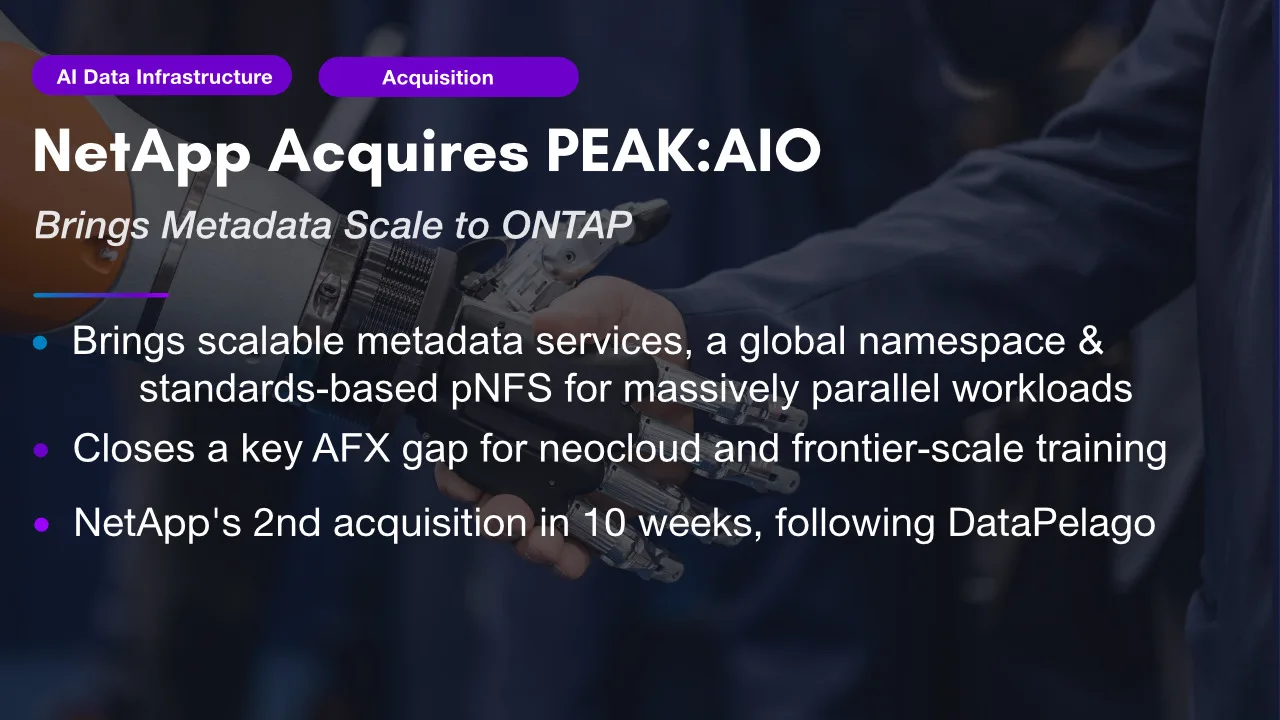
NetApp announced a definitive agreement to acquire PEAK:AIO, a Manchester, UK-based software-defined storage company whose core technology is a scale-out, disaggregated metadata service for parallel NFS (pNFS).
NetApp said it will integrate PEAK:AIO’s metadata services, global namespace, and parallel NFS access into ONTAP, extending its AI infrastructure to support AI clouds that must handle trillions of files and multi-exabyte deployments.
Financial terms were not disclosed, and the transaction remains subject to customary closing conditions and regulatory approvals.
The deal targets the metadata bottleneck, the least visible yet most persistent constraint in scale-out file storage for large GPU clusters. It arrives ten weeks after NetApp acquired DataPelago, and the two transactions together show NetApp methodically assembling the components it needs to compete for the highest-end AI training and neocloud deployments, a segment where competitors like VAST Data and WEKA have set the pace.
The acquisition is also a clear proof point of a broader market shift. Storage is becoming a data platform, and established storage vendors are rebuilding their architectures to meet the concurrency, scale, and governance requirements of agentic AI.
NetApp is buying the capabilities to make that transition on its own terms.
Who Is PEAK:AIO?
PEAK:AIO was founded in 2021 by Mark Klarzynski and Eyal Lemberger, and is a small company with an outsized technical reputation.
PEAK:AIO built its early business by delivering high-performance AI storage on industry-standard servers, starting with a single node. That approach won a following among hospitals, universities, and research labs that needed to keep a handful of GPU servers fed but could not justify a large enterprise array.
In June 2026, PEAK:AIO and LANL released Lattice, which the companies describe as the first open source pNFS metadata server.
Here’s how to think about Lattice:
- It breaks the traditional single metadata server into four independent layers, the Protocol State Plane, the Lattice Core, the MD Catalog Authority, and the Data Server Control Plane, allowing each to scale independently.
- It runs in user space, allowing the metadata service to behave as an elastic, resizable service separate from the persistent metadata catalog.
- It uses the standard Linux pNFS client over RDMA, without a proprietary client agent.
- It is MIT-licensed and hosted as a Linux Foundation project. PEAK:AIO offers a commercially supported superset called PEAK:AIO pNFS, following a model similar to Lustre and its commercial distributions.
Potential Portfolio Integration
NetApp has not disclosed which products will receive PEAK:AIO technology first or a delivery timeline. The announcement only describes a target architecture that disaggregates metadata from data and keeps ONTAP as the resilient data foundation.
NetApp identifies the following elements of the planned combination:
- Independent metadata scaling: Metadata services are separate from the data path and scale independently of capacity and bandwidth, removing the metadata server as a ceiling on cluster size.
- Global namespace: A single namespace spans the data under management, simplifying how large GPU clusters access shared data.
- Standards-based parallel access: Parallel NFS provides concurrent access from many clients using the in-box Linux client, avoiding the specialized client software required by Lustre and several proprietary parallel file systems.
- ONTAP as the data foundation: Snapshots, replication, multi-tenancy, security, and ransomware protection remain intact under the new metadata tier.
- Scale targets: NetApp predicts the architecture will support trillions of files and multi-exabyte deployments while reducing GPU stalls related to data.
The natural landing point is AFX, the disaggregated, ONTAP-based AI storage system NetApp launched in October 2025. AFX already separates storage controllers from capacity, runs the same ONTAP code base as the rest of the portfolio, adds DX50 data compute nodes, and holds NVIDIA SuperPOD certification.
A scale-out pNFS metadata tier completes the disaggregated design. NetApp also states that the integration will create a clear evolution path for existing ONTAP customers.
Strategic Rationale for the Deal
NetApp’s rationale rests on a gap in its architecture and a narrowing window in the market. ONTAP carries three decades of enterprise data management capability, and AFX brought that capability into a disaggregated form.
However, the highest-end AI training environments stress metadata more than bandwidth, and that is where ONTAP’s heritage needs reinforcement.
The deal addresses several strategic needs at once:
- It closes the metadata gap in AFX: Scale-out metadata that grows along its own axis is the capability AI clouds require at the top end, and PEAK:AIO delivers it without forking ONTAP.
- It aligns NetApp with the market’s pNFS direction: Everpure, Dell, and Hammerspace have all moved toward standards-based parallel NFS. Acquiring the team that built an open-source pNFS metadata server with LANL gives NetApp immediate engineering depth and credibility in that approach.
- It accelerates the roadmap: Building a new metadata architecture internally would take years. A tuck-in acquisition compresses that timeline at a time when AI infrastructure buying decisions are being made.
- It adds specialized talent: Deep metadata and parallel file system expertise are scarce, and PEAK:AIO’s engineers bring them along with established national laboratory relationships.
Closing Portfolio Gaps for Neocloud and Hyperscale AI
The acquisition directly strengthens NetApp’s neocloud and hyperscale play. NetApp told investors that AFX has won deals at neoclouds, including a model training and fine-tuning deployment where AFX prevailed over competing disaggregated architectures on multi-tenant management, container integration, cyber resilience, and replication.
Those are ONTAP’s traditional strengths.
The remaining gap sat at the extreme end of the market, in frontier-model training and the largest GPU clusters, where metadata performance decides the outcome.
CEO George Kurian told investors this month that NetApp will announce advancements for high-end neocloud training and frontier-model use cases at its upcoming Insight conference, and PEAK:AIO supplies a core ingredient for that story.
With the deal, NetApp’s AI portfolio now spans the full range of AI cloud requirements:
- EF-Series delivers raw throughput.
- AFX delivers disaggregated performance with enterprise data management.
- AI Data Engine (AIDE) handles data readiness.
- DataPelago brings accelerated processing to the storage layer.
- PEAK:AIO adds metadata scale to the story.
NetApp also runs natively inside AWS, Azure, and Google Cloud, which gives it proven hyperscale operating experience that most AI-native storage competitors lack.
Neoclouds increasingly serve enterprise tenants who already run ONTAP, and NetApp’s ability to partner with both the neocloud and its enterprise customers is a distinctive commercial advantage.
Analysis
NetApp has used acquisitions to reshape its portfolio for two decades, with a clear pattern in which deals that became part of ONTAP or its core storage lineup delivered the most durable value:
- Spinnaker Networks (2003) supplied the scale-out foundation for clustered ONTAP, though full integration took most of a decade.
- Decru (2005) added storage encryption
- Bycast (2010) became StorageGRID object storage.
- Engenio (2011) became the E-Series and EF-Series, now the throughput anchor of NetApp’s AI portfolio.
- SolidFire (2016) brought scale-out all-flash block storage and cloud-provider credibility.
- Spot (2020), CloudCheckr (2021), and Instaclustr (2022) expanded NetApp into cloud operations, and NetApp later sold Spot and CloudCheckr to Flexera in 2025 to refocus on core data infrastructure.
- DataPelago (July 2026) and PEAK:AIO (September 2026) return to technology tuck-ins that plug directly into the data platform.
PEAK:AIO fits the successful side of that pattern. It is small, technically focused, and destined for ONTAP itself. The Spinnaker precedent also highlights the principal risk, as deep file system integration takes time.
NetApp’s decision to keep ONTAP as the data layer and add PEAK:AIO as a metadata tier is a more contained integration than Spinnaker required, thereby reducing that risk.
The remaining open question concerns stewardship of Lattice, where continued open-source investment would preserve LANL and community goodwill and reinforce NetApp’s standards-based message.
Impact on NetApp’s Intelligent Data Infrastructure
NetApp frames its strategy as Intelligent Data Infrastructure, a unified, ONTAP-based data platform that connects, protects, and activates data across on-premises and cloud environments. AIDE and AFX add automation and AI readiness.
PEAK:AIO strengthens the least visible yet most important layer of that strategy. Every higher-order data service depends on knowing what data exists, where it lives, and who may access it. All of that is metadata.
A metadata catalog that scales independently, as Lattice’s separation of the protocol service from the catalog authority allows, gives AIDE a faster and larger substrate for discovery, classification, guardrails, and vectorization.
NetApp’s most recent acquisitions also fit together as a coherent stack:
- ONTAP stores and protects the data.
- PEAK:AIO makes it findable and accessible in parallel at massive scale
- DataPelago processes it in place.
- AIDE activates it for AI.
That combination turns Intelligent Data Infrastructure from a positioning statement into an architecture with a distinct role for each component.
Practitioners
For the large base of ONTAP customers, the most important element of the deal is continuity. Storage teams keep the operational model, APIs, and data protection they know while gaining a path to parallel-file-system scale. Several practical considerations follow for teams evaluating the combined offering.
- Standard Linux pNFS clients reduce client-side software management compared with proprietary parallel file system agents.
- High-performance pNFS deployments depend on RDMA-capable networking, which adds design and operational requirements for teams that run primarily Ethernet NFS today.
- No product timeline is public, so organizations with near-term frontier-scale projects should evaluate current AFX capabilities and ask NetApp for committed roadmap dates.
- Existing PEAK:AIO customers, many of them smaller research institutions, should seek clarity on support continuity and the future of the single-server product line.
Competitive Landscape
The acquisition lands NetApp squarely in the competitive set for AI cloud and frontier-scale storage, where AI-native vendors hold early leads:
- Dell Technologies is the most direct rival. Its Lightning File System, GA since April 2026, provides Dell with a purpose-built parallel file system for the largest training clusters. Its new Exascale Storage hardware runs Lightning, PowerScale, or ObjectScale as interchangeable software personas. Dell sells that stack as part of the Dell AI Factory with NVIDIA, alongside its servers and networking.
- VAST Data enters the contest with a $30 billion valuation and major neocloud commitments
- WEKA has just released NeuralMesh 6 and continues to rapidly innovate in the space
- Everpure already ships a disaggregated metadata architecture with pNFS
The table below summarizes how the principal alternatives compare with NetApp’s planned combination.
| Alternative | Model / Approach | AI Cloud and Agentic Focus | Compared to NetApp with PEAK:AIO |
| VAST Data | DASE (disaggregated shared-everything) architecture with a single namespace spanning file, object, and database services | Markets itself as the AI Operating System company; DataEngine, PolicyEngine for governing agent activity, and DataEnclave for confidential AI; $1.17 billion CoreWeave agreement and Nscale deployment | The most mature neocloud incumbent and furthest along in expanding storage into a compute and data platform. NetApp counters with ONTAP data management depth, native hyperscaler presence, and a large enterprise installed base |
| Dell Technologies | Parallel file system built as a Lustre alternative, with zero-copy RDMA from GPU to storage and small-block IO optimization; runs as one software persona on Dell Exascale Storage alongside PowerScale and ObjectScale | Frontier-scale training and HPC inside the Dell AI Factory with NVIDIA; Dell claims 150 GB/s from a single 1U enclosure and about 6 TB/s per rack | The most direct competitor among established vendors, pairing a purpose-built parallel file system with a broad server, networking, and services portfolio. It uses its own client architecture, while NetApp keeps a standards-based pNFS path on a single ONTAP code base |
| WEKA | NeuralMesh, a software-defined, containerized microservices architecture running on standard servers and WEKApod appliances | NeuralMesh 6 adds native multi-tenancy and unified file and object on NVMe; Augmented Memory Grid extends GPU memory for inference and KV cache | Strong performance credentials and the clearest inference-memory story in the group. NetApp answers with standards-based pNFS access and broader enterprise data services, including cyber resilience and hybrid cloud replication |
| Everpure FlashBlade//EXA | Disaggregates metadata (FlashBlade nodes) from commodity data nodes, with pNFS client access | AI factories and large-scale HPC; Everpure claims more than 10 TB/s read performance in a single namespace | The closest architectural analog to the planned NetApp design, and already shipping. NetApp differentiates with the ONTAP ecosystem and its presence inside AWS, Azure, and Google Cloud |
| Hammerspace | Software-defined global data platform built on pNFS and the standard Linux kernel client | Data orchestration across sites and clouds; Tier 0 use of local GPU-server NVMe | The established standards-based pNFS player. It orchestrates data across existing storage, while NetApp combines pNFS scale with a full storage platform and data services |
| DDN | EXAScaler (Lustre-based) for HPC-style parallel file access, plus Infinia for AI data services | Long HPC pedigree and large NVIDIA-referenced AI deployments | Proven at extreme scale, but Lustre requires specialized clients and operational skills. A pNFS design on ONTAP lowers that operational barrier for enterprise and neocloud teams |
NetApp’s differentiation is strongest where enterprise data management meets AI scale. No competitor matches its combination of ONTAP data services, a large installed base, a native presence across all three major hyperscale clouds, and a standards-based parallel access path.
Dell presents the sharpest contrast among incumbents. It addressed the same metadata and parallelism problem by building a separate parallel file system with its own client, whereas NetApp is extending ONTAP with standards-based pNFS.
Dell’s approach delivers raw throughput today and full-stack procurement simplicity, while NetApp’s keeps a single data management model from the enterprise core to the AI cloud.
Its weakest point is time to market. Dell, VAST Data, WEKA, and Everpure ship AI-scale architectures today, and VAST has advanced furthest in expanding storage into a full AI data platform.
NetApp must quickly convert this acquisition into a shipping product to capture the current wave of neocloud buildouts.
Conclusion
NetApp’s acquisition of PEAK:AIO is a well-targeted deal. It addresses the specific architectural constraint that separates enterprise AI storage from frontier-scale AI cloud storage, does so through open standards, and keeps ONTAP at the center of the portfolio.
Paired with DataPelago, the acquisition gives NetApp a coherent answer to how an established storage company competes against AI-native platforms.
Execution is the key variable to watch. Integration timing, the fate of Lattice as an open-source project, and the product announcements expected at Insight will determine how quickly the combination reaches customers. NetApp’s decision to integrate PEAK:AIO as a metadata tier alongside ONTAP, along with its strong record of storage-centric acquisitions, provide a credible path to delivery.
The broader story is the transformation this deal confirms. Storage is evolving into the data platform that powers agentic AI, and NetApp is moving decisively into that space.
With PEAK:AIO, NetApp gains the metadata scale to compete for the largest AI clouds while maintaining the trust and data management maturity that enterprises and neoclouds depend on, giving it the potential to be one of the best-equipped incumbents for the next phase of AI infrastructure.
This is a fast-moving market, however, where success depends on quick and efficient integration.