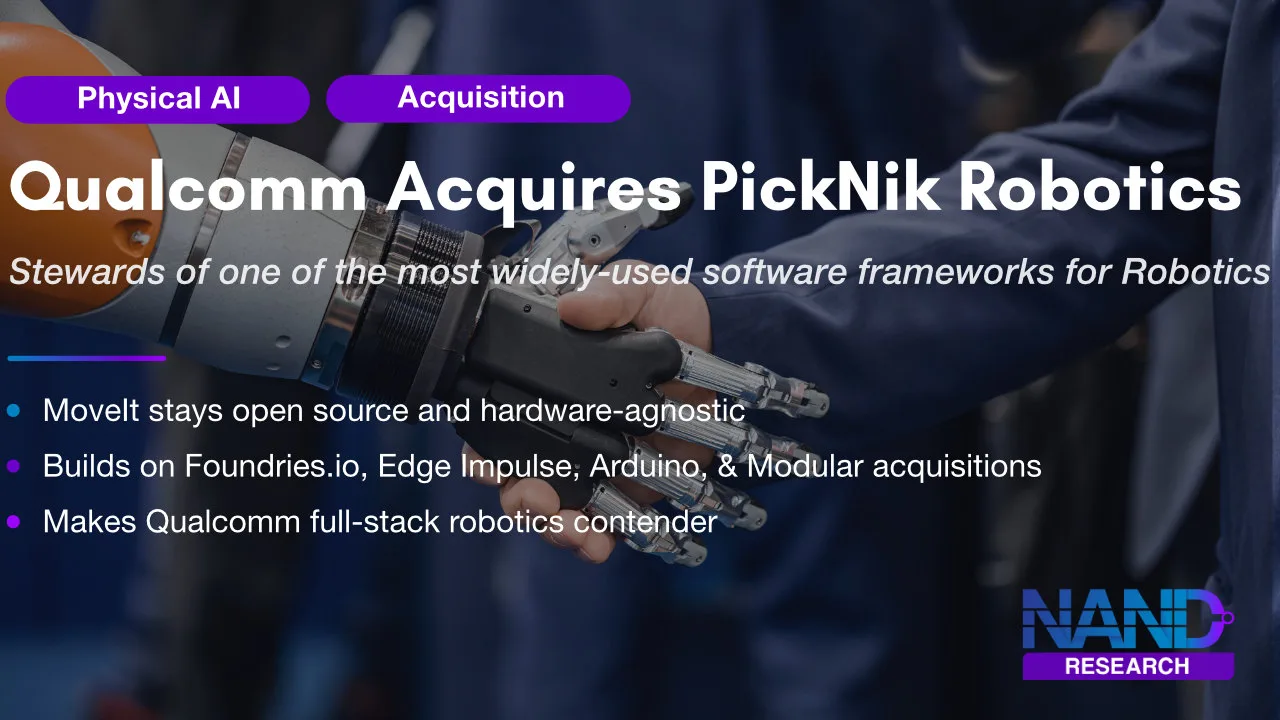
Qualcomm announced at ROSCon Toronto an agreement to acquire PickNik,the Boulder, Colorado-based company that stewards MoveIt, one of the most widely adopted open-source manipulation frameworks in the Robot Operating System (ROS) ecosystem.
The transaction is financially immaterial to Qualcomm but strategically significant. Qualcomm now targets $40 billion in non-handset revenue by fiscal 2029 and is assembling a full-stack physical AI platform through a steady series of targeted software acquisitions. PickNik is the piece that connects that stack to the physical act of manipulation.
Who Is PickNik?
PickNik Robotics was founded in 2015 by Dave Coleman, who interned on MoveIt at Willow Garage, the research lab that created ROS. After Willow Garage closed in 2014, Coleman formed PickNik to continue maintaining MoveIt. Dave Grant serves as CEO, with Coleman as founder and chief product officer.
The company’s early work included the Amazon Picking Challenge, and Google became its first customer.
PickNik funded much of its growth through non-dilutive government programs, accumulating more than $9 million in Small Business Innovation Research (SBIR) awards from NASA, the U.S. Space Force, and the Department of Defense.
PickNik began as a robotics services firm and has since shifted focus to products. The company describes MoveIt Pro as the “robotics equivalent of a game engine” such as Unity or Unreal.
Its business spans three offerings.
- MoveIt (open source): A ROS-based framework for motion planning, manipulation, perception, and kinematics, used by researchers, students, and commercial robot builders in industrial automation, service robotics, and mobile manipulation. PickNik is one of its primary maintainers and a founding member of the Open Source Robotics Alliance (OSRA), which governs ROS and related projects.
- MoveIt Pro (commercial): Launched in 2021 as MoveIt Studio and renamed in 2024, MoveIt Pro adds a visual behavior-tree builder, a production-grade runtime engine, physics-based simulation for digital twins, force-compliant and real-time controllers, whole-body control for mobile manipulators, and reference applications for bin picking, door opening, pick-and-place, peg-in-hole insertion, and visual servoing.
- Professional services and support: Engineering services covering integration, deployment, optimization, and long-term sustainment for business-critical robotic deployments.
MoveIt Pro 9.0, released in April 2026, added perception-to-motion capabilities and a redesigned teleoperation and training data collection system with integrated collision checking, multi-arm support, and coordinated mobile manipulation control.
The teleoperation work carries strategic weight because demonstration data is the raw material for training vision-language-action (VLA) policies, which PickNik now supports alongside classical planning.
Its customer base extends into aerospace, including a partnership with Motiv Space Systems to develop software for NASA’s Fly Foundational Robotics mission.
Deal Details
Qualcomm is structuring the acquisition to preserve MoveIt’s community standing while making Dragonwing the best-supported target for PickNik’s software.
The company’s public commitments are specific and set the benchmarks against which the developer community will judge Qualcomm after close:
- Open-source continuity: MoveIt remains open source under its existing license with community-driven roadmaps and open resources.
- Hardware neutrality: Qualcomm will continue to support MoveIt on third-party hardware, preserving the framework’s hardware-agnostic design.
- Dragonwing integration: MoveIt, MoveIt Pro, and future PickNik technologies receive first-class, optimized support on Dragonwing robotics platforms, enabling a path from VLA and vision-language models (VLMs) to planning, manipulation, and real-time control across Qualcomm’s heterogeneous CPU, GPU, and NPU compute.
- Arduino integration: MoveIt integration begins with the Arduino VENTUNO Q, a board based on the Dragonwing IQ-8275 processor, delivering up to 40 TOPS of dense NPU performance, paired with an STM32H5 real-time microcontroller, 16GB of LPDDR5 memory, and native ROS 2 compatibility (pre-orders for the VENTUNO Q opened in August 2026).
- Open-source governance: Qualcomm and PickNik are founding members of OSRA, and Qualcomm will continue to drive Space ROS, a hardened ROS distribution for mission-critical applications.
Qualcomm and PickNik are demonstrating MoveIt Pro on the VENTUNO Q and Dragonwing platforms at ROSCon this week.
Qualcomm has not disclosed post-close pricing or licensing changes for MoveIt Pro.
Strategic Rationale
Diversification Beyond the Handset
Qualcomm’s acquisition strategy follows directly from the pressure on its core business. In fiscal Q3 2026, which ended June 28, total revenue declined 4% year over year to $9.95 billion. Handset revenue fell 20% to $5.09 billion amid industry-wide memory supply constraints, and Qualcomm expects Apple-related revenue to decline sharply.
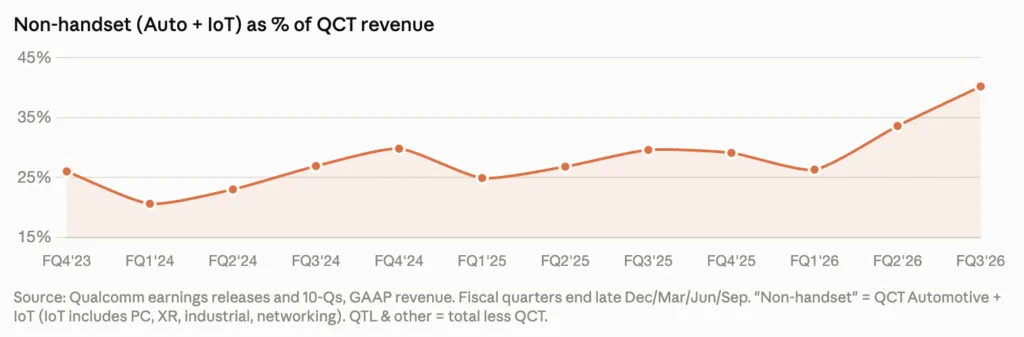
Its non-handset businesses offset much of that weakness:
- Automotive revenue reached a record $1.59 billion, up 61%.
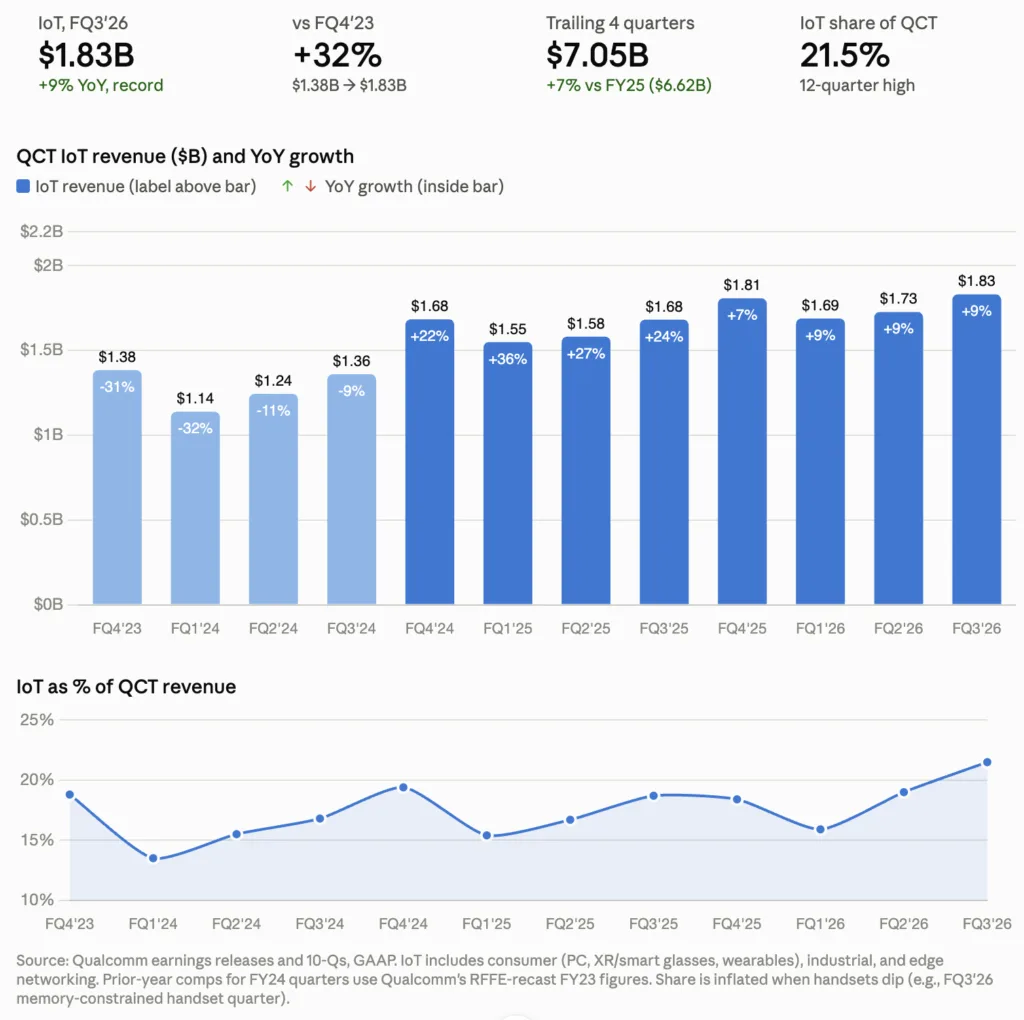
- IoT revenue grew 9% to $1.83 billion, with Qualcomm citing industrial, networking, and robotics as the drivers.
- Combined automotive and IoT revenue grew 28%.
At its June 2026 Investor Day, Qualcomm raised its fiscal 2029 non-handset revenue target to $40 billion, nearly double the $22 billion goal it set in November 2024. The new target includes:
- More than $15 billion from data center.
- $10 billion from automotive.
- More than $14 billion from IoT
- Qualcomm projects that handsets will account for only about one-third of chip revenue by fiscal 2029.
Qualcomm also named robotics and industrial AI as part of what it calls the next wave of physical AI. PickNik is a direct investment against that stated priority.
IoT and Physical AI
IoT is Qualcomm’s largest non-handset business today, and physical AI is the highest-growth opportunity inside it. Qualcomm consolidated its industrial and embedded IoT portfolio under the Dragonwing brand in February 2025, and at CES 2026 it introduced a full robotics architecture anchored by the Dragonwing IQ10, its premium processor for industrial autonomous mobile robots (AMRs) and full-size humanoids.
On its fiscal Q3 call, Qualcomm reported an industrial design-win pipeline exceeding $7 billion, with more than $3.5 billion in wins secured this fiscal year, and a channel presence spanning more than 38,000 customers.
Robotics suits Qualcomm’s engineering heritage. Robots are power-constrained, often battery-operated systems that need heterogeneous compute, on-device AI, wireless connectivity, functional safety, and long product lifecycles. These are the same requirements Qualcomm has addressed for its two decades in smartphones and, more recently, in automotive.
The obstacle has been software. Robot builders select compute platforms based on where their software stack already runs, and the ROS and MoveIt community has built its habits around x86 workstations and NVIDIA Jetson modules.
Owning MoveIt’s steward gives Qualcomm a direct role in making Dragonwing the lowest-friction target for that community.
Building the Stack Through Acquisition
PickNik is the latest in a sequence of acquisitions Qualcomm has used to assemble a software and developer platform around its silicon. The table below summarizes the deals most relevant to its IoT, robotics, and AI strategy
| Acquisition | Timing | Domain | Role in Qualcomm’s Stack |
| Foundries.io | March 2024 | Embedded Linux and device lifecycle | Secure OS builds, over-the-air updates, and fleet management for deployed devices |
| Edge Impulse | March 2025 | Edge MLOps | Data collection, model training, optimization, and deployment to edge targets |
| MovianAI | April 2025 | Generative AI research | AI research team led by former Google DeepMind researcher Hung Bui |
| Arduino | October 2025 | Developer platform and boards | 33 million+ active users, UNO Q and VENTUNO Q boards, Arduino App Lab |
| Augentix, Focus.AI | Completed by January 2026 | Vision silicon and video analytics | Camera SoCs and edge video event processing for industrial vision |
| Modular | Announced June 2026, closed July 2026 | AI compilers and inference runtime | Mojo language, MAX inference engine, and Modular Cloud across CPUs, GPUs, NPUs, and custom silicon |
| PickNik | September 2026 | Robot motion planning and control | MoveIt and MoveIt Pro for manipulation, planning, and real-time control |
Arduino gives Qualcomm the top of the developer funnel, and PickNik now provides Arduino’s robotics users with a professional-grade manipulation stack that scales from a classroom board to a production humanoid, all built on the same Dragonwing architecture.
Modular is the most consequential precedent. Most commentary talked aabout Modular in the context of Qualcomm’s data center ambitions and NVIDIA’s CUDA moat, and that framing continues to hold.
Qualcomm has also explicitly scoped Modular’s platform to edge infrastructure and to personal and industrial AI (reiterated at this week’s Snapdragon Summit 2026), and that scope matters for robotics.
A robot running a VLA policy needs an efficient runtime to execute the model on heterogeneous silicon, and it needs a planning and control layer to act safely on the model’s output. Modular covers the first requirement, and PickNik covers the second.
Taken together, the acquisitions produce a vertically integrated physical AI stack that runs from Dragonwing and Arduino silicon, through Foundries.io for the operating system and fleet management, Edge Impulse for data and MLOps, and Modular for model execution, to PickNik for motion planning and control.
Every deal so far has followed the same playbook. Qualcomm buys an asset with developer trust, commits to keeping it open and multi-vendor, and then makes its own silicon the best-optimized target.
The approach has held so far, and it gives Qualcomm a credible open alternative to NVIDIA’s vertically integrated robotics platform.
Analysis
The PickNik deal extends Qualcomm’s transition from component supplier to platform provider for physical AI. Qualcomm now controls meaningful assets at each layer a robot builder touches, from development boards and production processors to MLOps, inference runtimes, and motion planning.
Few competitors offer that breadth with an open, multi-vendor posture, and the approach aligns Qualcomm’s IoT strategy with the developer-first thinking behind its Snapdragon PC and data center efforts.
This carries several risks that investors and customers should weigh:
- Timing of robotics revenue: Humanoid and advanced AMR volumes remain small, and IoT grew 9% last quarter, while the fiscal 2029 target requires sustained acceleration. Robotics is a long-duration bet within a three-year target.
- Integration load: Qualcomm has acquired roughly a dozen companies in less than three years, several of them small, community-centric organizations whose value depends on retaining key engineers and maintaining cultural credibility.
- Credibility of openness commitments: Qualcomm’s record with Arduino, Edge Impulse, and Foundries.io has so far matched its promises. A misstep with MoveIt, a framework embedded in thousands of research and commercial projects, would draw fast and visible backlash from the ROS community.
The technical substance of the deal supports the strategy. Each acquisition addresses a specific gap, and the combined stack maps cleanly to the way robots are built, trained, and deployed.
The open question is execution speed relative to a competitor that already ships a tightly integrated alternative.
Practitioner Impact
The acquisition affects robotics software developers, system integrators, robot OEMs, and academic researchers who rely on MoveIt. For most of this audience, the near-term change is modest because MoveIt remains open and hardware-agnostic.
The longer-term effects focus on developers who adopt Dragonwing or Arduino hardware and on the sustainability of MoveIt itself:
- Project sustainability: MoveIt has relied heavily on a single small company for maintenance. Qualcomm’s backing removes the risk that the framework stalls if PickNik’s business falters, a concern for any team building a product on it.
- Shorter porting effort on Qualcomm hardware: Optimized MoveIt support on Dragonwing reduces the integration work required to run planning and perception on Qualcomm NPUs and GPUs, an area where developers have historically faced less mature tooling than on Jetson platforms.
- Prototype-to-production continuity: Teams can prototype on a VENTUNO Q using ROS 2 and MoveIt, then transition to Dragonwing IQ9 or IQ10 production hardware on a common architecture.
- Roadmap neutrality risk: Commercial MoveIt Pro features will likely receive Dragonwing optimizations first. Teams using NVIDIA hardware, including users of NVIDIA’s cuMotion planner, which integrates with MoveIt 2, should monitor whether upstream contributions remain balanced across platforms.
Teams evaluating Dragonwing for robotics should directly validate toolchain maturity, driver support, and long-term software maintenance commitments, since the integration work announced today has not yet shipped.
Competitive Landscape
NVIDIA is the reference competitor in robotics compute and software. Its Jetson Thor platform, Isaac simulation and training tools, and Isaac ROS libraries form the most complete robotics stack on the market, and NVIDIA released Isaac ROS 5.0 this week.
Alphabet’s Intrinsic competes in the software layer, while robot OEMs, embedded processor vendors, and vertically integrated humanoid programs present other alternatives. T
he table below summarizes the competitive options:
| Alternative | Model / Approach | Key Strengths | Compared to Qualcomm + PickNik |
| NVIDIA Jetson Thor + Isaac | Vertically integrated silicon, simulation, training, and ROS acceleration libraries | Performance leadership, mature CUDA tooling, Omniverse and Isaac Sim for synthetic data | Stronger ecosystem and simulation today, with higher power and cost. Uses MoveIt via cuMotion, so it depends on MoveIt’s continued neutrality |
| Intrinsic (Alphabet) | Robot software platform (Flowstate), owner of Open Robotics’ former commercial arm since 2022 | Alphabet AI research, deep ROS community ties | Software-only, with no silicon or board-level distribution. Qualcomm now owns an equally central ROS asset |
| Mobileye + Mentee Robotics | Vertically integrated humanoid program ($900M acquisition, January 2026) | Automotive-grade perception and safety expertise | Builds toward a proprietary humanoid. Qualcomm sells to many robot builders and covers a broader market |
| Robot OEM stacks (FANUC, ABB, Yaskawa) | Proprietary controllers and programming environments | Installed base, industrial reliability, certification | Dominant in structured factory cells and weaker in unstructured, AI-driven manipulation, the segment MoveIt Pro targets |
| Embedded MCU/MPU vendors (NXP, Texas Instruments) | Industrial processors with partner software ecosystems | Long-lifecycle industrial relationships, real-time control | Strong at the control layer, with no owned manipulation framework or comparable AI inference stack |
Qualcomm’s differentiation is strongest in power efficiency, connectivity, Arduino’s reach into the developer funnel, and ownership of a neutral, widely deployed open-source manipulation framework.
Its differentiation is weakest in simulation and synthetic data generation, where NVIDIA’s Omniverse and Isaac Sim have no Qualcomm equivalent, and in the depth of accumulated robotics developer tooling on Jetson.
Ownership of MoveIt also creates a subtle dependency for NVIDIA because cuMotion integrates with a framework that Qualcomm now stewards, although Qualcomm’s neutrality commitments limit how much leverage that provides in practice.
Final Thoughts
Over the past three years, Qualcomm has pursued a disciplined, consistent acquisition strategy in IoT and AI software, and PickNik fits that pattern closely. The deal adds the one layer of the physical AI stack Qualcomm did not already own, arriving alongside the shipment of robotics hardware from the Arduino VENTUNO Q to the Dragonwing IQ10. It also brings a respected open-source steward into a company that has so far honored its openness commitments.
The Modular and PickNik deals together show where Qualcomm is heading. Modular gives Qualcomm a portable layer for running AI models, while PickNik gives it a trusted layer for turning those models into physical action.
With Arduino at the entry point and Dragonwing at the high end, Qualcomm now offers robot builders an open, end-to-end alternative to NVIDIA, ranging from a $44 development board to a full-size humanoid. It’s a strong portfolio.
Qualcomm’s diversification story has long rested on automotive and, more recently, the data center. With PickNik, it now has the software foundation to compete for the robots that will define the next phase of edge and physical AI.
The acquisition makes Qualcomm a full-stack contender in physical AI for the first time, making it one of the few major players that can offer robot builders an open, end-to-end alternative to NVIDIA’s proprietary Jetson and Isaac stack.
That’s a powerful position.