Dell Technologies has expanded its Dell AI Data Platform, the data foundation of the Dell AI Factory, with updates to orchestration, processing, storage, and services. The headline additions include a Unified Semantic Layer, an Enterprise Knowledge Graph, and topic-scoped Knowledge Agents, which give AI applications and agents a shared, governed understanding of enterprise data.
Dell pairs these with NVIDIA cuDF acceleration in its Data Processing Engine, multitenancy and security enhancements for PowerScale, an open-source S3 benchmarking tool, the general availability of Dell-managed PowerScale for Microsoft Azure, and new implementation services.
The announcements show Dell continuing to evolve up-the-stack from storage and data engines into the semantic and knowledge layer, a domain long held by cloud data platforms and data governance vendors.
Announcement Details
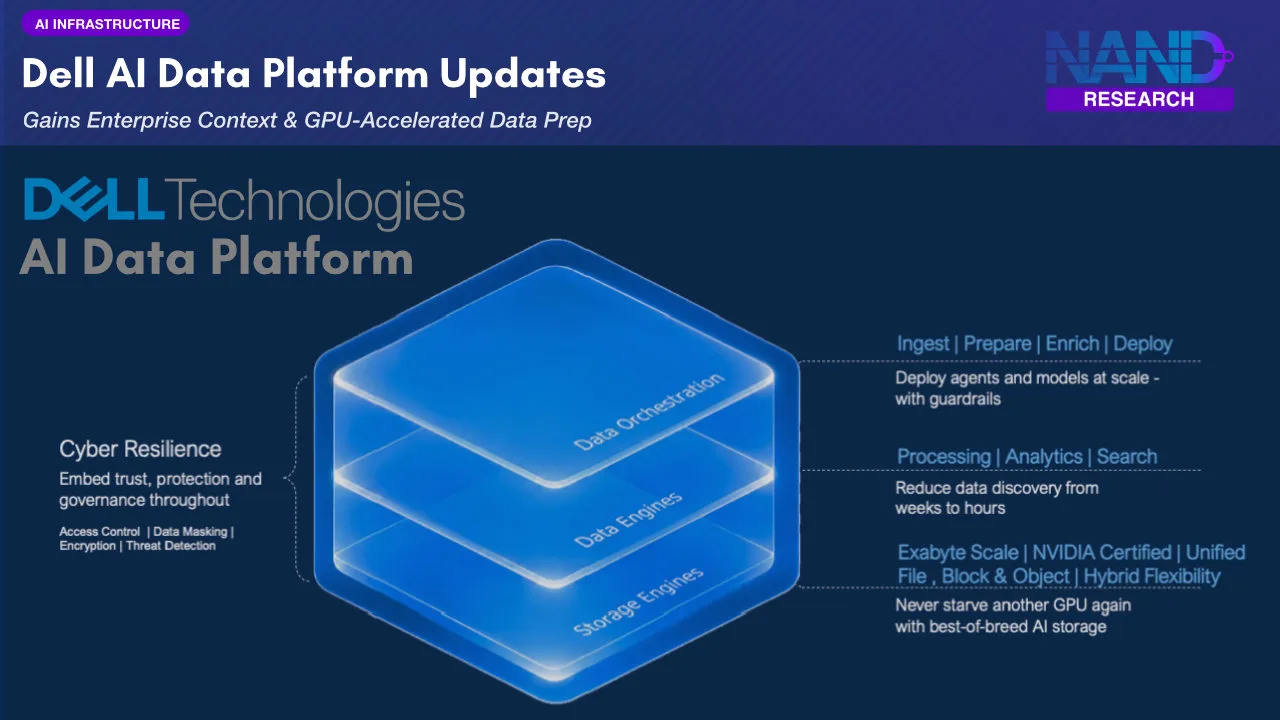
Dell’s AI Data Platform provides three layers, each protected by cyber-resilience controls:
- Storage Engines (PowerScale and ObjectScale) provide unified file, block, and object storage at exabyte scale, with NVIDIA certification.
- Data Engines handle processing, analytics, and search.
- Data Orchestration handles ingest, preparation, enrichment, and deployment of models and agents.
Access control, data masking, encryption and threat detection run across all three layers.
NVIDIA Nemotron Retriever models provide document parsing, embedding, and reranking, while NVIDIA cuVS accelerates vector indexing and search.
Enterprise Context for Agentic AI
The three new context capabilities live in the Dell Data Orchestration Engine and run inside the customer’s data center:
- Unified Semantic Layer: Applies consistent business definitions, rules, and a searchable glossary across structured and unstructured data, so that “client” in one system and “account” in another map to the same entity. Customers can import existing ontologies and classification taxonomies. Dell also enables NVIDIA Auto-Ontology, an open-source library that builds knowledge graphs from enterprise data.
- Enterprise Knowledge Graph: Maps relationships between structured and unstructured data using metadata, lineage, and query history, and retunes itself as usage changes. When an agent submits a query, the graph assembles the related tables, data products, multimodal data, and vector indexes the agent is permitted to access.
- Knowledge Agents: Topic-specific agents grounded in a defined slice of the knowledge graph. Customers set the guidance each agent follows, the data it can access, the quality threshold it must meet, and its spending limit. Nemotron Retriever models provide reasoning and visual understanding.
Dell’s approach promises fewer retrieval steps and tool calls, lower token consumption, and the ability to use smaller or locally hosted models.
Accelerated Data Preparation
Dell is adding GPU acceleration across all of its Data Engines. Processing uses NVIDIA cuDF with Apache Arrow (new), search uses cuVS, and analytics uses cuDF. Apache Arrow moves data between Dell storage and the processing engine, allowing jobs to query data in place.
Dell reports an average speedup of 3.9x across workloads and a peak of 20.4x on a batch data-mining workload. Both configurations used defaults with no tuning.
Storage, Benchmarking and Cloud
The storage updates address both shared-platform operators and buyers who are evaluating object storage for AI pipelines:
- PowerScale multitenancy and security: Support for up to 500 tenants in a single cluster, mTLS over NFS to encrypt and authenticate file traffic, and more granular, per-tenant role-based access control. The target is AI service providers and enterprises operating shared AI platforms.
- Dell Storage Performance Tool: An open-source tool on GitHub for benchmarking S3-compatible object storage across training, inference, and checkpointing patterns. It combines a CLI, an interactive UI, and a containerized engine, reports live throughput and latency, and verifies data persistence.
- PowerScale for Microsoft Azure, Dell Managed: A cloud-native PowerScale deployment on Azure infrastructure, now generally available as a fully managed Dell offer. Dell claims up to 4x the read throughput per namespace, 4x the namespace size and 2x the cluster resiliency of its closest competitor, which it does not name. The supporting analysis is dated August 2025.
Analysis
Dell continues its strategic move up the AI stack. The company has already built a broad AI infrastructure portfolio spanning servers, networking, storage, and data processing. Adding a semantic layer, an enterprise knowledge graph, and policy-bounded Knowledge Agents gives Dell a strong, credible story around one of enterprise AI’s harder problems: providing agents with trusted, governed context.
This matters because the value of enterprise AI increasingly depends less on raw access to data and more on whether applications understand what that data means, how it relates, and how to use it.
Dell’s approach is built around the idea that context built and governed on-premises, next to the data, is more trustworthy and cheaper to serve than context reconstructed per query or moved to a cloud platform:
- Data gravity and sovereignty: Keeping the semantic layer, knowledge graph, and agents in the customer data center aligns with requirements for regulated industries and sovereign AI, an area where Dell’s on-premises installed base is a genuine asset.
- NVIDIA alignment: Deep use of Nemotron Retriever, cuVS, cuDF, and Auto-Ontology strengthens Dell’s standing in the NVIDIA ecosystem. These components are available to all NVIDIA partners, which limits the differentiation Dell can claim.
- Services as a lever: The expanded implementation services directly address the curation and integration burden and leverage Dell’s scale in professional services.
Practitioner Impact
Data platform teams, AI engineering teams, and infrastructure operators will feel these announcements in different ways:
- The semantic layer and knowledge graph matter most to teams building retrieval and agent applications that keep failing due to inconsistent definitions across business units.
- The accelerated processing engine matters to data engineers running Spark preparation jobs that sit in front of every training and RAG pipeline.
The operational implications are significant :
- Curation effort: A semantic layer is only as good as the definitions it contains. Dell’s import of existing ontologies and NVIDIA Auto-Ontology reduce the initial effort, but reconciling definitions, such as the deck’s three-plant “defect” example, is an organizational task that requires data stewards and business owners.
- Integration scope: The knowledge graph’s value depends on how many enterprise sources it reaches. Dell has not detailed which connectors, catalogs, or existing semantic tools (dbt, Unity Catalog, Collibra, and similar) it integrates with, which determines whether this complements or duplicates investments customers have already made.
- GPU economics for data prep: The cuDF results use RTX PRO 4500 Blackwell GPUs, a cost-effective inference-class part. Teams should weigh GPU cost and power against the speedup on their own workloads, since a 3.9x average from untuned defaults leaves a wide range of possible outcomes.
- Shared platforms: PowerScale’s 500-tenant support and mTLS over NFS provide AI service providers and internal platform teams with a practical way to serve multiple groups from a single cluster while maintaining stronger isolation.
- Benchmarking: The Storage Performance Tool provides buyers with a repeatable way to test S3 performance on their own infrastructure. Results from a vendor-authored tool still warrant cross-checking against neutral benchmarks such as MLPerf Storage.
Competitive Landscape
Dell competes on two fronts with these announcements:
- Against storage and infrastructure vendors: Dell now offers one of the broadest data-layer roadmaps in the category.
- Against cloud data platforms: Dell enters a semantic and agent-context market those vendors already serve with production tools.
The table below summarizes the relevant alternatives.
| Alternative | Model / Approach | Strengths | Compar4d to Dell AIDP |
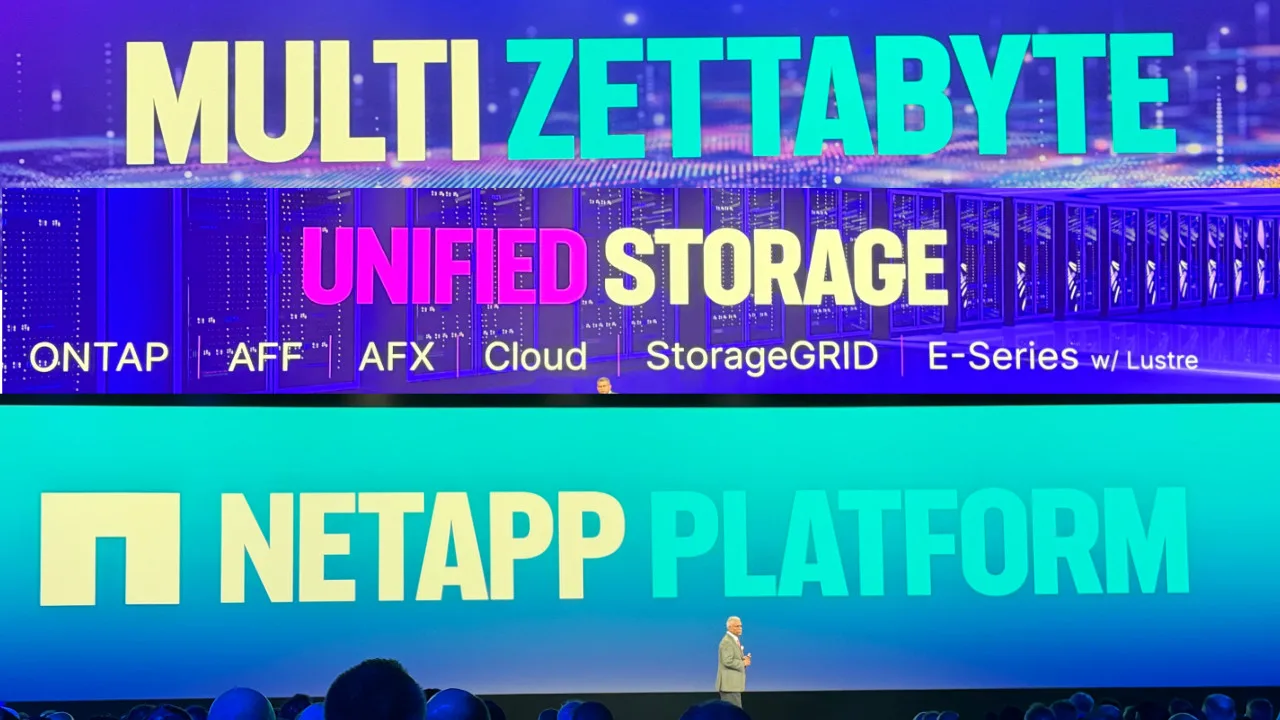
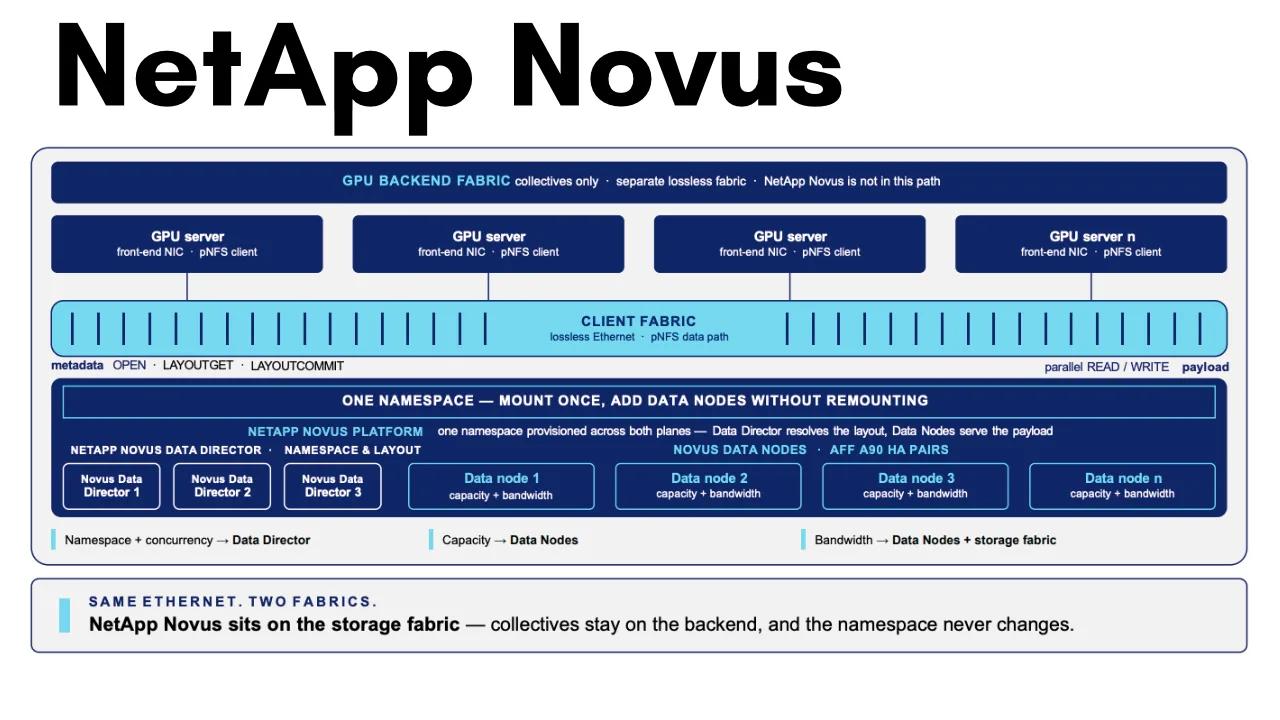
| NetApp (AFX, AI Data Engine) | Storage-integrated AI data services built on ONTAP, with metadata, search and vectorization close to the data | Large installed base, mature data management, strong hybrid cloud reach through first-party hyperscaler services | Closest storage-vendor analog. Dell now goes further up the stack with a semantic layer and knowledge graph, though Dell’s versions do not ship until 1H 2027 |
| VAST Data (AI OS, InsightEngine) | Unified storage, database and compute runtime with in-platform vector search and agent execution | Single-system architecture, strong traction with GPU clouds and large AI builders | VAST collapses more of the pipeline into one system today. Dell offers broader portfolio choice and services depth, with more components to integrate |
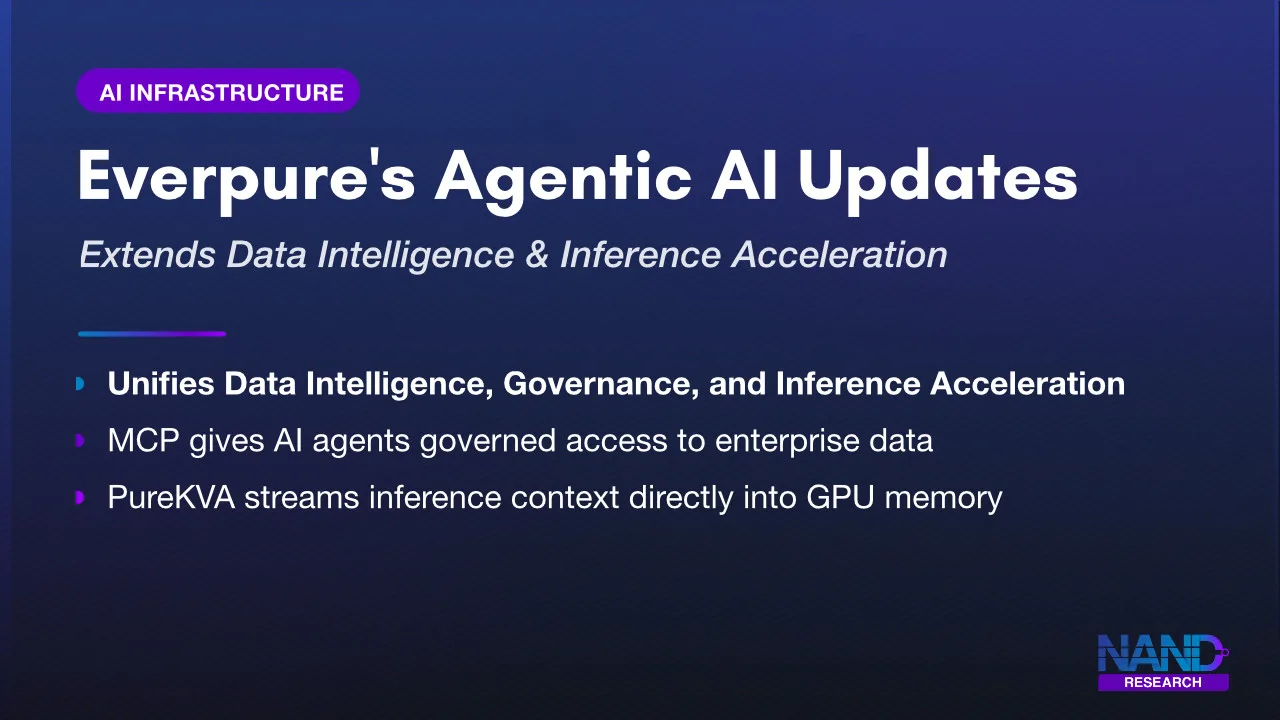
| Everpure (Enterprise Data Cloud) | Storage-as-a-service with fleet-level data management and AI-focused inference acceleration | Operational simplicity, Evergreen subscription model, strong flash economics | Pure emphasizes storage-layer efficiency and has less to say about semantics or business context. Dell holds a wider data-engine scope |
| HPE (Private Cloud AI, Alletra MP, Data Fabric) | Turnkey private AI stack co-engineered with NVIDIA, with a unified data fabric layer | Integrated full-stack offer, GreenLake consumption model | Similar NVIDIA-aligned full-stack positioning. Dell’s semantic and knowledge graph roadmap is more explicit about agent context |
| Databricks, Snowflake | Cloud data platforms with governance catalogs, semantic and metric layers, and native agent frameworks | Deep data-engineering mindshare, mature semantic and governance tooling in production today | These platforms own the semantic layer conversation today. Dell competes on on-premises data gravity, sovereignty and integrated infrastructure |
| Azure NetApp Files, Qumulo on Azure | Managed enterprise file services on Azure | First-party Azure integration (ANF), established cloud file presence | Relevant to PowerScale for Azure. Dell claims performance and namespace advantages over an unnamed competitor without independent validation |
Dell’s differentiation is strongest where on-premises data gravity, sovereignty requirements, and existing Dell infrastructure intersect. Few storage-centric competitors have articulated a semantic layer and a governed knowledge graph that run alongside the storage and processing engines.
Its differentiation is weakest against Databricks and Snowflake, whose semantic and governance tooling is already in production and sits in front of many of the same data sources.
Final Thoughts
The strongest part of Dell’s strategy is its alignment with data gravity. Enterprises with large on-premises estates, sovereignty requirements, or regulated data may prefer to build and govern AI context alongside the data rather than continuously move it to a cloud data platform.
A semantic layer, a lineage-aware knowledge graph, and policy-bounded agents, running alongside governed storage and GPU-accelerated data engines, provide a complete answer to the “agents keep rebuilding context” problem.
Dell can use its installed base, infrastructure portfolio, and services organization to make that approach attractive. Its reliance on NVIDIA technologies strengthens implementation. Dell’s advantage will come from how well it integrates semantics, metadata, storage, processing, governance, and services into a coherent operating environment.
For customers, the takeaway is that Dell now builds both the infrastructure where AI data lives and the layer that explains what that data means to agents. Enterprises with significant on-premises data estates and sovereignty constraints should include Dell’s context capabilities on their evaluation roadmap, as this gives the AI Factory a durable reason to anchor enterprise agent deployments on-premises.