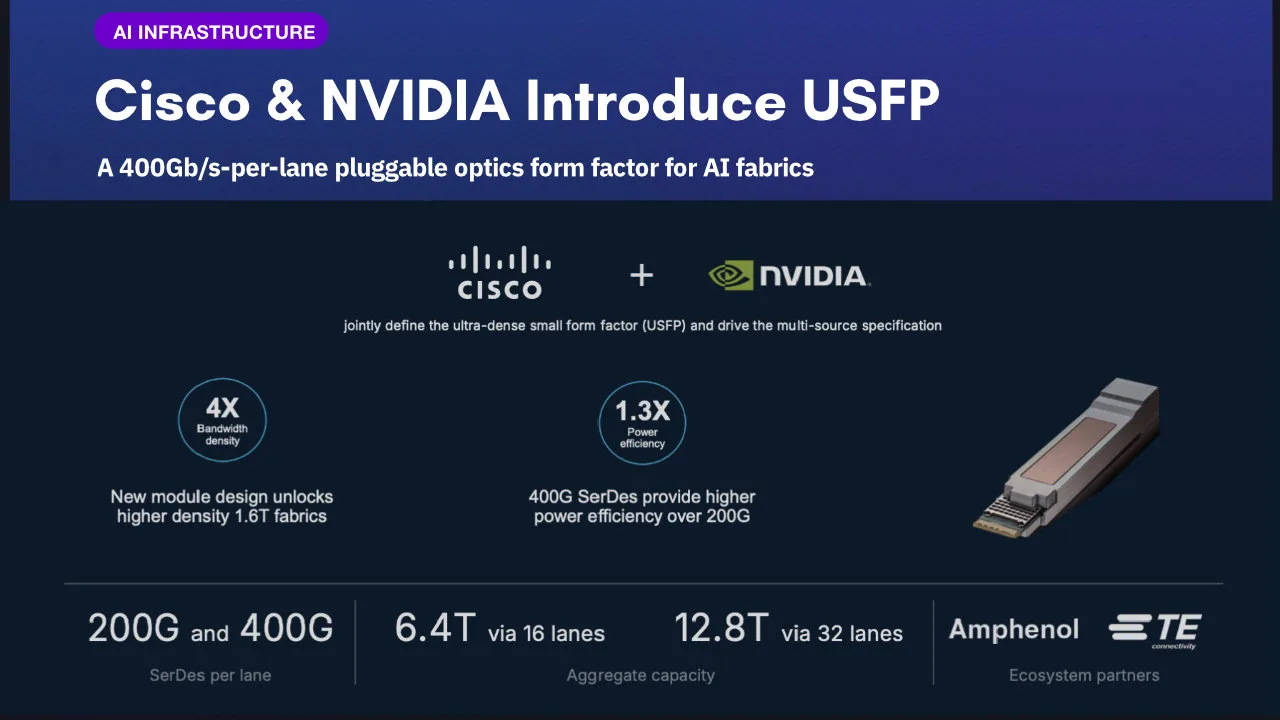
Cisco and NVIDIA introduced the Ultra-Dense Small Form Factor Pluggable (USFP) at the Open Compute Global Summit 2026. The new optical transceiver form factor supports 400Gb/s per electrical lane.
The initial design places 16 full-duplex lanes in a module roughly the size of today’s OSFP, yielding 6.4 Tb/s per module. A 32-lane variant delivers 12.8 Tb/s.
The two companies are collaborating with TE Connectivity and Amphenol on cages, connectors, and modules and plan to publish USFP as an open specification through a community-led multi-source agreement (MSA).
USFP addresses front-panel density, which has become the limiting factor in scaling AI fabrics. When a switch runs out of ports, operators add another network tier, along with the optics, power, and latency that come with it.
USFP provides switch and SuperNIC designers with a path to maintain the pluggable, field-replaceable operating model through the next SerDes generation.
NVIDIA and Cisco are two of the most influential suppliers of AI networking silicon and systems, and their joint backing makes USFP an immediate contender in a crowded field of next-generation form factors, already including the Arista-led XPO MSA, OSFP-XD, socketed optics under Open CPX, and co-packaged optics (CPO).
Technical Details
USFP doubles both the lane count and the per-lane rate of eight-lane 200Gb/s modules, such as the 1.6T OSFP. Making that jump practical within a pluggable package required changes to the connector, the thermal envelope, and the range of optical designs the module supports.
The announcement included the following specifications:
- Lane configurations: Initial modules carry 16 full-duplex lanes at 400Gb/s, totaling 6.4Tb/s, and a 32-lane configuration doubles that to 12.8Tb/s. Cisco describes these as two module flavors, x16 and x32.
- Density: The companies claim 4x the front-panel bandwidth density of 200Gb/s-per-lane pluggables, measured against a 1.6T OSFP module with a comparable footprint.
- Power efficiency: NVIDIA states that moving to 400G SerDes doubles per-lane bandwidth while increasing power by roughly 1.5x, resulting in the claimed 1.3x improvement in energy per bit. No independent measurement supports this figure yet.
- Connector: A new two-dimensional contact array uses a two-step insertion sequence in which the high-speed contacts engage only after the module is fully seated. The companies say this reduces contact wear, stabilizes insertion force, and improves signal integrity at 400Gb/s and 200Gb/s per lane.
- Thermal envelope: USFP supports up to 100W of module dissipation without an embedded cooling circuit in the transceiver and fits both air-cooled and liquid-cooled system designs.
- Optical flexibility: The format supports multiple optical technologies and reach classes, including designs that simplify signal processing to reduce latency and power.
- Targets: Ethernet AI fabrics, with modules intended for both switches and SuperNICs.
Several details remain open. The companies have not published Ethernet port mappings, optical modulation options, supported reach classes, or qualification methods.
Cisco paired the announcement with Silicon One updates, including:
- A 51.2Tb/s G302 top-of-rack ASIC built on 256 lanes of 200G SerDes
- Initial shipments of the 102.4Tb/s G300 in Cisco 8000 and Nexus 9000 systems.
NVIDIA’s Spectrum-6, which Meta is adopting for its Vera Rubin clusters, also operates at 200G per lane.
Neither company announced 400G-per-lane switch silicon at OCP, leaving USFP ahead of the silicon it is meant to serve.
Analysis
For Cisco, USFP strengthens its standing as an optics supplier for AI back-end networks, a segment where it has lagged Arista and NVIDIA in mindshare. Cisco’s optics business, including Acacia, provides module design and manufacturing depth that few switch vendors match. Pairing that depth with the Silicon One roadmap enables Cisco to tell a complete story from ASIC to optics.
Co-authoring a form factor with NVIDIA also extends the two companies’ existing interoperability work between Spectrum-X and Silicon One-based networks, already placing Cisco in NVIDIA reference architectures.
For NVIDIA, USFP serves as a hedge. NVIDIA has invested heavily in CPO through its Spectrum-X and Quantum-X Photonics switches, and USFP provides customers not yet ready for CPO with a pluggable path at the same lane rate.
Backing both models lets NVIDIA serve whichever deployment approach a customer prefers while keeping its own SerDes and NIC roadmap at the center of either option.
Practitioner Impact
For the hyperscalers, neoclouds, and sovereign cloud operators building large Ethernet AI fabrics, USFP preserves the operating model these teams already use. Teams can swap failed modules from the front panel, keep practices separate, and keep optics procurement separate from switch procurement.
CPO forces operators to rethink each of those practices, which is why many large operators remain cautious about CPO.
As USFP matures, practitioners should weigh several considerations:
- New hardware: USFP is mechanically and electrically distinct from OSFP and requires new switch and NIC designs. Neither company claims compatibility with existing OSFP ports.
- Thermal planning: A 100W ceiling per port across a dense faceplate creates chassis-level heat loads that will push most deployments toward liquid-cooled switches, even though the module itself does not require an internal cooling loop.
- Fiber management: Sixteen- and 32-lane modules increase fiber counts per port, adding pressure on cabling, connector selection, and patch-panel density.
- Timing: Without a sampling date, USFP serves as a planning input for the 400G-per-lane generation of fabrics that follows today’s 200G build-outs.
Competitive Impact
USFP enters a field already crowded with approaches to the same problem, each striking a different balance among density, serviceability, thermal envelope, and integration.
The most direct comparison is the XPO MSA, which Arista presented at Hot Interconnects. XPO aggregates 64 channels in a liquid-cooled module, reaching 12.8Tb/s at 200G per lane today with a roadmap to 25.6Tb/s at 400G per lane, and supports up to 500W per module with direct 50V power.
The table below summarizes the alternatives.
| Alternative | Backers | Model / Approach | Compared to USFP |
| USFP | NVIDIA, Cisco, TE Connectivity, Amphenol | Pluggable, 16 or 32 lanes at 400G, up to 100W with no embedded cooling circuit | Subject of this note. Specification in development, no availability date |
| OSFP (1.6T) | OSFP MSA | Eight-lane pluggable at 200G per lane | Installed-base standard for AI optics. USFP claims 4x its front-panel density |
| OSFP-XD | OSFP MSA | Sixteen-lane pluggable at 200G per lane, 3.2T | Matches initial USFP lane count at half the per-lane rate and requires dedicated cages |
| XPO | Arista-led MSA, with members including Semtech | 64-channel liquid-cooled pluggable, 12.8T at 200G, 25.6T at 400G, up to 500W | Higher per-module capacity and thermal budget, with liquid cooling built into the module |
| Open CPX | Ciena, Coherent, Marvell, Molex, Samtec, TeraHop, 80+ participants | Socketed optical engines near or on the ASIC package, 6.4T at 200G, 400G on roadmap | Moves optics closer to silicon for lower power while keeping engines replaceable, off the front panel |
| Co-packaged optics | NVIDIA, Broadcom | Optical engines integrated with the switch ASIC package | Lowest power per bit, at the cost of field-replaceable optics and tighter vendor coupling |
USFP’s differentiation is strongest in its thermal pragmatism and its sponsors. A 100W module without an embedded cooling loop fits more chassis designs than XPO’s liquid-cooled envelope, and NVIDIA and Cisco can drive demand through their own switches and NICs.
Differentiation is weakest in raw density, where XPO’s 25.6Tb/s roadmap exceeds USFP’s 12.8Tb/s ceiling, and in neutrality, where the OSFP and Open CPX groups draw from broader memberships.
Arista’s absence from USFP and NVIDIA’s and Cisco’s absence from XPO point to at least two rival 400G pluggable ecosystems competing for the same faceplates.
| Analyst Take USFP is the clearest signal yet that the pluggable model will carry into the 400G-per-lane generation. The open question is whether the industry consolidates on USFP or XPO, and that outcome will depend on which form factor the next wave of 400G switch silicon ships with. |
Final Thoughts
Cisco and NVIDIA identified the right problem. Front-panel density forces the addition of extra network tiers, and the pluggable model remains the operational preference among most large operators.
USFP’s two-step connector and 100W envelope, without internal cooling, are practical engineering solutions to the challenges of 400G-per-lane signaling, and enlisting TE Connectivity and Amphenol early addresses the component supply chain that every new form factor requires.
For customers, USFP gives operators a credible path to scale AI fabrics through the next SerDes generation without committing to co-packaged optics. For Cisco, co-authoring that path with NVIDIA places it at the center of physical-layer decisions shaping the next generation of AI networks.