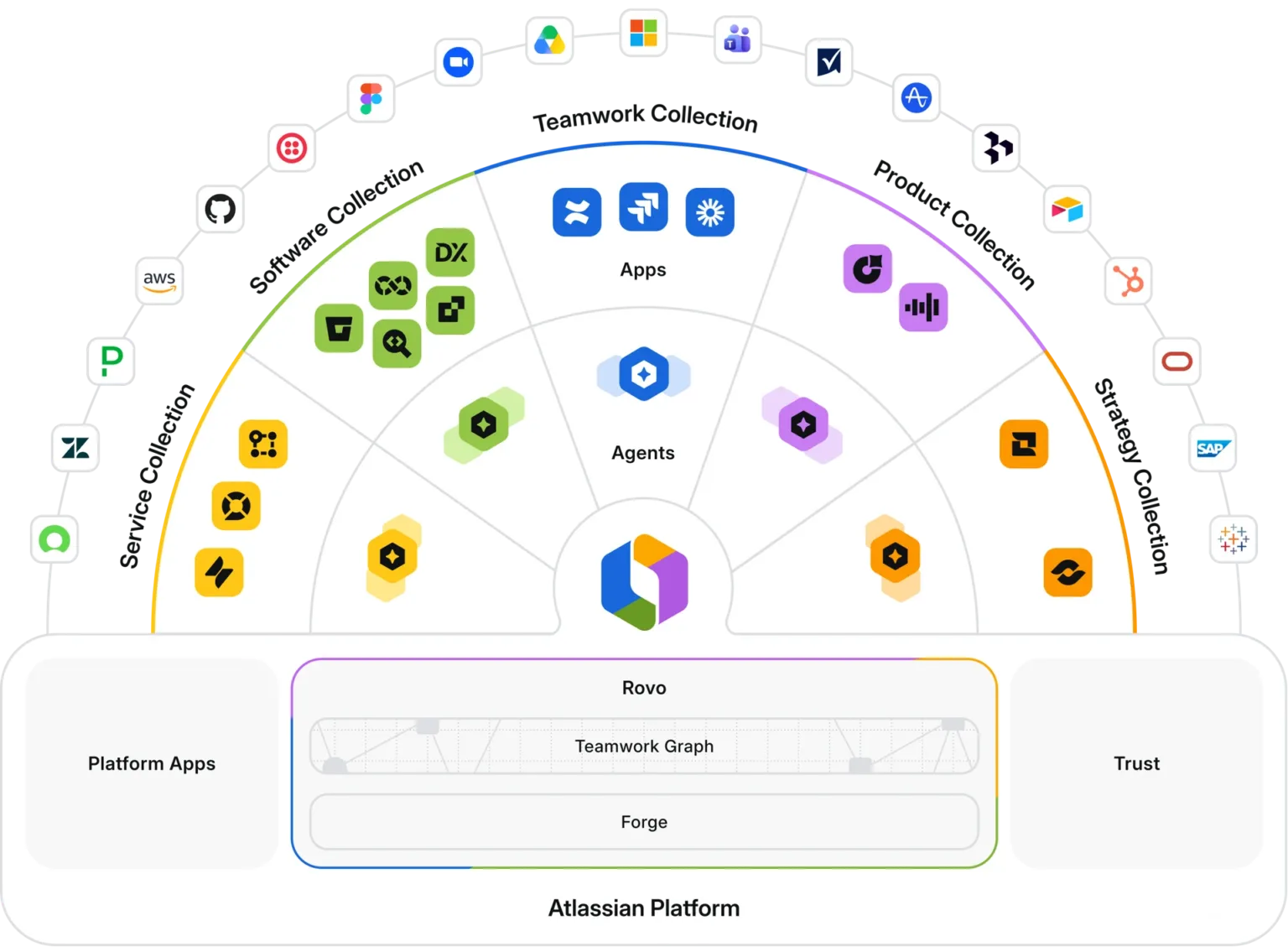
Atlassian made a broad set of announcements at its recent Team ’26 Europe conference impacting nearly every product in its portoflio, including:
- Teamwork Collection updated with a broad set of new capabilities.
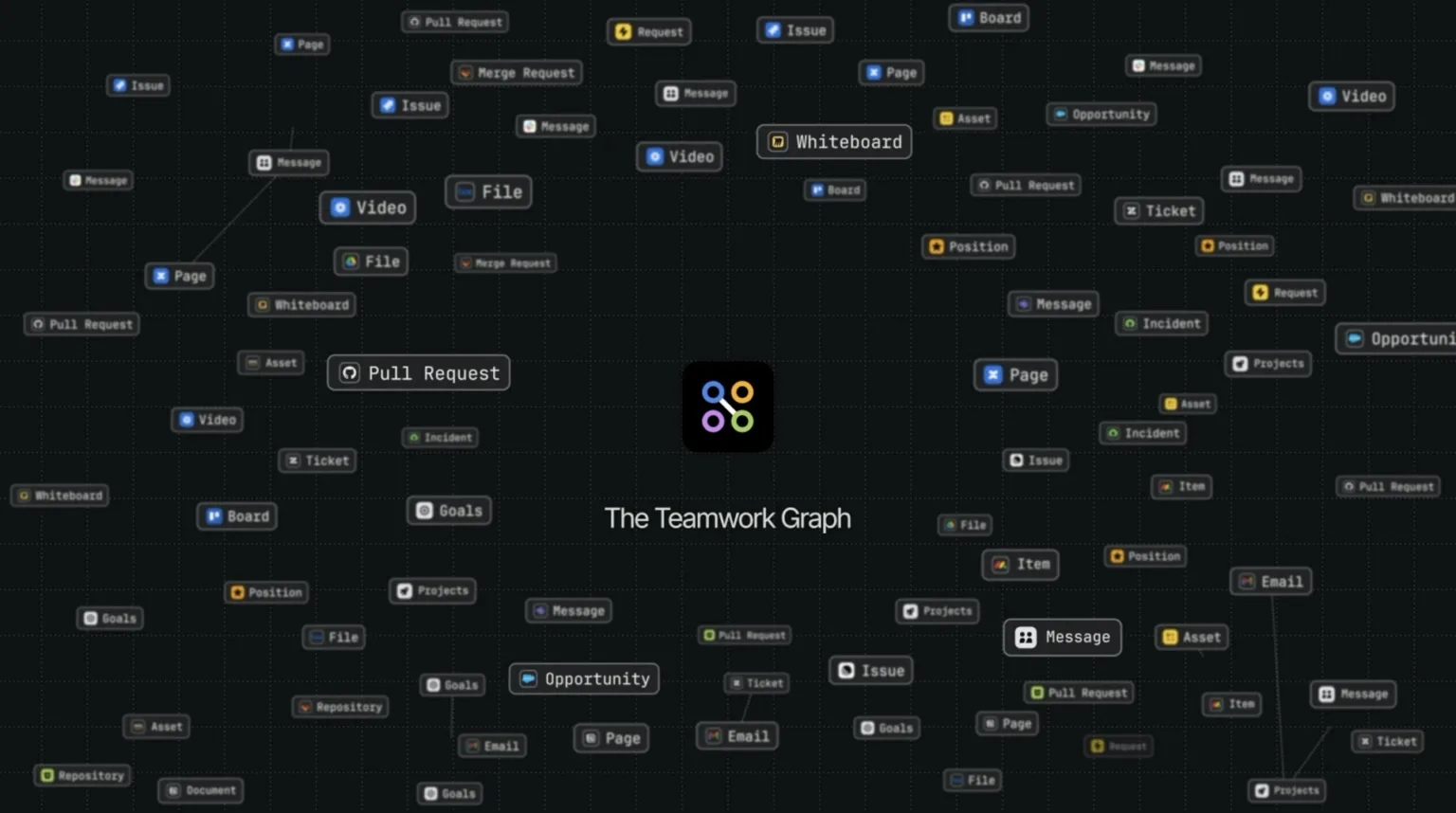
- Teamwork Graph gains new context.
- A rebuilt Atlassian MCP server.
- An expanded set of capabilities for AI-native software delivery.
- New capabilities in Service Collection for IT and operations teams.
- New governance and data-locality controls aimed directly at European buyers.
- Atlassian is opening its platform to third-party agents from OpenAI, Anthropic, Cursor, Cognition, and others
- Introduced Agent Multiplayer Protocol (which we cover in a separate Research Brief)
The underlying theme across all the announcements is to make the Teamwork Graph the context and governance layer on which enterprise agentic AI relies.
Announcement Details
Teamwork Graph and Context
According to Atlassian, the Teamwork Graph now includes more than 250 billion connected objects across seven context types, powered by more than 80 connectors.
The additions at Team ’26 Europe extend the graph to include source code and structured business data, two areas that previously lay outside the graph:
- Code context (open beta): Indexes connected Bitbucket and GitHub repositories down to the file, symbol, class, and function levels, combining lexical and semantic search. A new Rovo Code Search app exposes this to engineers, and the same context is available to coding agents via MCP and the CLI.
- Data context and Atlassian Insights: Structured data becomes a native Teamwork Graph context type. Atlassian Insights, which succeeds Atlassian Analytics, curates more than 20 structured data sources, including Databricks, Snowflake, Tableau, and BigQuery, and provides catalog, glossary, and lineage. A phased rollout to paid Cloud customers begins after the event.
- Connectors: New connectors include Zoom, Gong, Microsoft Entra ID, and Google Identity, along with more than 65 improvements to existing connectors. Third-party folders in Confluence now sync content from SaaS sources, such as Google Drive.
- Agent sessions as context: Agent sessions are indexed in the graph and distilled into reusable session memory, so subsequent agent runs in the same area start with prior findings.
Rovo Work, Artifacts, and Collaboration Surfaces
Rovo Work is a new mode in Rovo Chat for complex, multi-step tasks. The user states a goal; Rovo proposes a plan for approval; and execution then proceeds across Jira, Confluence, and connected tools within a cloud sandbox governed by administrators.
Several related capabilities support the same collaboration model:
- Artifacts app (beta, all paid plans): Provides a permanent, permission-controlled URL for AI-generated pages, prototypes, calculators, and HTML views from any AI tool. These URLs are embeddable in Confluence pages, Jira work items, and Slack, and each artifact is indexed back into the graph.
- Rovo clients: A rebuilt native Rovo desktop app, a new Rovo mobile app, and chats that users can schedule, pin, and share with permission.
- Workflow integration: A Jira app for Slack and Microsoft Teams routes chat threads to agents or people as tracked work, and third-party agent triggers let external events, such as a Salesforce status change, start agent workflows in Jira and Confluence.
- Loom: AI overlays (early access) add generated titles, highlights, and motion graphics to recordings.
Atlassian MCP Server and Third-Party Agents
Atlassian rebuilt its MCP server from the ground up, expanding it from dozens to more than 200 tools that cover nearly every Atlassian app, including custom Forge apps and Marketplace apps. Atlassian says the new server uses up to 25% fewer tokens for equivalent Jira and Confluence work (based on internal benchmarking of Claude models).
Access is governed by Atlassian Guard and per-toolset administrator permissions, and every tool call is logged in the audit log.
Atlassian paired the server with broader support for external coding agents and a new OpenAI partnership:
- Third-party coding agents: Cognition’s Devin, Factory, and Warp are available on the Atlassian Marketplace, with OpenAI Codex coming soon. Teams can assign a work item to an agent, invoke an agent via an “@mention” in a comment, or trigger an agent via a Jira automation with human approval checkpoints.
- OpenAI partnership: The partnership adds OpenAI’s frontier models to the model mix powering Rovo and connects ChatGPT and Codex to the Teamwork Graph via the Atlassian plugin and MCP. Atlassian reports that more than 3,000 of its own developers use Codex through ChatGPT Enterprise. Deeper integrations for autonomous agents that pick up work items and sync local session history remain on the roadmap.
AI-Native Software Development
Atlassian framed its engineering announcements around an AI SDLC playbook, citing its 2026 study, which found that 94% of engineering leaders said their teams use AI, while only 6% said they have the systems to scale and govern it.
The new capabilities span planning, design, development, review, and measurement across the stages of release:
- Planner (private early access): Turns a prompt into a structured Confluence spec by asking clarifying questions, then breaks the approved plan into sequenced Jira work items with acceptance criteria for people or agents.
- Record for Agent (open beta): Converts a narrated Loom screen recording, including click tracking and on-screen annotations, into a structured brief for a coding agent to act on.
- Agent Sessions (closed EAP): Links local IDE and terminal sessions, as well as cloud agent sessions, to Jira work items in real time, with a team-wide view filtered by session status (needing input, ready for review, or complete). Untracked sessions can be dragged onto a board to create a populated work item.
- Interactive PR Reviews with Loom (closed EAP): Generates narrated walkthroughs of Bitbucket pull requests that explain the change, key files, and the risks reviewers should consider.
- DX AI Measurement (GA): Connects AI usage to throughput, quality, and adoption outcomes; benchmarks AI ROI against anonymized peer groups; and scores individual agent sessions on requirements clarity, human steering, scope, context quality, and model fit.
Service Collection
The Service Collection updates target IT and operations teams via Jira Service Management and include a mix of generally available and early-stage capabilities:
- Solution Composer (open beta): builds a configured service desk, including request types, workflows, SLAs, and portals, from a natural-language description.
- Workforce Management in JSM (GA) unifies scheduling, real-time availability, capacity, and skill-based routing.
- AI Change Risk Assessment workflows (GA): score proposed changes across business, technical, operational, compliance, and financial factors using Teamwork Graph context, and recommend mitigations.
- Proactive Service Management (closed EAP): monitors endpoint device health and remediates or routes issues before users submit tickets.
- Hardware Asset Management module: adds physical IT assets to JSM and supports discovery through Atlassian, Flexera, and Lansweeper. A separate Flexera agreement brings Technopedia data into JSM and Assets.
- Service and operations context where you work (closed EAP): lets agents run incident investigations and request resolutions from Slack, Microsoft Teams, or Claude while respecting JSM permissions.
Governance, Data Locality, and Pricing
Atlassian paired the agent announcements with controls over data exposure, agent identity, and processing location, along with billing changes that take effect later this year:
- Atlassian Guard Premium: Adds full-site historical scanning, real-time scanning of content and attachments, and guardrails across Rovo Chat and connected tools.
- Agent accounts and non-human identity inventory (“soon”): Provides every agent, app, and service account, whether from Atlassian or a third party, with a managed identity that administrators can inventory and revoke from a single place.
- EU AI inference (“rolling out”): Restricts LLM processing to models hosted within the EU. Atlassian also cited alignment with the EU AI Act and ISO 42001 for Rovo.
- Strategy Collection: AI Capital Management, which reports AI spend by model provider, department, and initiative, is in open beta. Agentic updates in Focus provide portfolio-level progress and risk summaries.
- Pricing: Overage billing for Rovo credits begins on December 3, 2026, at a list price of $0.01 per credit. Atlassian’s documentation indicates that extra usage is enabled by default.
Analysis
Atlassian’s strategy treats foundation models as rented intelligence and places durable value on enterprise context and governance. The Team ’26 Europe announcements extend that thesis from Atlassian’s own agents to others’ agents, recasting Jira as a record of the work performed by agents and people, as well as the work teams planned.
The direction builds on the Forge migration, which moved Marketplace apps into Atlassian’s governed runtime, and on usage-based pricing, which enables Atlassian to charge for work performed without a seat.
Practitioner Impact
The near-term value for practitioners lies in the capabilities already in production, namely the rebuilt MCP server, DX AI Measurement, Workforce Management, AI change risk workflows, and Guard Premium scanning.
There are several practical considerations to keep in mind before fully exploiting the new capabilities:
- Data locality conflicts: EU AI inference keeps prompts and model processing in Europe, while code context stores indexed code in the United States and automatically enables it for paid Bitbucket workspaces connected to Rovo. Regulated European organizations will need to reconcile these two before enabling code search.
- Cost predictability: Credit overage billing begins on December 3. Atlassian has not disclosed how credits are consumed by long-running Work tasks or whether administrators can cap a single task. Organizations should set usage limits before then.
- Permission hygiene and content quality: Rovo surfaces only what a user can already access, so overly broad grants become retrieval paths for agents. Session memory compounds stale or conflicting content with accurate content, making space cleanup and permission reviews direct inputs into agent quality.
- Attribution gaps: Rovo Work runs under the launching user’s identity, so agent actions appear as human actions until dedicated agent accounts are available.
Competitive Landscape
Atlassian competes at several layers at once:
- Microsoft contends for the enterprise context and identity plane.
- ServiceNow for service and operations workflow.
- GitLab for the software delivery pipeline.
- A set of AI-native vendors for the context layer and lightweight team workflow.
The table below summarizes the principal alternatives.
| Alternative | Model / Approach | Primary Overlap | Compared to Atlassian |
| Microsoft (Microsoft 365 Copilot, GitHub Copilot, Azure DevOps) | Productivity suite and developer platform with Copilot agents grounded in Microsoft Graph and Entra ID | Enterprise context layer, coding agents, agent identity | Far larger distribution and ownership of the identity plane. Atlassian holds deeper structure around plans, work items, and service workflows, and now ingests Entra ID as a Teamwork Graph connector. |
| ServiceNow | Single workflow platform with CMDB, AI agents, and centralized agent governance | ITSM, change risk, asset management, agent oversight | Stronger incumbency in large-enterprise ITSM and CMDB depth. Atlassian counters with developer-to-operations integration, faster setup through Solution Composer, and lower cost of entry. |
| GitLab (Duo Agent Platform) | Single DevSecOps application with integrated source control, CI/CD, security, and agents | Agent-driven SDLC, code context, review automation | GitLab owns the code and pipeline in one product. Atlassian code context covers Bitbucket and GitHub today, with GitLab support still pending. |
| Glean | Application-neutral enterprise search and agent platform built on a broad connector library | Cross-application context for agents | Glean is vendor-neutral by design. The Teamwork Graph carries native work structure and write actions inside Jira and Confluence, which Glean reaches only through connectors. |
| Linear, Notion | Lightweight planning and documentation tools with embedded AI agents | Planning, specs, agent assignment of work | Faster, simpler experiences favored by startups and product teams. Neither matches Atlassian breadth in service management, portfolio planning, or enterprise governance. |
Atlassian’s differentiation is strongest where planning, code, documentation, and service workflows intersect, a combination no single competitor matches today, and where cross-vendor agent attribution and governance are critical.
It is weakest at the identity layer, where Microsoft controls Entra ID and Atlassian’s own agent accounts have yet to ship, and in large-enterprise ITSM, where ServiceNow’s CMDB depth and incumbency remain difficult to displace.
Context-layer specialists such as Glean also pose a challenge because customers who standardize on a neutral search and agent platform may treat the Teamwork Graph as just one source among many.
Final Thoughts
Team ’26 Europe delivered a consistent, credible platform story. Atlassian has expanded the Teamwork Graph into code and structured data, shipped a substantially more capable MCP server, opened Jira to the coding agents developers already use, and added DX-based measurement to help engineering leaders assess whether AI spend produces results.
The OpenAI partnership and EU inference strengthen both the multi-model and European elements of the pitch.
For customers, the core takeaway is that Atlassian’s value in agentic work now depends on the quality of the context and controls each organization brings to the platform. Atlassian is building a system in which every vendor’s agents record, coordinate, and account for their work. Enterprises that invest now in permissions, content hygiene, and spend controls will capture the returns others pay for with credits.