Everpure (formerly Pure Storage) recently announced ActiveCluster for file, extending its synchronous replication and continuous availability capabilities from block storage to file workloads. The company sees this capability as a foundational component of its Enterprise Data Cloud strategy, with general availability planned for Q2 2026.
The core problem that ActiveCluster for File addresses is the inflexibility of traditional file-resilience architectures. Legacy approaches typically bind data protection to specific controller pairs, require manual intervention for failovers and migrations, and create data silos that complicate AI and analytics workloads requiring access to unstructured data.
At the same time, organizations face growing pressure to modernize these architectures due to new AI workloads that require higher throughput from file storage and more frequent multi-site operations. ActiveCluster addresses this need.
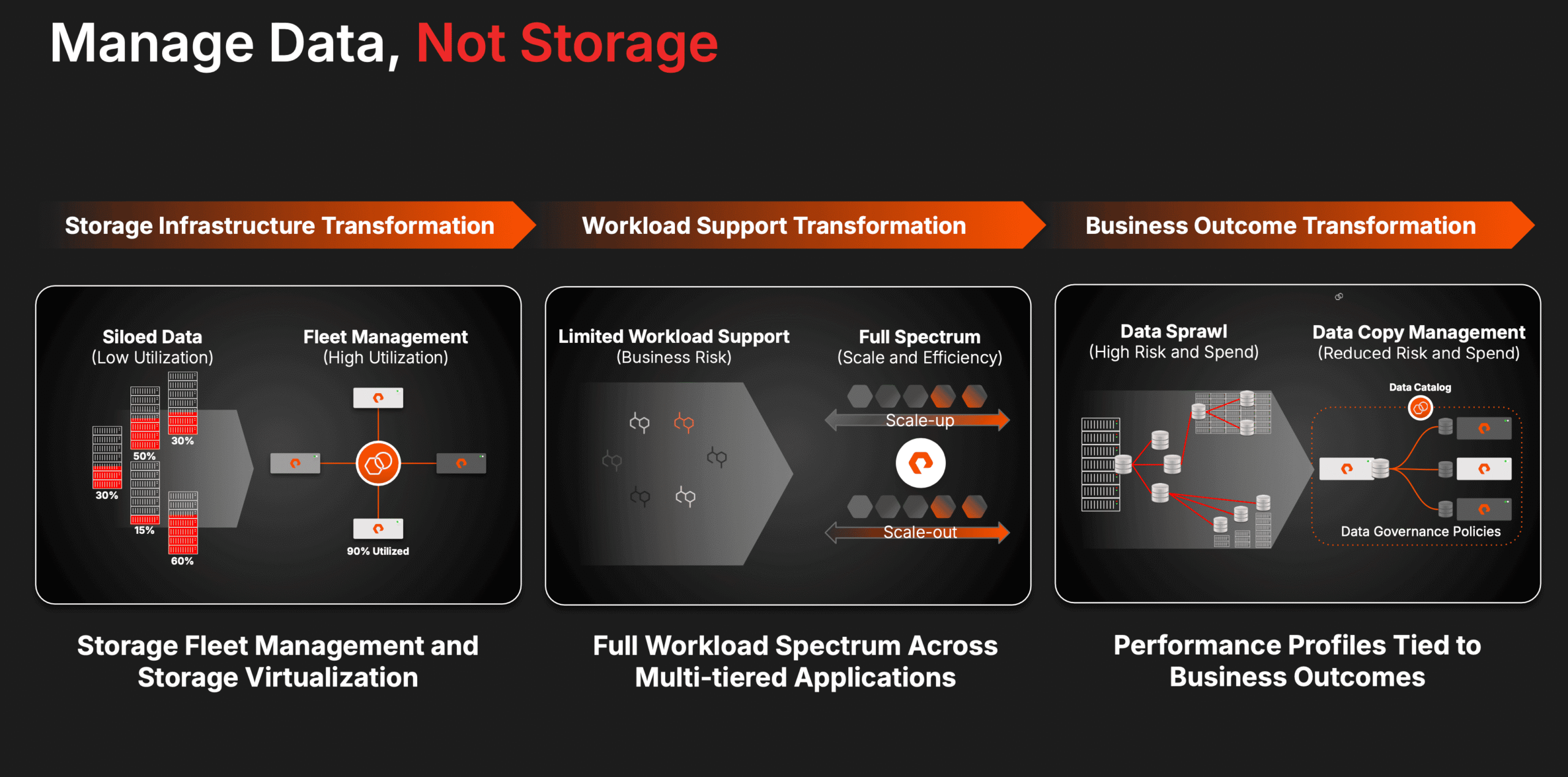
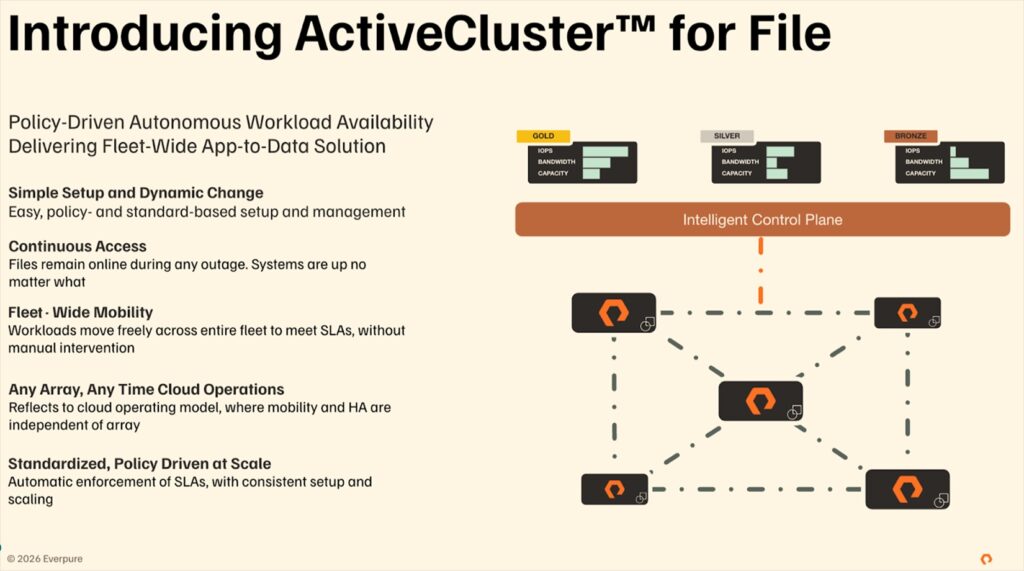
ActiveCluster for File integrates with Everpure Fusion, the company’s orchestration layer, to enable policy-driven data mobility across its FlashArray and FlashBlade fleet. Rather than requiring dedicated hardware pairs for continuous availability, the capability treats the entire storage fleet as an available resource pool.
Everpure says this approach delivers zero-recovery-point-objective (RPO) protection with automatic failover while reducing the administrative overhead associated with traditional stretched-cluster configurations.
Technical Details
ActiveCluster for File is an extension of Everpure’s existing block-focused synchronous replication capabilities. Its architecture centers on several core components that work together to deliver continuous access and policy-based mobility.
Architecture and Integration
The capability operates as a native data service within Purity, Everpure’s storage operating environment. This native integration enables tighter coordination among data protection, performance optimization, and fleet-wide management functions.
Key characteristics include:
- Synchronous replication with writes committed at both sites before acknowledgment, enabling zero RPO protection (contingent on network connectivity between sites)
- Global namespace presenting a single, consistent view of data to users and applications, regardless of which site is active
- Integration with Everpure Fusion for centralized policy definition and automatic enforcement across the storage fleet
- SMB file lock and lease coordination that transfers session state during failover events
Policy-Based Operations
A key characteristic is the declarative approach to availability and mobility. Instead of configuring protection at the individual array level, administrators set SLAs within Everpure Fusion. These policies specify requirements like RPO targets, target sites, and performance parameters. The control plane then automatically provisions and manages replication relationships to achieve those objectives.
This model unlocks several practical operational patterns:
- Organization-wide policy enforcement without per-array configuration
- Workload-level SLA definition aligned to applications, tenants, or organizational realms
- Automatic adjustment of data placement as policies change or conditions evolve
- Non-disruptive mobility between arrays without manual mount/remount coordination
SMB Continuous Availability
Everpure’s ActiveCluster for File manages SMB file locks and leases on the active array and transfers that state during failover events. This retention of session state allows applications to keep their file handles and I/O behavior through failover instead of needing to reconnect.
During planned maintenance windows, the platform shifts I/O without requiring users to remount shares or modify path configurations. For unplanned disruptions, failover occurs automatically with the same file paths remaining valid throughout the event.
Deployment and Hardware Requirements
ActiveCluster for File will be delivered as a non-disruptive upgrade through the Purity operating environment. Everpure states that no new hardware is required and no downtime is needed to enable the capability. This software-based delivery aligns with the company’s Evergreen subscription model, which focuses on continuous capability delivery rather than hardware-driven upgrades.
The capability supports deployment across geographically dispersed sites. However, like any synchronous replication technology, practical deployment distances will depend on network latency tolerances and the specific RPO/performance needs of protected workloads.
Organizations should understand that zero RPO guarantees assume continuous network connectivity; split-brain scenarios and network partitions require careful planning.
Analysis
For storage administrators and infrastructure teams, ActiveCluster for file shifts the operational model from hardware-centric configuration to SLA-governed management. The practical implications span several areas:
- Centralized policy management through Everpure Fusion reduces the need to configure and maintain per-array replication relationships
- Automatic failover reduces the operational burden during both planned maintenance and unplanned outages
- Non-disruptive upgrades and mobility eliminate scheduled downtime for many common administrative tasks
The timing of the release aligns well with enterprise demand for more flexible unstructured data management as AI workloads increase. Organizations dealing with GPU underutilization caused by storage throughput issues or facing complex data mobility needs will find the value compelling.
Overall, ActiveCluster for File is a natural progression of Everpure’s platform strategy, introducing proven synchronous replication ideas from block storage to file workloads. Its policy-driven approach and Everpure Fusion integration set it apart from traditional file resilience architectures, solving real operational challenges for organizations managing distributed file systems.