Everpure (formerly Pure Storage) used its recent financial analyst meeting to explain how it plans to grow beyond the enterprise storage array business that defined its first 17 years.
Management built its growth story around four vectors that it’s named Core and Core AI, Modern Data Software, Scale AI, Hyperscale Solutions.
The last three now roll up into a new revenue category that Everpure expects to account for roughly 20% of total revenue by fiscal 2030, with annual disclosures starting from a fiscal 2027 baseline.
Everpure paired that strategy with a preliminary fiscal 2028 outlook that beat financial analysts’ expectations:
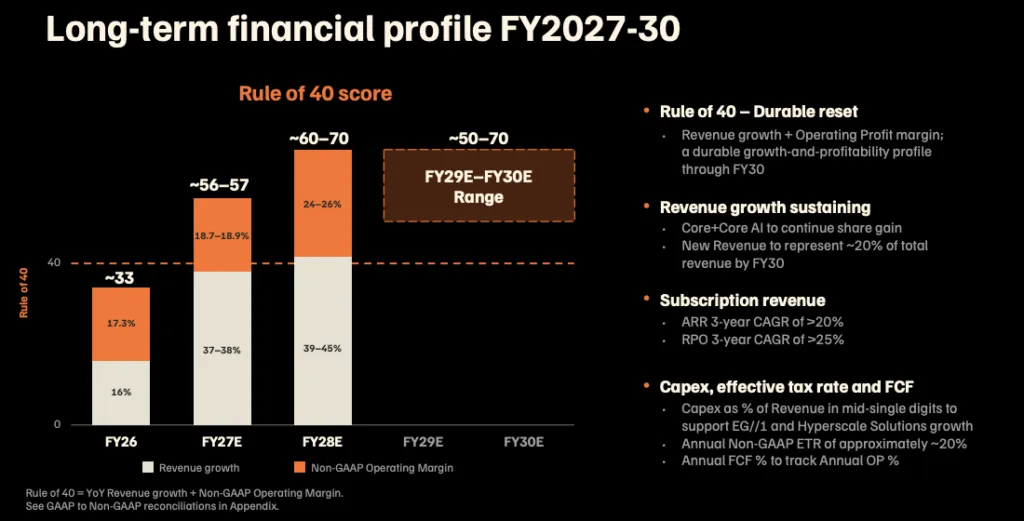
- $7.0 billion to $7.3 billion in revenue, or 39% to 45% growth,
- $1.7 billion to $1.9 billion in operating income, which implies a 24% to 26% operating margin.
- Reaffirmed fiscal 2027 guidance of roughly $5.05 billion in revenue and $950 million in operating income at the midpoint.
The event attaches numbers and a market-sizing framework to Everpure’s transition, which began in February with its rebrand and its acquisition of the data intelligence company 1touch.
Everpure argues that a single software foundation built on Purity and DirectFlash lets it enter data management software, neocloud-scale AI storage, and hyperscaler flash infrastructure without fragmenting its R&D or sales organization.
It’s a coherent strategy that plays to Pure’s overall strengths. Its success, however, depends on selling to buyers and competing against competitors who sit well outside the storage administrator relationships that built the company.
Details
Everpure reported that more than 95% of its R&D spend goes to software, that trailing-twelve-month GAAP R&D now exceeds $1 billion, and that non-GAAP R&D runs at about 19% of revenue. The company claims this makes it the largest R&D investor in its segment by absolute dollars and credits that investment with enabling a single codebase to serve four distinct markets.
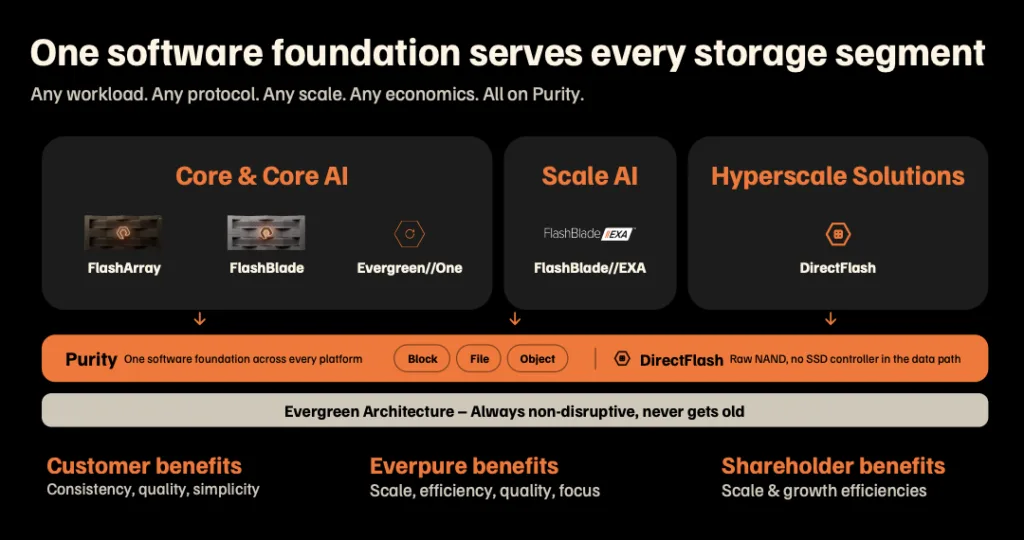
The company is building its growth strategy around four vectors that all share a common software stack.
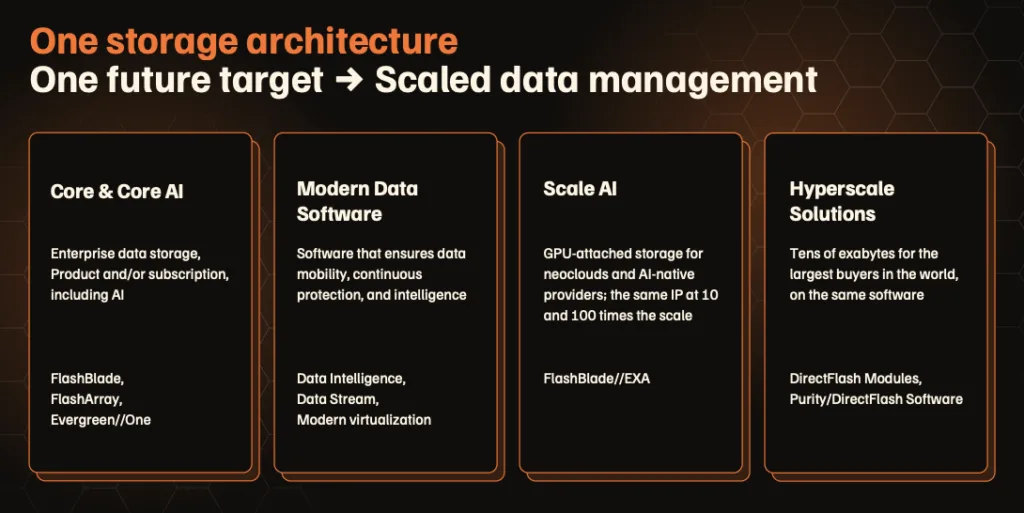
Let’s look at each of those vectors.
Core and Core AI
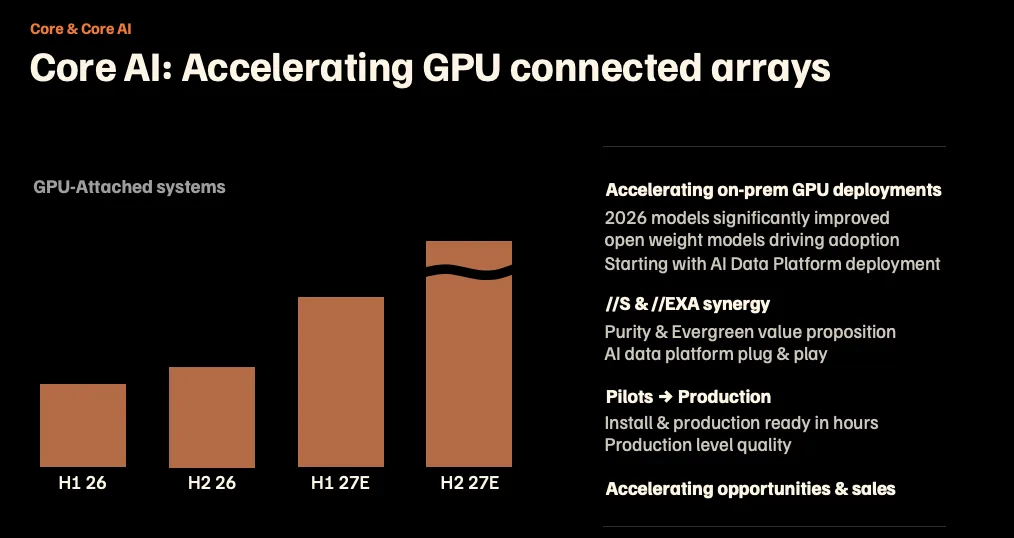
The core segment covers FlashArray, FlashBlade, and the Evergreen//One storage-as-a-service offering, and it now includes enterprise systems attached directly to GPUs.
Everpure presented unit shipments of GPU-attached systems, a metric that removes the effect of price increases, showing a sharp acceleration beginning in early calendar 2026. Giancarlo attributes the inflection to open-weight models reaching a quality level at which enterprises can justify running inference on their own infrastructure.
Everpure expects the underlying enterprise storage market to accelerate to a 12% CAGR, reaching $79 billion by fiscal 2030.
Pure’s core offering rests on several capabilities:
- FlashBlade//S and FlashBlade//EXA run the same software, so an enterprise AI project can start on S-class systems and scale to EXA-class systems without a platform change.
- Evergreen, non-disruptive upgrades eliminate hardware refresh cycles, which Everpure credits with high retention and with denying competitors refresh-driven sales openings.
- Fusion, the intelligent control plane, manages arrays as a policy-governed fleet within the Enterprise Data Cloud architecture.
- Evergreen//One contracts, which Everpure says are on track to surpass a $1 billion annualized TCV run rate, give the company control over the configurations and margins for each SLA.
Modern Data Software
This vector represents the most significant departure from Everpure’s historical approach. The company intends to sell software that operates on customer data wherever it resides, including competitor storage, SaaS applications, and public cloud.
Giancarlo framed the opportunity around a thesis he calls data primacy, arguing that decades of application-centric architecture have left enterprises with many conflicting sources of truth that AI agents cannot reconcile without explicit context.
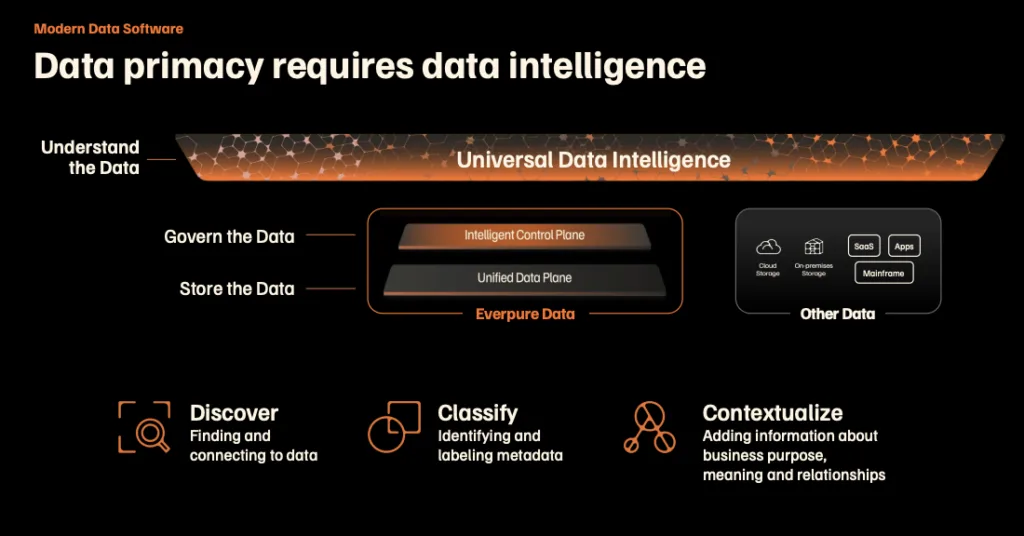
The portfolio includes the following components.
- Everpure Data Intelligence: built on the 1touch acquisition that closed in May 2026, discovers, catalogs, and classifies data across sources, adds semantic context, and supports data security posture management.
- Data Stream: built on the NVIDIA AI Data Platform reference design, automates ingestion, vectorization, and delivery of data to RAG and inference systems while preserving security controls from source data through to vectors.
- Portworx: provides Kubernetes data management and supports virtualization modernization for customers moving VM workloads onto container platforms.
- Everpure Cloud: evolves Cloud Block Store into a managed service that, together with Portworx, spans on-premises environments and multiple public clouds.
Scale AI
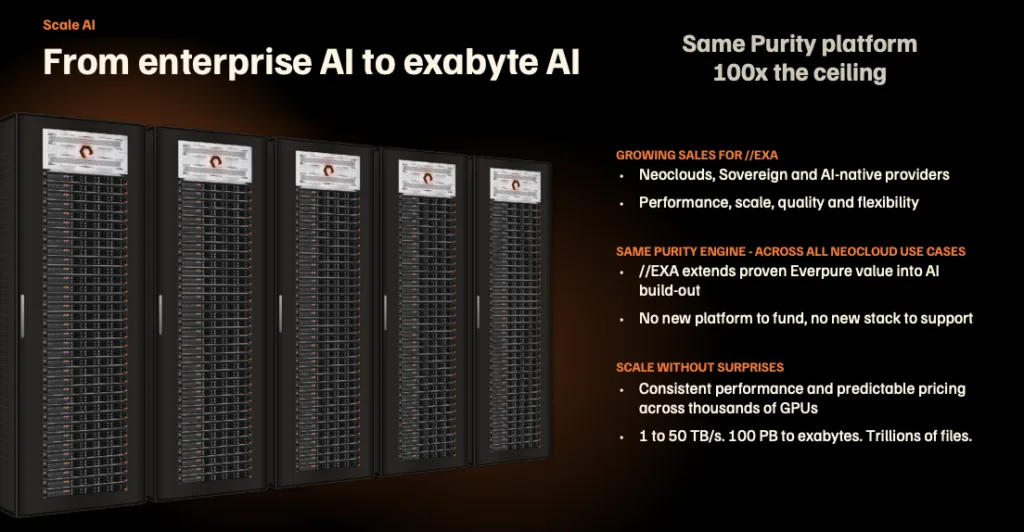
Scale AI targets neoclouds, frontier model builders, and other large AI operators with FlashBlade//EXA. EXA decouples metadata and data services so each can scale independently, and it pairs FlashBlade software with a more open hardware platform.
The company also said that its latest MLPerf Storage submission ranked first across all categories and configurations, with checkpoint throughput scaling linearly as the test configuration expanded from 10 to 30 nodes.
In most neocloud deals, the customer procures hardware through its own supply chain, making Scale AI primarily a software sale.
Hyperscale Solutions
Hyperscale Solutions brings DirectFlash into hyperscaler storage tiers, with Everpure software managing raw NAND at the host level in user space beneath the hyperscaler’s own distributed storage software.
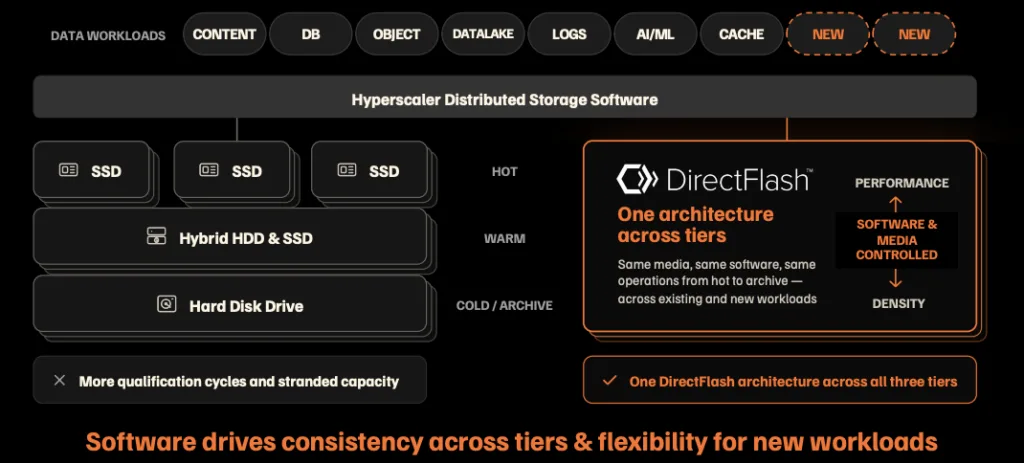
Everpure said that the integration requires minimal change to that software layer, and that only operators with their own storage software stacks qualify for the offering.
The company claims the following advantages over conventional SSDs at hyperscale:
- Twice the media lifetime and up to a 5x reduction in physical footprint.
- Reliability improvements of 2x to 5x in hyperscale environments, compared with the 10x figure Everpure cites for enterprise deployments.
- A single architecture that serves hot, warm, and cold tiers through software and media configuration, with the eventual goal of replacing both hard drives and SSDs.
- Multi-vendor NAND qualification is handled by Everpure, drawing on long-standing co-engineering relationships with suppliers such as Kioxia.
Hyperscale revenue consists of software licenses plus non-NAND components, all reported within product revenue, and CFO Robbiati guided investors to assume a 75% to 85% gross margin for the category.
Everpure has two hyperscaler customers, reports firm commitments through fiscal 2028, and says its penetration of each customer’s storage estate remains low.
Market Sizing and Financial Framework
Robbiati presented a total addressable market that grows from $108 billion to $207 billion over the forecast period, and a serviceable all-flash market that doubles from $34 billion in fiscal 2026 to $69 billion in fiscal 2030.
The table below summarizes Everpure’s fiscal 2030 estimates for each vector and the competitors’ management named (all figures are company estimates):
| Growth Vector | FY2030 TAM (Everpure est.) | Growth | Key Competitors |
| Core and Core AI | $79 billion | 12% CAGR | Dell, NetApp, HPE, IBM |
| Hyperscale Solutions | $97 billion | 22% CAGR, from $44 billion today | In-house hyperscaler designs, SSD and HDD suppliers |
| Modern Data Software | $22 billion | 26% CAGR | NetApp, Dell, Veeam, Cohesity, IBM, Databricks |
| Scale AI | $9 billion | Nearly doubles | VAST Data, DDN, WEKA |
Beyond fiscal 2028, Everpure expects to operate between 50 and 70 on the Rule of 40, up from 33 in fiscal 2026. The framework assumes ARR growth above 20% and remaining performance obligation growth above 25% annually, capital expenditures in the mid-single digits as a percentage of revenue, and a non-GAAP effective tax rate near 20%. Capital allocation priorities, in order, are organic investment, tuck-in M&A, and share repurchases.
Analysis
The investor day delivered Everpure’s most comprehensive articulation of its expansion strategy and provided investors with a framework for tracking it.
The single-architecture approach carries real weight. Maintaining a single Purity codebase across enterprise arrays, neocloud systems, and hyperscaler deployments gives Everpure engineering leverage that multi-platform competitors cannot easily replicate without restructuring their R&D and margin profiles.
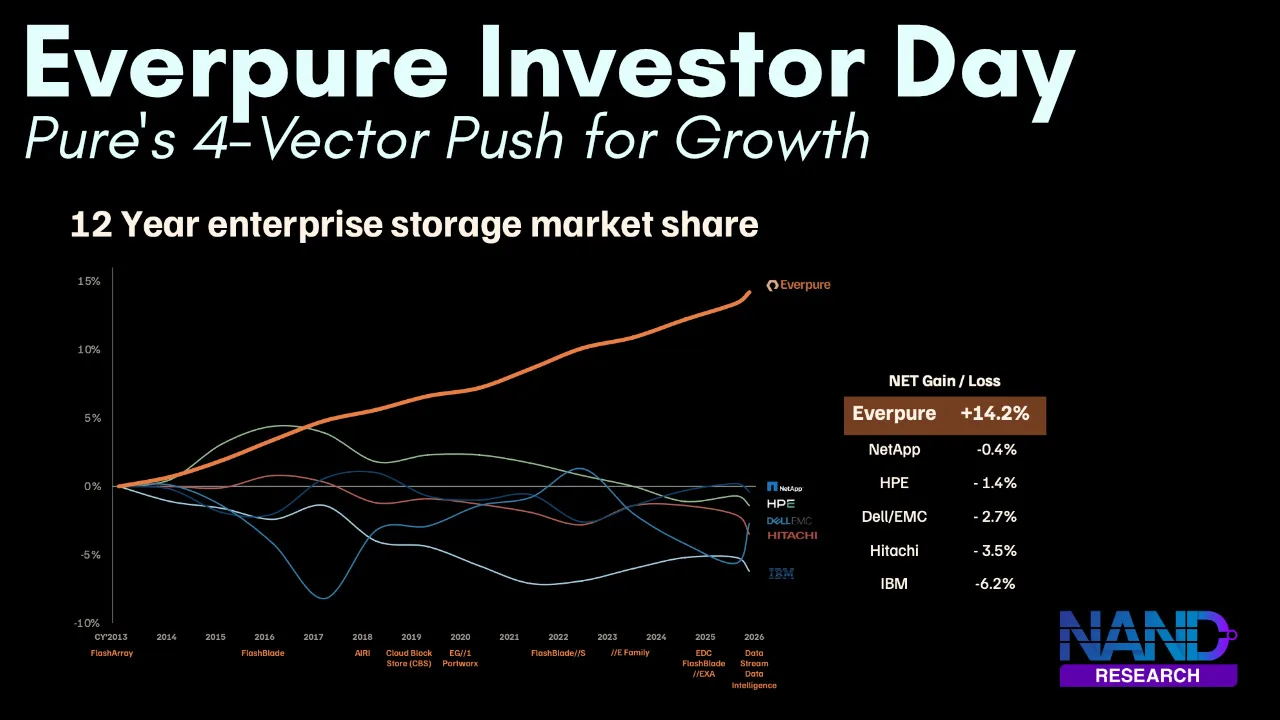
Everpure also enters this phase with momentum, reporting eight consecutive quarters of accelerating revenue growth and more than a decade of uninterrupted share gains.
Several elements of the positioning, however, deserve scrutiny.
- The new revenue category will account for only about 20% of total revenue by fiscal 2030, yet management said most forward growth will come from the new markets. Analysts pressed on this tension during Q&A, and annual-only disclosure will make it difficult to track progress between year-end updates.
- Fiscal 2027 growth of 38% includes price increases driven by NAND inflation. Everpure declined to quantify the pricing contribution, and the fiscal 2028 outlook assumes prices remain near current levels. The GPU-attached unit data offers some evidence of volume-driven growth, but the revenue split remains undisclosed.
- Hyperscale revenue depends on two customers and arrives in lumpy increments. The largest long-term prize, hard drive replacement, is deferred until NAND pricing normalizes.
Practitioner Impact
For enterprise IT organizations, the most practical change is that Everpure now offers (or will soon offer) solutions for data owners, including chief data officers, CISOs, and AI platform teams, alongside its traditional storage infrastructure.
Everpure reports roughly 80% logo overlap between the 1touch customer base and its own large enterprise accounts, and says those accounts are bringing data and security leaders into the conversation.
Practitioners evaluating the expanded portfolio should weigh several considerations.
- Data Intelligence and Data Stream operate across heterogeneous storage, which allows evaluation without an array commitment. Buyers should validate connector coverage for their specific SaaS applications and databases before assuming enterprise-wide reach.
- Most large enterprises already run catalog and governance tooling from Informatica, Collibra, Microsoft Purview, or Databricks Unity Catalog. Adding a storage-originated data intelligence layer raises ownership and overlap questions that need answers early.
- The shared software across FlashBlade//S and EXA lowers the migration risk that often accompanies AI projects moving from pilot to production scale.
- NAND and system cost inflation is raising array prices across the industry. Evergreen//One contracts shift that exposure to Everpure, which makes consumption models more attractive for customers who need capacity during the current pricing cycle.
- Enterprise-wide franchise agreements, which now reach eight and nine figures, deliver volume leverage but increase dependence on a single vendor for primary storage and data services.
Competitive Impact
Everpure now competes in four markets with four different sets of rivals, and its advantages vary considerably across them.
In the core enterprise market, it holds a strong position built on Evergreen, high Net Promoter Scores, and consistent share gains against Dell, NetApp, HPE, and IBM. In the newer markets, it is a challenger facing entrenched specialists.
The competitive picture breaks down along the following lines.
- Scale AI: VAST Data, DDN, and WEKA hold established positions in the largest GPU clusters. Everpure’s case rests on enterprise-grade reliability and operational simplicity, attributes that matter more as neoclouds run multi-tenant inference alongside training.
- Hyperscale Solutions: DirectFlash has no direct commercial equivalent, and Everpure’s primary competitor is the hyperscaler’s option to build similar NAND management in-house or to keep pressing SSD suppliers on price. Hard drive vendors Seagate and Western Digital hold the capacity tier until flash pricing falls.
- Modern Data Software: Everpure competes with data protection vendors such as Veeam and Cohesity, lakehouse platforms such as Databricks, and storage incumbents that also sell data services. Several of these rivals already own relationships with the data-owner buyer Everpure is now pursuing.
The table below summarizes the principal alternatives across Everpure’s four growth vectors.
| Alternative | Segment | Model/Approach | Compared to Everpure |
| Dell Technologies, NetApp, HPE, IBM | Core and Core AI | Broad enterprise portfolios spanning flash, hybrid, and HDD systems, often bundled with servers and services | Larger installed bases and bundling leverage. Everpure leads on upgrade model, customer satisfaction, and share momentum. |
| VAST Data | Scale AI | Disaggregated all-flash platform with database and compute services layered on storage | Deeper neocloud footprint and broader data platform story. Everpure counters with enterprise continuity from S to EXA. |
| DDN, WEKA | Scale AI | Parallel file systems tuned for large-scale AI training and HPC | Long production track record in the largest clusters. Everpure contests performance with MLPerf results and emphasizes manageability. |
| Hyperscaler in-house engineering, SSD and HDD suppliers | Hyperscale Solutions | Commodity SSDs and HDDs managed by hyperscaler software, or custom NAND management built internally | Lowest dependency on a third party. Everpure claims lifetime, density, and reliability gains plus multi-vendor NAND qualification. |
| Veeam, Cohesity, Databricks | Modern Data Software | Data protection, data management, and lakehouse governance platforms sold to data and security owners | Established with the target buyer. Everpure brings installed-base overlap and storage integration, with a newer product set. |
Everpure’s differentiation is strongest at the two ends of its portfolio:
- In core enterprise storage, Evergreen and a decade of share gains give it a durable position
- In hyperscale, DirectFlash offers a capability no competitor sells commercially.
Differentiation is weakest in Modern Data Software, where Everpure is entering a crowded field with a recently acquired product and must win a buyer who has historically never needed to talk to its storage vendor.
Scale AI falls in between, with credible technology facing competitors that already own the largest neocloud deployments.
Final Thoughts
Everpure delivered an investor day with substance to back its ambition. The four-vector framework is coherent, the single-architecture approach is a real engineering advantage, and the fiscal 2028 outlook puts specific numbers to a strategy that the February rebrand had only described.
The company’s history of consistent share gains across both inflationary and deflationary NAND cycles lends credibility to its core growth assumptions, and the hyperscale commitments through fiscal 2028 provide rare visibility for a new business line.
Open questions remain. Pricing tailwinds inflate current growth rates by an undisclosed amount, the hyperscale business currently depends on two customers, and the annual-only new revenue disclosure limits outside visibility into whether the expansion markets are scaling as planned.
Modern Data Software carries the greatest execution risk, since it requires Everpure to earn credibility with data and security leaders against vendors that already hold those relationships.
The most important takeaway is that Everpure has converted a storage franchise into a platform for entering three adjacent markets, and it has now publicly committed to results that will show whether that platform will travel.
Core storage remains roughly 80% of the business through fiscal 2030 under the company’s own plan, so the enterprise array franchise still funds the transition.
Over the next two years, the fiscal 2027 new revenue baseline and Modern Data Software’s progress beyond Everpure’s own arrays will determine whether investors ultimately value Everpure as a data management company or as the leading all-flash storage vendor.
Given Pure’s continued outperformance and strong execution history, we believe the company’s strategy is competitively strong.