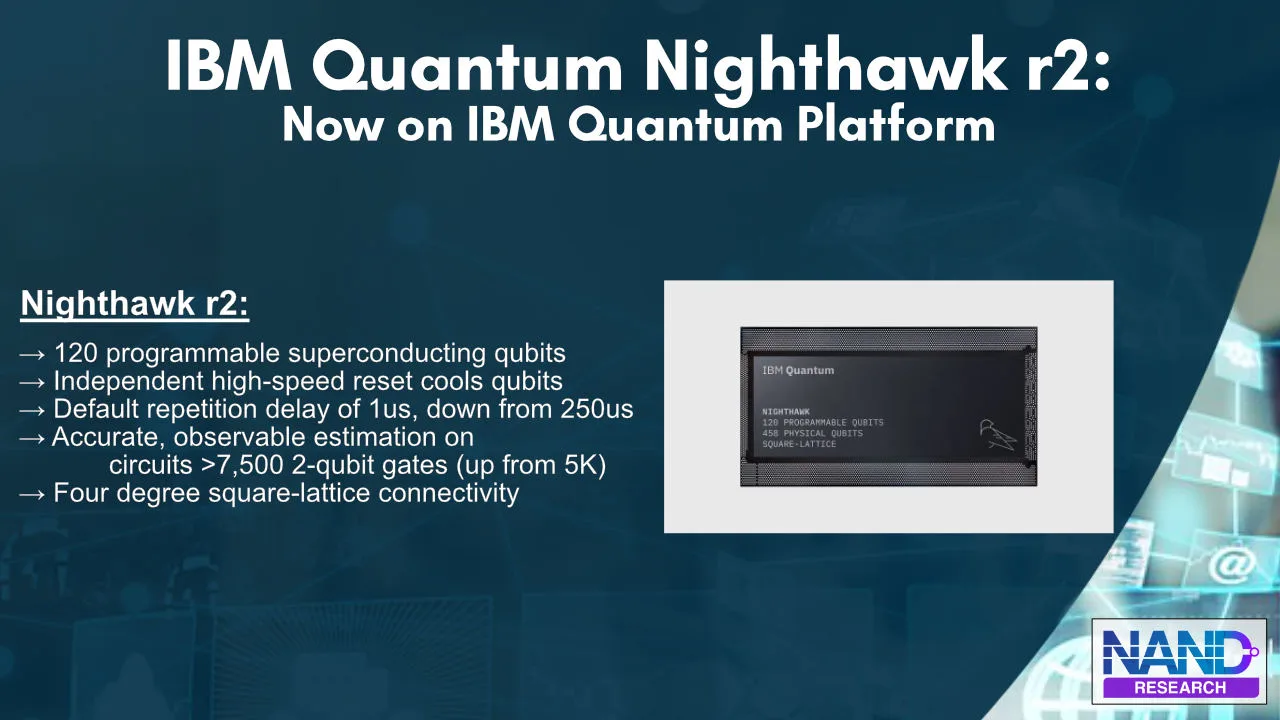
IBM announced that the second revision of its Nighthawk quantum processor is now available on the IBM Quantum Platform. The chip retains the 120-qubit square lattice introduced in the first Nighthawk revision and adds an independent, high-speed qubit reset (which reduces the default repetition delay from 250 microseconds to 1 microsecond).
IBM said that the change yields up to 25 times the circuit throughput of its Heron processors while maintaining fidelity, and that the device supports accurate observable estimation for circuits with more than 7,500 two-qubit gates.
The gate figure carries weight because 7,500 two-qubit gates is the target IBM set for the end of 2026 when it published its current quantum roadmap. Reaching it in September puts IBM ahead of its own published schedule, and schedule credibility is the currency every quantum vendor trades in right now.
The throughput improvement addresses a separate constraint. Circuit complexity determines which problems a machine can express, whereas execution speed determines how many samples a researcher can collect before queue time and budget run out.
Details
Nighthawk is the branch of IBM’s hardware roadmap designed for near-term quantum advantage, distinct from the Loon and Starling lines that carry the fault-tolerance work. The r2 revision is an architectural refinement that maintains the qubit count and lattice constant while addressing initialization time and error, which were the two limiting factors in the original device.
IBM has also moved Nighthawk fabrication toward 300mm wafer processing, a manufacturing shift that enables faster design iteration across revisions.
The processor and its supporting stack have the following characteristics:
- 120 programmable superconducting qubits, arranged on a square lattice with four-degree connectivity and connected by 218 tunable couplers.
- An independent, high-speed reset cools qubits via a 50-ohm termination. IBM reports an 11-fold reduction in initialization error on the r2 device and says that it has observed no T1 degradation in neighboring qubits during reset.
- A default repetition delay of 1 microsecond, down from the 250-microsecond standard on prior hardware, produces execution rates above 100,000 max circuits per second, compared with roughly 4,000 per second on Heron.
- Support for accurate, observable estimation on circuits exceeding 7,500 two-qubit gates, up from IBM’s approximately 5,000 gates cited for the first Nighthawk revision.
- Coherence performance is consistent with the Nighthawk family, in which IBM reported a median T1 of near 350 microseconds on the initial device. IBM characterizes r2 fidelity as matching Heron, and its most recent Heron r3 system has a two-qubit error rate of approximately 2.15 × 10⁻³ across 100 qubits.
- Four-degree square-lattice connectivity, which independent benchmark work has found to produce the lowest structural compilation overhead among the architectures tested, requires fewer two-qubit operations overall for comparable workloads.
IBM Quantum Platform
IBM Quantum Platform is the cloud environment through which this hardware is accessed. It manages identity, organizational structure, and access policies, and it issues each workload a scoped instance identified by a Cloud Resource Name.
Underneath it sits IBM Quantum Compute Service, formerly known as Qiskit Runtime, which executes circuits on the hardware fleet and applies error suppression and mitigation during execution, sparing the user from assembling that layer.
The platform provides:
- Primitive interfaces for sampling and expectation-value estimation, exposed via the qiskit-ibm-runtime client, support job, session, and batch execution modes.
- Access tiers span the Open Plan, the consumption-based Flex Plan, the Premium Plan, and on-premises deployment. The first Nighthawk device was restricted to Premium and Flex customers (a pattern IBM has repeated with new silicon).
- Qiskit Serverless for hybrid quantum-classical workloads spanning CPU, GPU, and QPU resources, with persistent cloud execution and task parallelization.
- The Qiskit Functions Catalog includes roughly a dozen circuit and application functions from IBM and partners, including Q-CTRL, Kipu Quantum, Qunova, Qedma, and ColibriTD. The 2026 updates added support for up to four concurrent experiments and per-workload resource accounting via job result metadata.
- Fleet scale and regional presence, with more than 2,400 qubits across roughly 17 QPUs in the US and EU, IBM Quantum System Two installations in New York, Kobe, and San Sebastián, and reported cumulative execution of more than 3.9 trillion circuits at 97 percent average uptime.
- August 2026 platform work that added bit-by-bit measurement outcome views, circuit timing charts showing operation schedules, full OpenQASM 3.0 support in the Composer, and visible usage-limit reset dates for instance administrators.
Analysis
IBM has organized its entire quantum narrative around two dated commitments, verified quantum advantage in 2026 and a fault-tolerant Starling system in 2029. Nighthawk r2 is the vehicle for the first commitment.
Meeting the end-of-2026 gate target a quarter early is the strongest evidence IBM has offered that its roadmap discipline is real. That discipline is itself a competitive asset in a market where dated claims are common, and delivery against them is not.
IBM’s approach carries both risks and strengths.
- IBM has defined quantum advantage as a verifiable computation that outperforms any known classical method on quantum hardware, and it publishes a tracker that invites classical rebuttals. That framing is also exposed because a strong classical simulation can retroactively undermine a claimed advantage.
- Splitting the roadmap into a near-term advantage line and a separate fault-tolerance line lets IBM sell capability today while building toward error correction. It also means Nighthawk is a transitional architecture, and customers who build deeply around its specifics will face migration work when the Loon-derived systems arrive.
- The platform investment, particularly the Qiskit Functions Catalog and Qiskit Serverless, moves IBM toward selling outcomes to domain scientists who do not write circuits. That is where durable revenue lives, and IBM is further along that path than any competitor.
- Nighthawk r2 is an incremental hardware revision with a stable qubit count. IBM is buying performance through control-system and packaging engineering while it waits for the long-range couplers that will take the roadmap past 1,000 qubits in 2028.
Practitioner Impact
The people who feel this change first are quantum algorithm researchers in national labs, universities, and corporate research groups who run variational chemistry, condensed-matter simulation, and optimization workloads. For them, throughput has been the silent tax.
A mitigated expectation-value estimate can require millions of shots, and at Heron repetition rates, that translates into hours of wall-clock time per data point and correspondingly large consumption against a Flex or Premium allocation. Compressing the repetition delay by more than two orders of magnitude directly reduces that cost.
Competitive Landscape
The competitive focus in quantum computing has shifted from raw qubit counts to usable circuit volume per unit time, which combines qubit count, fidelity, connectivity, and clock speed. Nighthawk r2 is a deliberate play on the clock-speed axis, where superconducting hardware holds a structural advantage over trapped-ion and neutral-atom systems.
The competitors that beat IBM on fidelity generally lose on speed and commercial availability, and those that match IBM on availability generally lose on scale.
| Alternative | Model or Approach | Compared to Nighthawk r2 |
| Google Quantum AI | Superconducting transmon devices centered on error-correction milestones, with limited third-party hardware access | Google leads on published below-threshold error-correction results and on its Quantum Echoes verifiable-algorithm demonstration. It offers no comparable general-purpose commercial cloud service, so enterprises cannot buy time on the hardware the way they can with IBM. |
| Quantinuum | Trapped-ion QCCD architecture with all-to-all connectivity, delivered through Helios-class systems | Quantinuum holds an advantage in two-qubit gate fidelity and in connectivity, which lowers compilation overhead. Ion shuttling makes its clock speeds orders of magnitude slower, so Nighthawk r2 delivers far more circuit volume per hour at lower per-qubit fidelity. |
| IonQ | Trapped-ion systems distributed through AWS Braket, Azure Quantum, and Google Cloud | IonQ wins on procurement breadth because customers reach it through hyperscaler marketplaces they already use. Its gate speeds and installed fleet size trail IBM, and its software stack depends more heavily on third-party ecosystems. |
| Rigetti Computing | Superconducting transmon devices built on a modular multi-chip approach | Rigetti shares IBM physics and packaging concepts at smaller scale. It has demonstrated modular chiplet assembly ahead of some peers, while its qubit counts, coherence figures, and software tooling remain behind IBM. |
| Neutral-atom vendors | Reconfigurable atom arrays from QuEra, Pasqal, and Atom Computing | Neutral-atom systems reach large qubit counts and flexible connectivity at comparatively low hardware cost. Cycle times are slow, gate-based tooling is less mature, and none currently offers throughput in the range Nighthawk r2 claims. |
| Cloud aggregators | Hardware-neutral access layers such as AWS Braket and Azure Quantum | Aggregators give buyers vendor optionality and a single procurement path across modalities. They own no silicon and cannot match the tight coupling between processor, error mitigation, and runtime that IBM controls end to end. |
IBM’s differentiation is strongest in the combination of fleet scale, throughput, and a managed service that abstracts away error mitigation from the user.
It is weakest in per-gate fidelity and connectivity, where Quantinuum’s trapped-ion systems remain ahead by a clear margin, and in independent verification, where Google has published more peer-reviewed error-correction results.
The 2028 long-range coupler milestone is the pivot point. If IBM delivers it on schedule, the fidelity gap matters less because circuit volume compounds. If it slips, trapped-ion vendors gain time to close the throughput gap through parallelization and larger traps.
Final Thoughts
IBM delivered a meaningful hardware improvement ahead of its own published date by fixing an unglamorous bottleneck. Qubit reset time draws few headlines, yet addressing it produced a larger practical gain for working researchers than adding another twenty qubits would have.
For organizations evaluating quantum access, the key takeaway is delivery discipline, not silicon. IBM published a multi-year gate-count roadmap, exposed itself to being measured against it, and has now beaten one of its own milestones by a quarter while shipping the result into a commercial cloud service that customers can buy today.
In a market where most competitors are still selling a future, IBM is selling a schedule it keeps meeting, and that is the asset that will determine who holds the enterprise relationships when fault-tolerant hardware finally arrives.