
Pure Storage has rebranded as Everpure, reflecting a multi-year evolution from storage management into broader data management, and is also acquiring 1touch:
- Rebranding reflects Pure’s evolving market as enterprise AI adoption shifts infrastructure requirements from peak performance to sustained reliability, data governance, and lifecycle integrity
- The company’s evolution follows a logical three-stage arc: storage management → dataset management → full data management
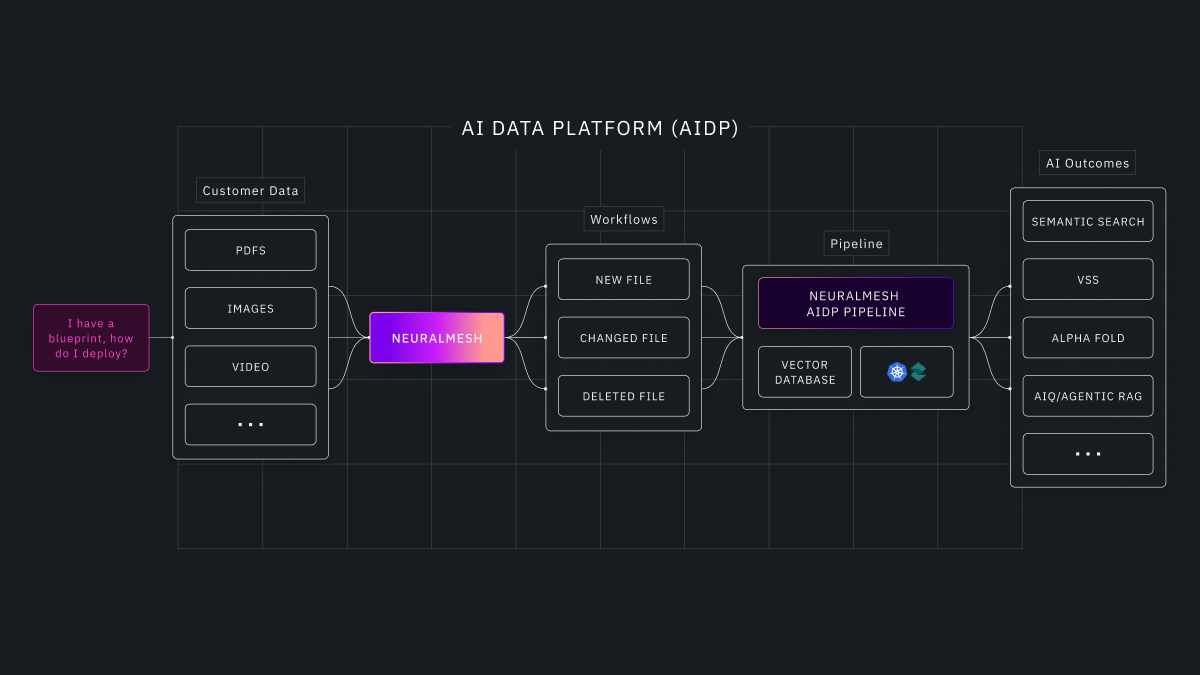
- 1touch brings continuous discovery, AI-driven classification, dynamic ontology construction, and knowledge graph mapping to the platform
- The acquisition fills the gap between governing datasets operationally and understanding data in a business context
Executive Summary
Pure Storage today rebranded as Everpure, matching its ongoing expansion from its roots in performance flash storage into the broader data management market. The transition is accompanied by its intent to acquire 1touch, a startup specializing in AI-driven data discovery, classification, and semantic mapping.Together, these moves are the most significant strategic repositioning in the company’s 15-year history.
The rebranding is not cosmetic; rather, it reflects a multi-year architectural progression from storage provisioning and performance optimization to dataset lifecycle management, and finally to full data governance and contextual intelligence.
The company’s core storage platform, including its Purity OS, DirectFlash architecture, and Fusion control plane, remains central to the strategy. The expansion up the stack is framed as an extension of that foundation, not a departure from it.
Rationale for the Rebranding
The constraint in enterprise AI is no longer access to large language models. Cloud-based model access has become broadly commoditized. The constraint is on data: clean, governed, continuously accessible, and semantically understood.
Organizations that have moved AI initiatives from pilot to production consistently report that model performance degrades when fed stale, poorly organized, or inconsistently governed data. The bottleneck is infrastructure readiness, not inference capability.
This dynamic creates specific and compounding pressure on storage architectures. AI workloads do not behave like traditional enterprise workloads:
- Persistent inference economics favor predictable, sustained latency and throughput over the short-lived burst performance that defined training workloads
- RAG architectures depend on embedding storage, vector index management, and data recency, capabilities that traditional storage systems were not designed to optimize
- Lifecycle management is continuous rather than periodic, as embeddings, curated datasets, governance artifacts, and backup copies all require active management rather than passive retention
- Data gravity intensifies as regulatory, sovereignty, and compliance requirements anchor certain datasets to specific environments, limiting architectural flexibility
Storage architecture, in this context, becomes central to the conversation. Storage moves beyond capacity planning, becoming the prerequisite for data lifecycle integrity, compliance enforcement, and AI reliability.
It’s this framing that grounds Pure Storage’s evolution into Everpure.
Everpure’s Progression from Storage to Data Management
Everpure reframes the company’s mission, showing its expansion as a deliberate, cumulative progression through three distinct, yet interconnected stages:
- Storage management covers provisioning, performance optimization, availability guarantees, and hardware lifecycle management. This is Pure Storage’s established domain, and is the capability set that built the company’s market position and customer base.
- Dataset management introduces policy enforcement, lifecycle awareness, protection orchestration, and optimization across hybrid and multi-cloud environments. This is where Fusion’s fleet-level control plane and the EDC architecture operate.
- Data management adds the third dimension: contextual understanding of data itself, including its relationships, lineage, ownership, business relevance, and semantic meaning across heterogeneous environments. This is the stage that Everpure is now entering, and it is where the 1touch acquisition becomes strategically critical.
The progression is internally consistent. Storage management provides the foundation for performance and availability. Dataset management extends that foundation into policy-driven orchestration. Data management requires both prior layers to function reliably before laying in contextual intelligence. A governance framework built on unstable or inconsistently performing infrastructure will fail at scale.
The Architectural Continuity Enabling the Expansion
Understanding Everpure’s strategic rationale requires engaging seriously with its architectural foundation. Pure Storage’s original design philosophy was not only about building faster storage. It reflected specific first-principles decisions, such as prioritizing simplicity, non-disruptive operations, and software-driven intelligence.
These foundational decisions anchor the company’s data management ambitions:
- Purity OS and key-value metadata architecture: Aunified operating system spanning block, file, and object storage while also preserving performance consistency across workloads. Its key-value metadata engine, initially offered as an efficiency mechanism, established a programmable foundation for policy enforcement and lifecycle awareness. That architecture now serves as connective tissue between storage operations and higher-order data intelligence.
- DirectFlash technology: Purpose-built all-flash architecture that eliminates the abstraction layers associated with legacy NAND translation, enabling lower-latency access patterns that persistent inference workloads increasingly require.
- Evergreen non-disruptive upgrades: A consumption model and upgrade philosophy that maintained operational continuity across hardware and software generations. Evergreen is built on design principles that directly inform the company’s expansion into data management, where governance continuity across infrastructure changes is a significant enterprise concern.
- Fusion control plane: An abstraction layer that unifies management across individual arrays into fleet-level policy orchestration. Fusion shifted the management paradigm from device-centric administration to centralized, software-driven governance. This is another critical architectural step toward the Enterprise Data Cloud model.
More than marketing constructs, these elements are architectural decisions that differentiated Pure Storage in the storage market and that retain relevance as the company expands into data management.
Everpure’s Enterprise Data Cloud (EDC) synthesizes these architectural elements into a unified operating model. Under the EDC framework, Purity creates a virtualized global storage pool spanning on-premises and cloud environments. At the same time, Fusion extends governance, automation, and orchestration across that pool without sacrificing the performance and non-disruptive guarantees the platform established.
The 1touch Acquisition
1touch is a data intelligence startup whose platform focuses on enterprise-wide data discovery, classification, and contextualization. Its core capabilities center on constructing dynamic ontologies and knowledge graphs across structured and unstructured datasets, enabling organizations to understand data relationships, lineage, and ownership across heterogeneous environments (on-premises, cloud, SaaS, and edge).
The company addresses a problem that sits above the storage and dataset management layers: not where data resides or how it is governed operationally, but what it means in a business context and whether it can be trusted for downstream use cases, including AI inference.
The acquisition is architecturally consistent with Everpure’s progression. Rather than introducing a disconnected capability layer, 1touch extends the existing metadata and control plane architecture into contextual intelligence.
These capabilities include:
- Continuous discovery: Automated, ongoing identification of data assets across distributed environments. This capability is different from point-in-time cataloging, which degrades in accuracy between audit cycles and fails to reflect the dynamic nature of enterprise data estates.
- AI-driven classification: Automated categorization by data type, sensitivity, regulatory relevance, and business context, reducing the manual overhead that limits governance program scalability in large enterprises.
- Dynamic ontology construction: A structured representation of data relationships and categories that adapts as the data estate changes, enabling governance policies to remain aligned with actual data conditions.
- Knowledge graph mapping: Semantic mapping of data lineage, ownership, and relationships that allows organizations to trace how data moves, transforms, and connects across systems — a prerequisite for defensible AI governance
- Cross-environment semantic mapping: Data understanding that operates across on-premises, cloud, SaaS, and edge infrastructure without requiring centralization, which matters in enterprises where data gravity and regulatory constraints prevent architectural consolidation
Taken together, these capabilities shift Everpure’s scope from governing datasets to governing data itself (lineage, ownership, semantic relationships, and policy boundaries across environments). That is a meaningful expansion, and it directly addresses the failure modes that cause enterprise AI initiatives to stall before reaching sustained production.
Analysis
The transition from Pure Storage to Everpure reflects something larger than a single company’s strategic pivot. It is a meaningful response to an enterprise market undergoing a significant shift, where AI-fueled workflows are forcing IT organizations to evolve from providing storage to delivering a strategic foundation for enterprise data management. With this rebranding, Pure Storage is deliberately and wisely responding to the market. It’s also doing this faster than many of its competitors
What distinguishes Everpure’s move is the architectural coherence of its progression. The company is not bolting on data management capabilities to a storage platform. Rather, Everpure is extending a metadata architecture and control plane that were designed with programmability and policy enforcement as foundational principles. That distinction matters for enterprise buyers evaluating platform longevity and integration complexity.
The 1touch acquisition has the potential to close a gap in Everpure’s data management story, the gap between governing data and understanding it. Continuous discovery, semantic classification, and knowledge graph construction are capabilities that enable organizations to move from knowing where their data lives to knowing what it means, who owns it, and whether it can be trusted for AI inference.
That is a meaningful expansion, and it arrives at a moment when enterprise AI adoption is exposing the cost of not having it.
There’s risk, of course, to Pure rebranding and expanding its missions. CMO Lynn Lucas faces the daunting challenge of managing a significant market identity transition without losing the credibility of the category-defining position Pure Storage built over 15 years. Watching the Pure team execute over the past decade gives me faith that they can pull it off.
Overall, the strategic foundation is sound, the architectural logic is coherent, and the market conditions create genuine demand for exactly what Everpure is assembling. For enterprise technology decision-makers, the relevant question is whether Everpure can execute it with the same architectural discipline and customer-centric operational rigor that defined its storage legacy.
Pure Storage, under the focused leadership of Charlie Giancarlo, has demonstrated time and again that it has the focus and operational discipline to deliver what’s required in the moment. Pure consistently outperforms the markets it competes in, which gives me confidence that this will continue as Everpure evolves.
Pure Storage, after all, was the company that brought a stagnant storage industry kicking and screaming into the age of flash storage over a decade ago. Now it’s looking to do that all over again for the age of AI. It’s going to be fun to watch.