
Hewlett Packard Enterprise extended its HPE AI Factory with NVIDIA to support production-ready agentic AI deployments at its just-wrapped HPE Discover 2026. The announcements add governance, security, and compute capabilities for organizations moving AI agents into operational production environments.
The announcements bring three primary additions to HPE Private Cloud AI, the turnkey AI factory platform that HPE co-engineers with NVIDIA:
- The NVIDIA Agent Toolkit, comprising NVIDIA Nemotron open models, the NemoClaw blueprint, and the OpenShell secure runtime, serves as what HPE calls an “agent operating system” for monitoring agent behavior and enforcing policy.
- HPE ProLiant Compute DL394 Gen12 server, built on the Arm-based NVIDIA Vera CPU, provides a compute-optimized foundation for agentic and reinforcement-learning workloads.
- NVIDIA Confidential Computing, now extended across the HPE AI Factory with the NVIDIA portfolio, protects models and data during execution.
HPE paired these additions with new HPE Zerto Software capabilities designed to detect rogue agent actions and roll environments back to a clean state, as well as with HPE Alletra Storage MP X10000 enhancements intended to improve token economics in AI data pipelines.
Details
The announcements span agent governance, CPU-based compute, confidential computing security, and storage-driven token economics. They are summarized below:
- NVIDIA Agent Toolkit: bundles NVIDIA Nemotron open models, the NVIDIA NemoClaw blueprint, and the NVIDIA OpenShell secure runtime for HPE Private Cloud AI. HPE describes the toolkit as an agent operating system that enables customers to monitor agent behavior, enforce governance policies, and reduce deployment risk across autonomous, long-running multi-agent systems.
- Secure local agent registration: HPE Private Cloud AI adds a registration capability that lets customers approve specific AI models, skills, and tools against centralized governance and security policies before agents can act.
- HPE ProLiant Compute DL394 Gen12: a new AI server based on the NVIDIA Vera CPU, delivering high single-core performance and approximately 1.2 TB/s of memory bandwidth, ideal for agentic reasoning, reinforcement learning, and complex sequential workloads such as financial modeling.
- NVIDIA Confidential Computing: extends across the HPE AI Factory with the NVIDIA portfolio, using cryptographic attestation and encryption to protect models and private data while workloads execute, targeting HPE AI Factory at-scale and Sovereign AI Factory configurations.
- HPE Zerto Software rogue-agent protection: new capabilities to detect when an agent takes an action outside its authorized scope and to apply continuous data protection to roll the environment back to a clean state.
- HPE Alletra Storage MP X10000: this is the data layer for agentic pipelines, providing agents with direct access to data and metadata. HPE claims token response time improvements of up to 20x in benchmark tests run on an HPE ProLiant DL380a Gen12 server with eight NVIDIA H200 NVL GPUs, paired with a three-controller-node X10000 configuration.
- Multi-node inference and gateway capabilities: HPE Private Cloud AI adds multi-node inference scaling up to 256 GPUs, a unified model gateway that provides governed access to frontier models, and active workload prioritization, all part of the July 2026 release.
These additions build on the infrastructure HPE announced earlier in 2026, including the NVIDIA Vera Rubin NVL72 by HPE rack-scale system for frontier-scale models exceeding one trillion parameters, the HPE Compute XD700 built on NVIDIA HGX Rubin NVL8, supporting up to 128 Rubin GPUs per rack, and NVIDIA Quantum-X800 InfiniBand support for the HPE Cray Supercomputing GX5000.
Analysis
The announcements reinforce the position HPE has consistently built since closing its acquisition of Juniper Networks: that the network, not compute alone, is the control plane for the agentic era.
The company tied that argument directly to AI governance for the first time at Discover, framing networking, storage, and software as a single full-stack answer to agent oversight.
For IT and AI infrastructure teams, the Agent Toolkit and secure local agent registration give practitioners a governance checkpoint before agents reach production, which should reduce the risk of unmonitored agent sprawl that several enterprises have already reported in 2026.
HPE’s focus on elevating token cost visibility to a first-class operational concern aligns well with current concerns about enterprise AI. HPE’s own commentary at Discover, describing how its support systems saw token consumption scale directly with the volume of autonomous operational signals, mirrors a problem practitioners are already encountering that traditional infrastructure monitoring struggles to detect.
Competitive Landscape
HPE’s closest competitors in full-stack AI factory infrastructure are pursuing similar agentic governance narratives on overlapping timelines. There is also a narrow set of competitors capable of providing full-stack AI factory solutions:
| Competitor | Competitive Position | HPE Differentiation |
| Dell AI Factory with NVIDIA | Compute-led full-stack AI infrastructure portfolio with broad server and storage breadth; deep NVIDIA co-engineering on the server side. | HPE leads with networking as the differentiator. |
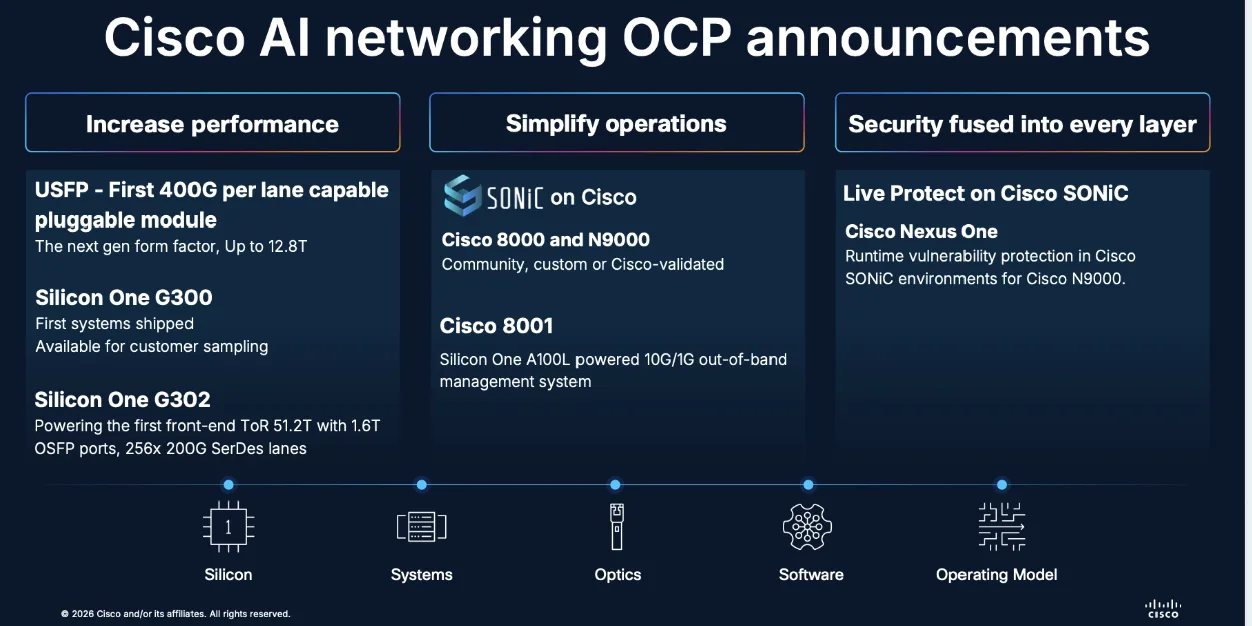
| Cisco (Secure AI Factory with NVIDIA) | Networking and security-first AI infrastructure stack, built on Cisco’s switching and security portfolio paired with NVIDIA. | HPE’s Juniper-based 800G routing, QFX switch family, and Aruba/Mist integration give it a comparably deep networking story with broader enterprise WAN and campus reach. |
| Lenovo (Hybrid AI Advantage) | Server-centric AI infrastructure with NVIDIA, strong in edge and liquid-cooling density for enterprise data centers. | HPE’s combination of Private Cloud AI governance tooling, Zerto rollback, and OpsRamp token observability is materially more built out than Lenovo’s current agentic governance layer. |
Other competitive thoughts:
- HPE has genuine differentiation in networking depth (as a result of the Juniper acquisition) that competitors cannot replicate without a comparable networking asset of their own.
- HPE’s governance and rollback tooling is more mature in announcement than several peers’ equivalents, but Dell’s near-simultaneous Deskside Agentic AI launch shows the competitive window for a governance-first message is already closing.
- IBM and Cisco both carry stronger incumbent positions in the regulated and security-sensitive accounts that confidential computing and sovereign AI factory configurations are designed to win, meaning HPE’s technical capability may outpace its relationship advantage in those segments.
Final Thoughts
The first phase of enterprise AI focused on model access and infrastructure deployment. The next (current) phase centers on governance, accountability, security, and economics as AI agents begin making decisions, initiating actions, and interacting with business processes without continuous human oversight. HPE’s moves are aimed squarely at that transition.
By combining agent governance, confidential computing, operational rollback capabilities, token-cost visibility, and high-performance AI infrastructure into a single platform, HPE builds an AI Factory that provides a robust operational environment for production AI.
HPE enters this phase with a more comprehensive stack than many competitors and a differentiated networking foundation (following its acquisition of Juniper). As agentic AI deployments move from pilots to production, those operational capabilities are likely to become as important as simply raw AI performance.