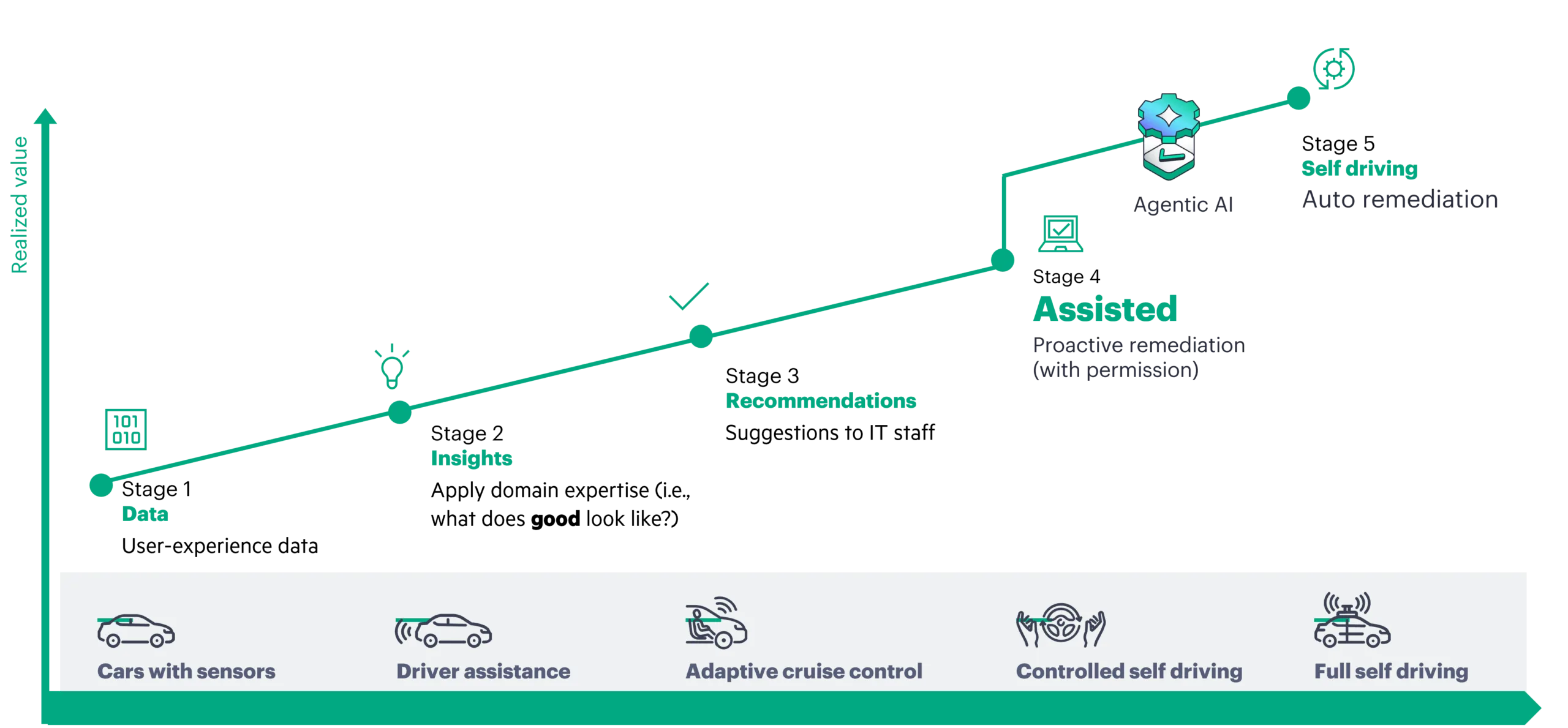
At its recent HPE Discover event in Las Vegas, Hewlett Packard Enterprise announced a broad set of networking updates spanning AI data center switching, autonomous network operations, and unified secure access, extending its “self-driving” networking strategy into general availability across AI factories, data centers, campus, and edge environments.
The core of the announcement is the continued integration of HPE Juniper Networking and HPE Aruba Networking, a process HPE calls “cross-pollination,” twelve months after HPE closed its $14 billion acquisition of Juniper.
New switching hardware, including the Juniper QFX5252 for AMD Helios rack-scale systems and the QFX5140 for inference clusters, anchors the AI data center’s switching side.
On the operations side, HPE extended its Mist AIOps platform to support Aruba CX switches and brought Marvis self-healing automation to Aruba Central, while introducing a new unified, AI-native SASE platform that converges SD-WAN and security service edge into a single console.
Details
HPE’s networking announcements cover four areas: new AI data center switching hardware; agentic AIOps software spanning both the Juniper-derived Mist platform and the Aruba-derived Central platform; a unified SASE architecture; and tighter integration among networking, compute, and private cloud telemetry within GreenLake:
- HPE Juniper Networking QFX5252: a liquid-cooled, scale-up switch built for AMD Helios AI rack-scale systems, supporting UALink over Ethernet and SONiC for AI-native operations. Like the recent Arista 7060XE7 series, the new HPE switch is built on dual Broadcom Tomahawk 6 silicon.
- HPE Juniper Networking QFX5140: a 16 Tbps switch in 1RU, designed for inference clusters and edge AI, and optimized with HPE Marvis AI-native tooling for workloads where latency and bandwidth directly affect GPU utilization.
- HPE Juniper Networking QFX5250: a 102.5 Tbps liquid-cooled switch for scale-out AI data center networking, complementing the QFX5252 scale-up design.
- HPE Networking Data Center Director integration: the HPE AI Data Center Solution now manages the Juniper QFX switch family directly via Data Center Director, consolidating AI fabric management into a single operational tool (rather than using separate Juniper- and Aruba-native consoles).
- Mist support for HPE Networking CX switches: HPE Networking CX wired access switches now run on the Mist AIOps platform, providing CX customers with AI-native visibility, zero-touch provisioning, layer 2 wired assurance, dynamic packet capture, and HPE Marvis-driven automated actions previously available primarily on Juniper-native hardware.
- Marvis self-driving capabilities in Aruba Central: HPE extended Marvis AI-powered automation to Aruba Central, including trusted automated actions such as wired port remediation, building on the autonomous networking capabilities HPE introduced in May 2026.
- Mist data center operations: the Mist platform gained predictive analytics to identify potential hardware and optical failures before they cause service disruption, extending Mist’s AIOps reasoning from campus and branch environments into the data center.
- Unified AI-native SASE platform: built on HPE Networking EdgeConnect technology, the platform converges SD-WAN and Security Service Edge into a single management console. It includes an embedded SSE connector that accelerates zero-trust deployment without a separate Zero Trust Network Access infrastructure, a dedicated Secure Web Gateway tunnel that extends protection to IoT endpoints, and a sovereign SASE configuration that keeps traffic within enterprise-controlled boundaries.
Analysis
These announcements are the strongest evidence to date that Juniper is being integrated into a unified portfolio. HPE has consistently argued since the deal closed that the network is the control plane for the agentic enterprise, and Discover 2026 is the first event where that argument was backed by concrete cross-pollination milestones rather than roadmap commitments.
Impact on Practitioners
For network operations teams, the practical change is the partial consolidation of tooling. Organizations running Aruba CX switches gain Mist-based AIOps capabilities without a hardware refresh, lowering the near-term cost of adopting AI-native operations.
At the same time, organizations building new AI data center fabric gain a single management console, HPE Networking Data Center Director, for Juniper-derived switching that previously required separate Juniper Apstra or Junos Space tools.
Competitive Landscape
HPE’s networking competitors fall into two groups: broad incumbents with larger installed bases contesting the same AI data center and campus budgets, and focused AI-fabric specialists competing directly on switching performance.
| Competitor | Competitive Position | HPE Differentiation |
| Cisco | Largest enterprise networking incumbent, with its own AI-native operations push (Cisco AI Assistant, Secure AI Factory with NVIDIA) and the deepest campus and data center installed base. | HPE’s Juniper acquisition gives it comparable AI-data-center routing and switching depth without requiring customers to rip out an existing Cisco estate. |
| Arista Networks | Focused, AI-data-center-first networking vendor with strong hyperscaler and neo-cloud relationships and a reputation for high-performance, low-latency Ethernet switching. | HPE’s QFX5252 and QFX5140 compete directly on AI fabric switching, and HPE pairs switching with compute, storage, and private cloud in a single procurement, which Arista does not offer. |
| Juniper Networks (pre-acquisition baseline) | No longer an independent competitor, but the integration risk it represents is itself a competitive factor: enterprises evaluate whether HPE has actually unified Juniper and Aruba or is running them in parallel. | HPE has shipped concrete cross-pollination milestones, including Mist support for CX switches and Marvis in Aruba Central, which counters the narrative that the acquisition is stalled. |
| VMware / Broadcom (network virtualization and SASE) | Strong incumbent in SD-WAN and security service edge through VeloCloud and Symantec-derived SSE, with deep ties to existing VMware-based data centers. | HPE’s unified SASE platform, built on EdgeConnect, bundles SD-WAN and SSE in one AI-native console with a sovereign SASE option that keeps traffic inside enterprise-controlled boundaries. |
Some additional thoughts on the competitive situation:
- HPE’s differentiation is breadth: it is one of a small number of vendors that can sell switching, routing, security, compute, storage, and private cloud as a single AI factory procurement, a combination neither Arista nor a standalone Juniper could offer before the acquisition.
- Cisco and Arista both carry longer field histories in AI data center switching, and enterprises with significant capital already committed to either vendor’s fabric face high switching costs that HPE’s new hardware alone does not overcome.
- The SASE and SD-WAN market is undergoing vendor reconsideration following Broadcom’s VMware pricing changes, which gives HPE a strong opening, though SASE migrations are typically multi-year efforts.
- HPE’s competitive risk is self-inflicted complexity: running Mist and Aruba Central as parallel AIOps platforms, even with growing interoperability, gives competitors with a single unified operations console an argument for simplicity that HPE cannot fully counter until convergence is complete.
Final Thoughts
HPE Discover 2026 marks an important milestone in the company’s post-Juniper integration journey. One year after closing the acquisition, HPE can point to tangible examples of technology integration across switching, operations, automation, and security. The introduction of Mist capabilities for Aruba hardware, Marvis automation within Aruba Central, and unified management for AI networking fabrics demonstrate measurable progress toward a more cohesive networking portfolio.
The timing is also significant. Enterprise networking is entering a period of architectural change driven by AI infrastructure, distributed inference, and increasingly autonomous operations. Organizations are evaluating not only network performance but also how effectively they can manage, secure, and automate environments across AI data centers, campuses, branches, and edge locations. Operational efficiency, visibility, and automation are becoming as important as raw throughput and latency.
HPE enters this phase with a broad portfolio spanning networking, compute, storage, private cloud, and security. The company’s ability to connect these domains through GreenLake, Mist, Aruba Central, Marvis, and Data Center Director gives HPE the tools to reduce operational silos and deliver a more consistent management experience across infrastructure layers.
Overall, the announcements at Discover 2026 indicate that the company is rapidly shifting from acquisition integration to platform execution. For enterprises evaluating long-term AI infrastructure strategies, HPE’s networking portfolio now warrants consideration as a unified platform. It’s a strong set of updates.