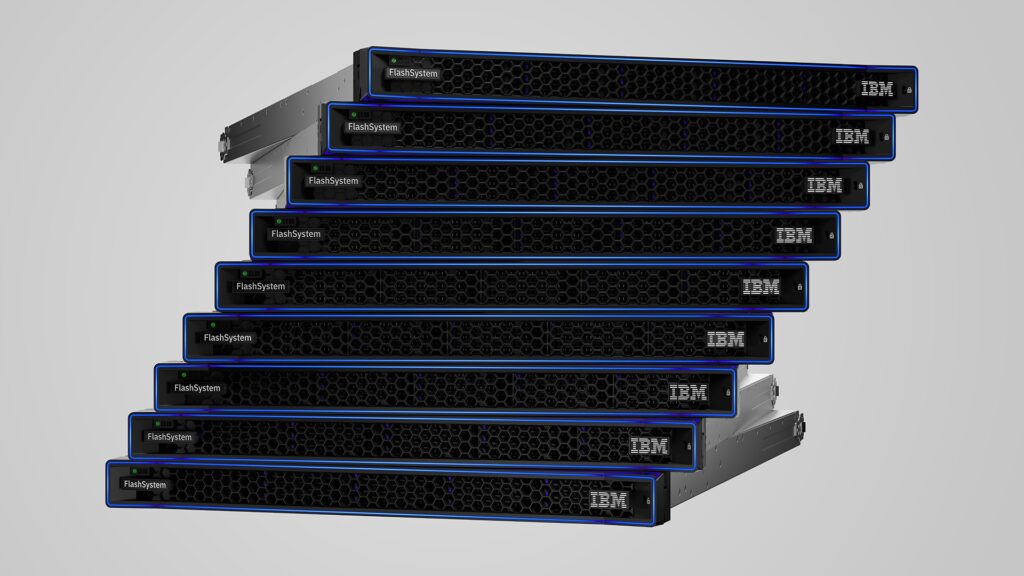
IBM recently announced a significant refresh of its FlashSysteme all-flash storage portfolio, introducing:
- New fifth-generation FlashCore Module (FCM)
- Revised system architectures
- New software layer called FlashSystem.ai, which IBM describes as enabling autonomous storage operations powered by agentic AI.
The new systems are expected to be generally available in March 2026.
Executive Summary
IBM recently announced a significant refresh of its FlashSystem all-flash storage portfolio, replacing the 5300, 7300, and 9500 product lines with new 5600, 7600, and 9600 models. The company also introduced its new FlashSystem.ai, an agentic AI administration layer that IBM claims can reduce manual storage management effort by up to 90%.
The headline hardware change is the shift to Gen 5 FCMs with capacities ranging from 6.6 TB to 105.6 TB raw, enabling the 9600 to reach 3.37 PB raw in a 2U form factor, nearly double the raw capacity of the 9500 it replaces (which topped out at 1.8 PB raw). The 5600 and 7600 bring the same generational drive improvements to the midrange and entry tiers.
Decision-makers evaluating storage refresh cycles should note that this launch is IBM’s most substantive FlashSystem update in nearly six years. The technical specifications are competitive, and the agentic AI direction is credible.
Let’s take a deeper look.
Technical Details
The new FlashSystem lineup retains IBM’s dual-controller SAN Volume Controller (SVC) OS architecture but introduces meaningful hardware differentiation across the three tiers. Notably, the 5600 uses Intel Xeon processors and PCIe Gen 4 connectivity, while the 7600 and 9600 shift to AMD EPYC CPUs with PCIe Gen 5.
This is not a minor footnote: PCIe Gen 5 doubles the I/O bandwidth at the bus level compared to Gen 4, and AMD EPYC’s memory architecture typically provides higher core counts and memory bandwidth, both of which are relevant to high-throughput storage workloads.
The 5600’s use of Intel Ice Lake-generation silicon suggests a cost-optimized platform choice appropriate for edge and remote office deployments, while the 7600 and 9600 represent a more aggressive positioning against higher-end competitors.
The following table summarizes key hardware specifications across the new product line, with previous-generation comparators where available for context.
| Model | Form Factor | CPUs | Drives | Max Raw Cap. | Max IOPS | Read BW | Max Eff. Cap. |
| FlashSystem 5600 | 1U / 12-drive | 2x Intel Xeon 12-core | 12 | 633 TB | 2.6M | 30 GB/s | 2.5 PBe |
| FlashSystem 7600 | 2U / 32-drive | 2x AMD EPYC 16-core | 32 | 1.68 PB | 4.3M | 55 GB/s | 7.2 PBe |
| FlashSystem 9600 | 2U / 32-drive | 2x AMD EPYC 48-core | 32 | 3.37 PB | 6.3M | 86 GB/s | 11.8 PBe |
| 9500 (prior gen) | 4U | — | — | 1.8 PB | 6.3M | 100 GB/s | ~9.6 PBe |
Note: Effective capacity figures reflect IBM’s data reduction and efficiency claims and should not be compared directly to raw capacity without understanding workload-specific data reduction ratios. The 9500-to-9600 transition shows a reduction in read bandwidth (from 100 GB/s to 86 GB/s) and I/O port count (48 to 32), trade-offs for the 4U-to-2U consolidation and capacity gains.
Fifth-Generation FlashCore Module
The Gen 5 FCM is the foundational hardware change enabling the new systems’ capacity and performance characteristics. IBM has expanded the available capacity points significantly compared to the prior generation, which topped out at 38.4 TB. The new FCM capacities are 6.6 TB, 13.2 TB, 26.4 TB, 52.8 TB, and 105.6 TB, with the largest drive being exclusive to the 9600.
Key FCM capabilities include:
- Per-I/O statistics recording: Each FCM records statistics on every I/O operation. The FlashSystem SVC software aggregates these per-drive statistics and forwards them to an onboard AI model, which IBM states checks drive behavior every two seconds against known ransomware patterns.
- Hardware-accelerated analytics: Complex statistical computations occur at the drive level, enabling real-time anomaly detection without routing workloads through the host CPU.
- Ransomware detection latency: IBM claims detection and alerting in under 60 seconds, with false positives below 1%, based on a model trained on tens of billions of data points from IBM’s telemetry and production environments.
- Autonomous recovery: IBM describes the FCM as capable of initiating recovery actions at the hardware layer, a claim that implies pre-configured recovery policies can execute without administrator intervention.
FlashSystem.ai: Agentic AI Administration
FlashSystem.ai is a new software layer that is foundational to how IBM drives autonomous storage operations. It sits above the SVC OS and is described as capable of executing thousands of automated decisions per day.
IBM draws a distinction between this agentic approach and prior template-based automation, claiming FlashSystem.ai adapts to application behavior within hours rather than requiring manual policy tuning.
Core capabilities include:
- Autonomous workload placement: The system performs intelligent, non-disruptive data mobility across storage devices, including third-party storage arrays.
- Proactive performance tuning: The AI agent monitors application behavior and suggests or implements performance improvements, including SLA adjustments, while explaining its reasoning to administrators. The system incorporates administrator feedback to refine future recommendations.
- Compliance and audit automation: FlashSystem.ai can auto-assemble evidence of configurations, protection policies, operational history, and risk posture, with AI-generated, explainable operational reasoning. IBM says that this cuts audit documentation time in half.
- Natural language interface: The platform supports conversational, self-service operations for routine administration tasks, reducing reliance on deep storage expertise for day-to-day management.
- Storage footprint reduction: IBM claims 30% to 75% reduction in required storage footprint compared to prior generation (depending on model) through optimized placement and consolidation.
Supporting Services and Replication
IBM’s Technology Lifecycle Services (TLS) layer augments FlashSystem.ai with:
- AI-enabled monitoring
- Automated issue detection through Call Home
- Pre-code health checks
- Priority support for critical issues.
On the data protection side, IBM’s Policy-based High Availability (PBHA) provides synchronous metro replication with a claimed zero RTO and zero RPO target for dual-site configurations, with asynchronous options for longer-distance disaster recovery.
Analysis
The IBM FlashSystem 5600, 7600, and 9600 launch is a substantive and credible enterprise storage update. The fifth-generation FlashCore Module delivers meaningful capacity gains, particularly at the high end where the 9600 nearly doubles the raw capacity of its predecessor in a smaller form factor.
FlashSystem.ai is the more strategically significant announcement. Embedding agentic AI into the storage control plane, with autonomous decision-making supported by explainable reasoning and administrator feedback loops, addresses a genuine operational burden in enterprise environments.
IBM’s hardware-native ransomware detection architecture, built on per-I/O statistics from the FlashCore Module, gives the platform a credible security differentiation claim that cannot be easily replicated by software-layer approaches. The promise of sub-60-second detection latency and a sub-1% false-positive rate is industry-leading.
Competitors that detect anomalies at the file system or application layer face inherent latency disadvantages compared to hardware-level detection. IBM’s claimed sub-60-second detection window is a genuine architectural advantage.
IT decision-makers evaluating storage refresh cycles in 2026 should treat this as a serious competitive option in the IBM ecosystem and an important benchmark for evaluating alternatives.
Organizations running aging FlashSystem 9500s have a compelling case for density and footprint consolidation. Organizations considering net-new deployments should weigh IBM’s AI and security architecture advantages against the read bandwidth and port count trade-offs in the 9600 and evaluate the total cost of ownership, including FlashSystem.ai service dependencies.
The broader market significance of this launch is clear: autonomous, AI-driven storage administration is no longer a roadmap aspiration, but a now-shipping capability, and the competitive pressure it creates will accelerate the entire industry’s AI integration timeline.
Competitive Impact & Advice to IT Buyers
The all-flash block storage market is highly competitive, and IBM’s new systems face capable alternatives across all tiers…
These sections are only available to NAND Research clients and IT Advisory Members. Please reach out to [email protected] to learn more.