A version of this post previously appeared in a LinkedIn newsletter
IBM revealed that it will invest more than $10 billion in quantum computing over the next five years, with the goal of delivering the first large-scale, fault-tolerant quantum computer by 2029.
The disclosure, which arrived not via a press release but through an SEC filing, came one week after the Trump administration awarded IBM roughly $1 billion in CHIPS Act funding to build Anderon, the first dedicated quantum chip manufacturing facility in the United States.
Together, the two moves mark the most significant quantum computing commitment by any company in history and promise to cement IBM’s status as the dominant force in the race toward practical quantum computing. Provided the company can execute, of course.
IBM’s Quantum Trajectory
IBM’s investment spans the full quantum development stack. The company said its $10B investment will support R&D, capital expenditures, ecosystem partnerships, manufacturing scale-up, and acquisitions.
The goal is IBM Quantum Starling, a fault-tolerant quantum computer the company is building at its quantum data center in Poughkeepsie, New York. Starling is designed to perform 100 million quantum operations with 200 logical qubits, specs that place it in a different class from any quantum system operating today.
IBM CEO Arvind Krishna described Starling as “20,000 times more powerful “than IBM’s current quantum platforms. Following Starling, the roadmap includes IBM Quantum Blue Jay, a follow-on system targeting 2,000 logical qubits and 1 billion quantum operations, expected after 2033.
IBM’s quantum roadmap from now through 2029 centers on a series of modular processors:
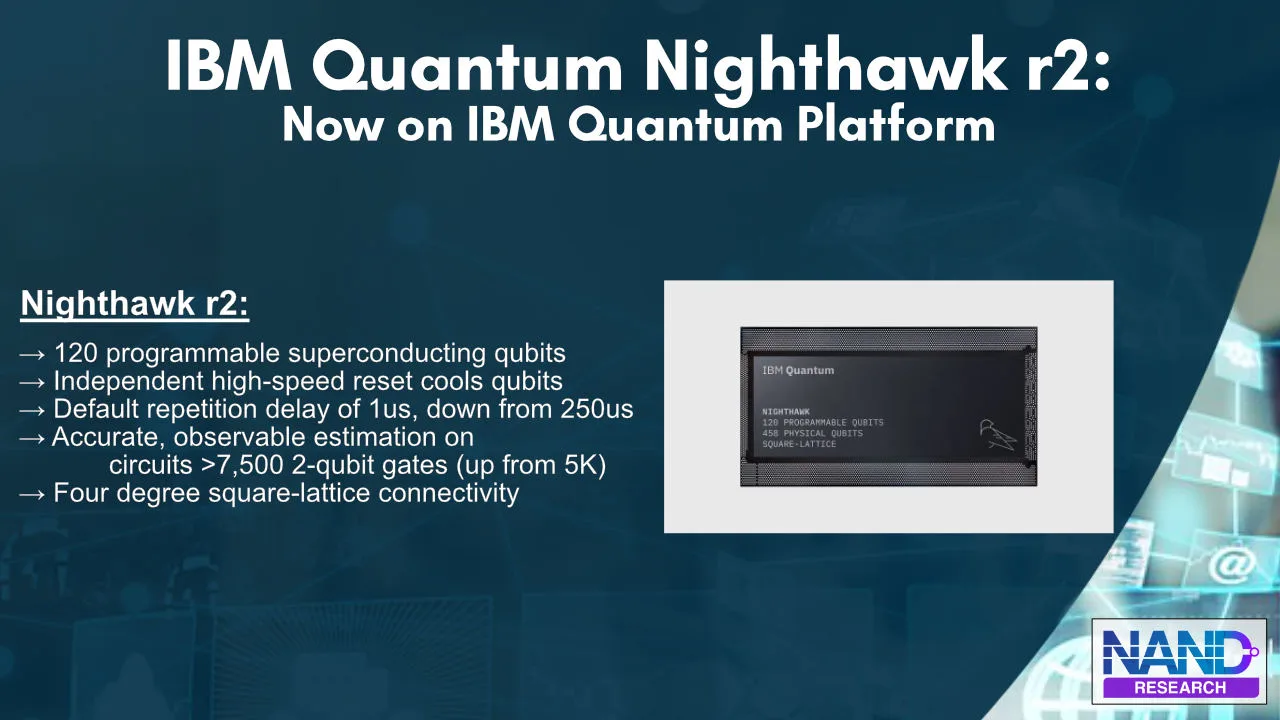
- Nighthawk (120 qubits, 5,000 two-qubit gates) is currently available on the IBM Quantum Platform, delivering 30% more circuit complexity than its predecessor, Heron.
- Kookaburra, expected in 2026, will be IBM’s first error-correction-enabled module.
- Cockatoo in 2027 will demonstrate entanglement between separate QEC-enabled modules.
Those milestones lead into Starling’s phased rollout: magic state injection across multiple modules in 2028, with full-system delivery in 2029.
IBM has already deployed more than 90 quantum systems, more than all other industry players combined, with an installed base spanning over 325 Fortune 500 companies, universities, and government agencies.
Anderon: America’s Quantum Foundry
Just a week before IBM announced its investment, the U.S. Department of Commerce issued a Letter of Intent for a $2 billion quantum manufacturing initiative as part of its CHIPS Act funding.
The agreement provides IBM with approximately $1 billion in CHIPS Act funding and requires IBM to contribute a matching $1 billion in cash to launch Anderon, a standalone company that will operate as the first pure-play quantum chip foundry in the United States.
Anderon will be headquartered in Albany, New York, and will operate a 300-millimeter quantum wafer fabrication facility. It’s a choice that aligns the operation with IBM’s existing semiconductor manufacturing supply chain, whose efforts are centered in the region.
The facility will initially focus on superconducting qubit wafers and related control electronics, with plans to expand into additional qubit modalities over time. IBM has pledged to contribute intellectual property, assets, and workforce, and is actively recruiting outside investors as the company scales.
The comparison to TSMC is hard to avoid. Anderon’s model, a standalone foundry offering fabrication services to competing quantum hardware vendors, mirrors the neutral-manufacturer dynamic that allowed TSMC to become indispensable to the classical chip industry.
IBM’s own $1 billion contribution and its base of 90-plus deployed systems give Anderon immediate credibility that a startup foundry cannot replicate.
CHIPS Act Funding Across the Ecosystem
IBM wasn’t the only beneficiary of the funding from the CHIPS Act. The full $2.013 billion amount spans nine companies, including:
- GlobalFoundries: Receives $375 million to expand secure domestic foundry capacity across superconducting, trapped-ion, photonic, topological, and silicon-spin quantum architectures.
- The pure-play cohort: D-Wave, Rigetti Computing, Infleqtion, PsiQuantum, Quantinuum, Atom Computing, and Dirq each receive between $38 million and $100 million in funding, with targets including error correction, photonic packaging, cryogenic integration, and neutral-atom optical systems.
As part of the arrangement, the US Commerce Department will take a minority, non-controlling equity stake in each recipient, following the model used in last year’s Intel CHIPS award.
Why This Moment Matters
The commercial potential is substantial. The quantum computing market is projected to generate up to $850 billion in economic value by 2040, with high-impact applications spanning drug discovery, financial modeling, materials science, climate simulation, and cryptography.
Despite its momentum, IBM isn’t the anointed king of quantum. The environment is increasingly competitive, with IBM most challenged by four companies:
- Quantinuum: IBM’s strongest enterprise and fault-tolerance challenger, which recently filed an S-1 with plans to go public
- Google Quantum AI: IBM’s strongest technical research rival.
- PsiQuantum: the market’s highest-risk/highest-reward long-term disruptor.
- IonQ: the strongest public-market commercial challenger.
Beyond these players sit a half-dozen credible challengers, including Rigetti Computing, PsiQuantum, Atom Computing, and QuEra Computing. This doesn’t include the emerging Chinese players.
But IBM’s combination of deployed hardware scale, a sovereign manufacturing asset in Anderon, a detailed processor-by-processor roadmap, and $10 billion in committed capital sets a benchmark that the rest of the field will now have to meet.
The CHIPS Act funding also matters beyond its dollar value. Federal equity stakes in nine quantum companies, the largest quantum R&D commitment in U.S. history, establish quantum computing as a national industrial priority alongside semiconductors and AI infrastructure. That policy will shape procurement, research funding, and competitive dynamics with China for years to come.
IBM has spent two decades building toward this moment. The hardware scale, the software ecosystem through Qiskit, and now the manufacturing infrastructure through Anderon give the company a structural advantage that is difficult to replicate quickly.
The open question is execution, including whether IBM can deliver Starling on schedule and whether Anderon can operate as a genuine open foundry without disadvantaging IBM’s own quantum customers.
This is a company with wind at its back, an ecosystem ready to engage, and a CEO laser-focused on success. Its chances seem pretty good.