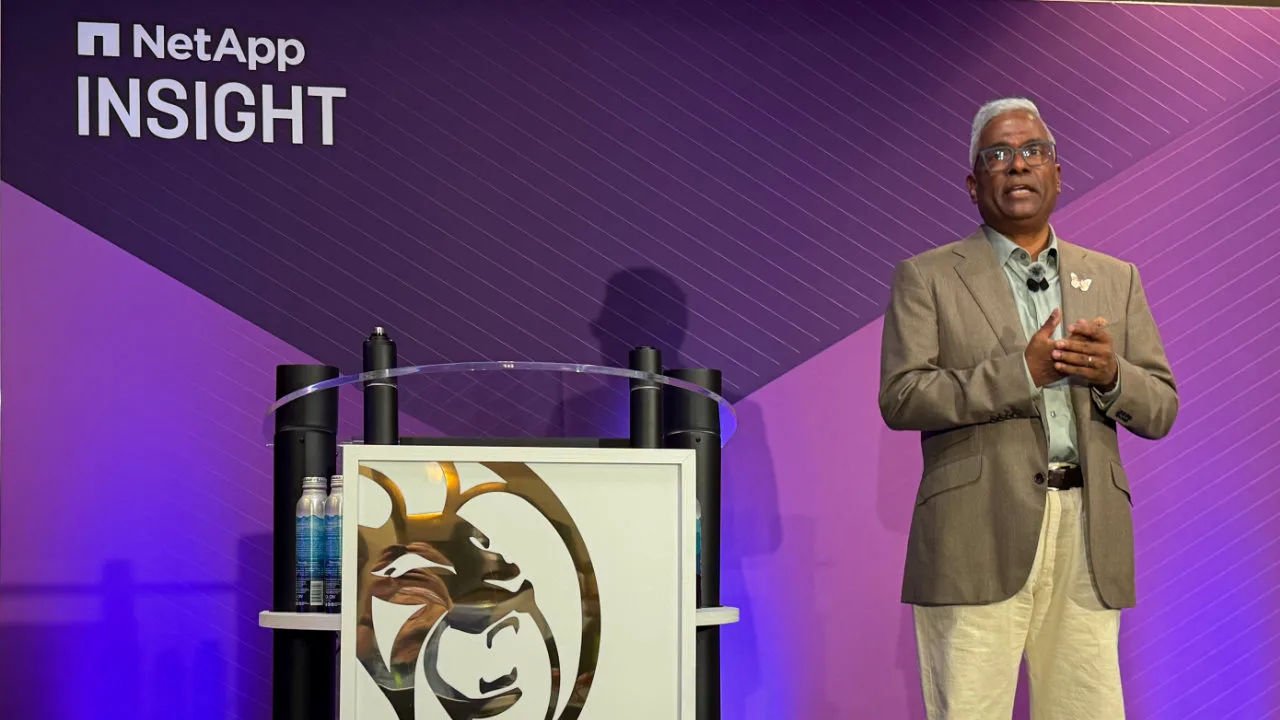
At NetApp’s recent INSIGHT 2026 event in Las Vegas, I had the chance to speak with CEO George Kurian about the state of the business (one of my favorite things about this job). Below is an edited transcript of our conversation.
Our coverage of the key announcements made at the event includes:
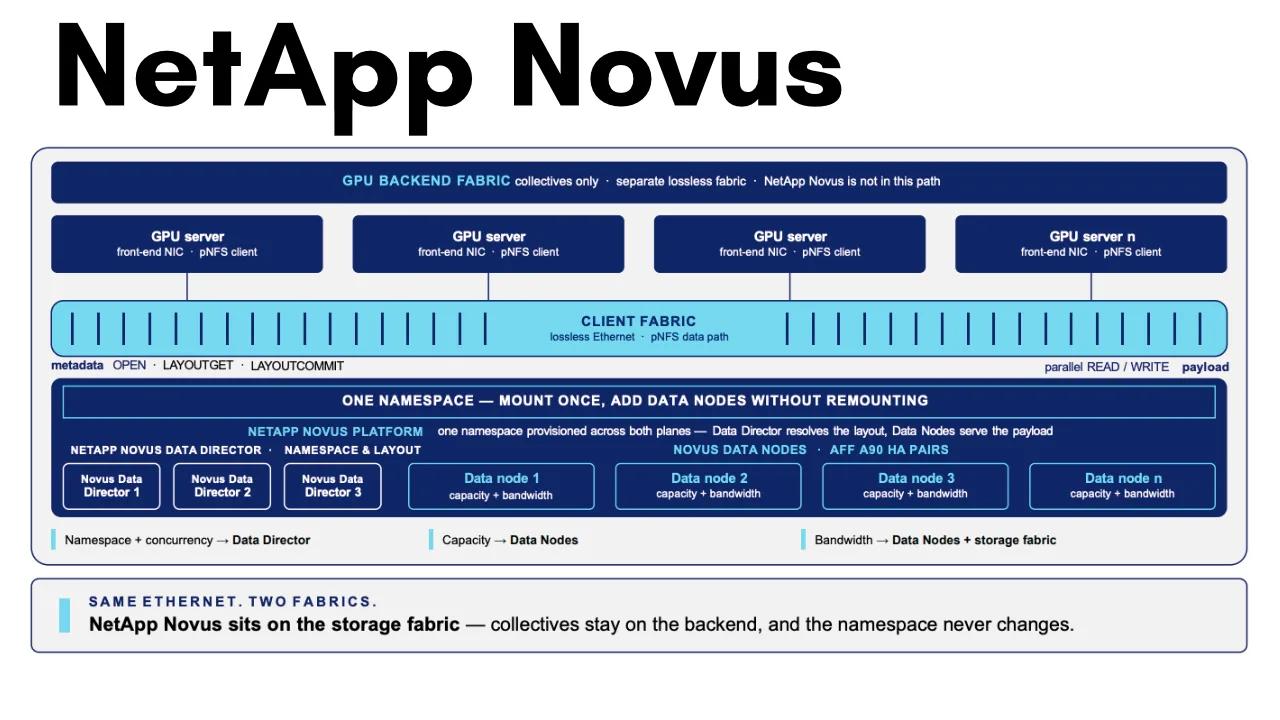
- Research Note: Novus Scalable Filesystem for AI Training & HPC
- Research Note: NetApp INSIGHT 2026 Announcement Round-Up
- Research Note: NetApp to Acquire PEAK:AIO (announced prior to event start)
Transcript edited for clarity and readability.
Steve McDowell: I saw IDC’s latest numbers last week. Congratulations on the growth. [NetApp grew an estimated 35.7%, recognizing ~$988M in calendar Q3 2026 and holding ~9.6% worldwide storage revenue share].
When you look at your own business and across your competitive landscape, are you happy with where you landed and the growth that you saw?
George Kurian:
The average enterprise has a relatively tight IT spending budget. I think what we see right now, and this is all public data, is that IT spending is growing strongly, driven by application process and AI transformation.
I think the infrastructure portion of that is getting a higher-than-fair share.
Some of that is related to inflation, and some of that is related to just modernization. I think in our business, we saw, as we reported on our earnings call, capacity growth in the high-performance flash.
And because we provide cost-effective hybrid flash solutions, we saw it growing there, not so much on capacity flash.
Are you still seeing the growth in hybrid?
We’re the only ones with the latest, greatest software running on hybrid. And we are seeing that, we said in our earnings call, that we’ve seen growth for two quarters now, and we are seeing a strong outlook.
Clearly, if, you know, at the bottom of the cycle, NAND flash was three to four times the cost of disk, it’s now orders of magnitude higher, maybe five times that number.
So 20x the cost of disk.
Are you seeing the slope of that curve come down at all?
I think the rate of increase, what we said on the earnings call, was the rate of increase is slowing down. But it’s still extraordinarily high.
I’m constrained by demand. The demand is, you know, I think the best place to look at that is what the NAND providers report. Their outlook has been extraordinarily strong.
It is, but they’ll tell you that they’re sold out.
So I guess the real question I’m driving toward here is: when you look at your supply chain, how do you feel about where you are with your supply chain and kind of deal stability from the time you quote, from a price perspective?
I think what we told our investors was that when we provide guidance, we have supply to back up the guidance. And we raised our guidance materially at the end of Q1.
We never really do that.
And so we have worked on supply agreements across pretty much every supplier of DRAM and NAND and hard drives. And it’s a good amount of work, but you’ve got to do that.
Switching gears. Last week you announced the acquisition of PEAK:AIO, and this week you’re announcing Novus. These are good announcements.
I want to get your perspective on how the big AI cluster is evolving with enterprise; it’s a constrained set of buyers, but a big revenue opportunity?
It’s a big revenue opportunity, but a small number of customers, and it’s very competitive in that space. Three years ago, I would have to call Vast or WEKA, but now pretty much everyone in your peer group has a solution there or is aiming toward one.
How do you characterize your opportunity in that market? Is it just NeoCloud? Are you seeing, the growth of GPU clusters on-prem for enterprise?
I think that first of all, Novus is an order of magnitude higher in scale and performance than anything else in the industry. I think if you look at most of the published benchmarks by our competitors, they are in the 15 terabytes per second.
We are north of 100, independently validated.
If you look at most of the other solutions in the market, they are, from a capacity standpoint, a few exabytes, maybe tens of exabytes. We are north of 1,500 exabytes.
We dwarf the competition. Our strengths are really the technology and our experience doing it at hyperscale.
We have control planes and operational capabilities and the ability to support customers at the biggest scale possible. And that should give our clients these very large model builders, our target clients, the confidence that we know how to do it better than anybody else.
With regards to the opportunities for this technology, two or three things:
I think first is we see AI factories in multiple flavors. I think clearly neoclouds. And if you look at sovereign AI factories, you’re seeing more and more players get into that market.
You saw the deal between Akamai and Anthropic. And so as AI, you know, compute demand is extraordinary and more and more private capital sources get into the market, there’s an opportunity for us, a broader opportunity, because wherever there’s a large compute cluster now, we have an opportunity to sell storage.
I think the second is that we are bringing it to all platforms. On-prem, public cloud, some of the traditional HPC environments. Sovereign, and over time, too, our hyperscaler solutions as well.
We will enable Novus on top of our first-party cloud storage services so that we can deliver that [eventually – no announcement is being made here].
With regard to the use cases in the enterprise, you know, there’s probably two or three.
One is there are high-performance computing landscapes in the enterprise. So you look at large-scale semiconductor design. You look at, you know, kind of elements of, you know, reservoir modeling.
You look at certain parts of the media rendering applications. You look at certain parts of life sciences that look very much like high-performance computing landscapes.
We think that those are targets.
And then, as Agentic takes off, what you see is you may not need the scale of Novus at its largest scale, but you need the throughput and the concurrency applications of Novus because agents can be highly concurrent.
You could have many, many agents going after the same piece of data, and the metadata service that Novus has uniquely allows us to serve that.
What’s your go-to-market for Novus? You’re targeting neoclouds initially and hyperscalers.
Do you see ultimately that this becomes part of a cloud offering with your public cloud work? I’m not asking to pre-announce anything, but from a vision perspective.
All of those use cases I talked about, we will pursue them through the right channels.
I think in some cases we’ll work with our channel partners to deliver it. In other cases, we’ll work more tightly with the customer itself.
We are working with some of the model builders to bring solutions to the enterprise, combining the LLM together with infrastructure and some partner solutions for inference.
It really depends on the customer use case.
Do you have line of sight to your first deal?
I don’t want to comment.
I’m not going to ask you who it is.
I would say Novus had input from several clients who were keenly interested in it. They’ll tell you more as you get to the market.
You’ve done a lot of acquisitions over the past two years, and they’ve all been very positive.
Where do you feel like you’re gapped? What’s next? Or are you going to sit back and absorb for a bit?
I think the landscape is changing quickly. And when you play in a landscape like that, you have to be super disciplined about what you choose to play in and where you should partner.
In our case, we wanted to build the most capable infrastructure solutions, which we now have.
With Novus and DataPelago at the layer above it, we think we have really compelling solutions.
I think that there are elements of the data stack above us where we don’t have all the capabilities, but where the stack is changing quickly.
You want to be disciplined about where you play and where you don’t play.
You’re embracing a new set of buyers, and, in some instances, a new set of competitors, many of whom are very entrenched.
What I’ve always respected about NetApp is you take a very disciplined approach and haven’t had many missteps.
It was refreshing coming out of the July Analyst Conference, too, how balanced the story is.
I go to some of your competitors’ events, and it’s all AI all the time. And enterprises don’t run on AI today.
Correct. It’s a future state.
And I think immediately after [your investor event], you did a data protection acquisition. You’re not forgetting your full customer.
Correct. I think what we would say is that we have future-proofed ONTAP better than anybody else in the planet. We brought ONTAP from file storage to databases, to virtualization, to the biggest public cloud, to now the biggest AI factories.
And a customer that has invested with us has had extraordinarily capable roadmaps, right?
There is literally nobody else in the industry who has done that. And that is why, in the AI factory use case, we chose to bring ONTAP forward because we know that the customers, the suppliers, the channel partners have made so much investment in that.
With regard to the traditional enterprise use cases, there’s a lot of announcements here.
I think we’ve got announcements with Commvault around a complete data protection offering. We’ve got announcements with Nutanix around a complete virtualization offering
We have brought Keystone to European sovereign landscapes where customers want to have their data, entirely in a European environment. We give them a management console, logs, and the entire stack in a completely sovereign environment.
We have autonomous management so that you can operate your environment using chat, for example, together with all the controls that we have built in.
And so, yeah, while we may be making announcements that are, you know, giving our clients a roadmap into the future, we’re not leaving their existing estates benign.
That’s a powerful story.
We’re right at time. Thank you so much.
Thank you for coming. It’s good to see you.