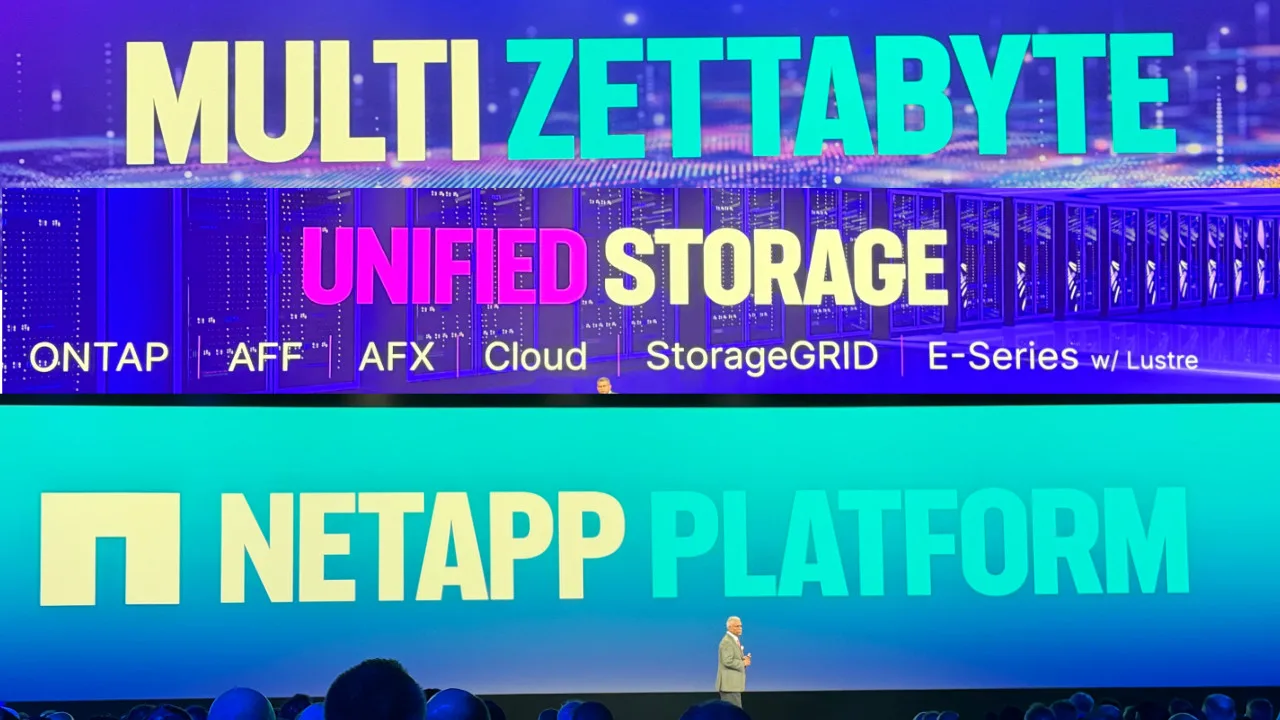
NetApp used its INSIGHT 2026 conference in Las Vegas to announce a broad set of platform, cloud, and partner updates alongside its headline Novus AI factory architecture (which NAND Research covers in a separate note).
The product announcements include:
- New sovereignty controls for its Keystone storage-as-a-service offering for European customers.
- NetApp Console extended with a customer-installed delivery model
- AI-assisted autonomous operations
- A conversational ChatOps interface
- NetApp AI Data Engine (AIDE) expanded to discover metadata on non-NetApp storage.
Its cloud and partner announcements include:
- A planned Oracle Cloud (OCI)-native ONTAP service
- An expanded SAP partnership
- A strategic collaboration with Supermicro
- Deeper cyber recovery integration with Commvault
- General availability of its Nutanix integration.
Taken together, the announcements make ONTAP the consistent data layer across every major location where enterprises run workloads, with an AI-driven control plane and data services layer above it.
Announcement Details
The announcements span infrastructure consumption, management software, AI data services, and partner integrations. Some items are generally available now, while others are pilots, previews, or statements of intent with no committed ship date.
Keystone Sovereign
Keystone Sovereign adds sovereignty controls to NetApp’s Keystone subscription offering for qualified customers in the European Economic Area. NetApp frames the requirement as extending beyond where data sits to who can access it, where telemetry flows, and where support is delivered.
The new controls include the following capabilities.
- European-based residency for relevant customer data, logs, backups, and telemetry, where applicable
- Support and escalation paths based in Europe
- Access and management processes under European control
- Documentation of telemetry, monitoring, and data flows
- Contractual and legal structures that reinforce sovereignty commitments
Initial pilots run in Germany and France, with additional countries planned. NetApp also stated during the keynote that customers can select where hardware is hosted and that local staff will provide operational support.
Executives separately referenced “Keystone Local,” which extends more of the platform into dark sites and sovereign environments, though NetApp published no standalone detail on that offering.
NetApp Console
NetApp Console is the company’s unified control plane for storage systems and data services across on-premises and cloud environments.
NetApp added three capabilities to it at INSIGHT:
- Console Fleet Management: A second Console delivery model installed directly in the customer’s environment, including dark sites, alongside the existing SaaS service. It manages the full estate as a single entity with observability and AI features, so Console now ships as one product with two delivery models.
- Console Autonomous Operations: AI-assisted operations with human oversight that predict issues, speed incident resolution, and optimize capacity and cost through API-first design and agentic orchestration. NetApp states the capability runs in air-gapped environments.
- Console AI ChatOps Interface: A conversational interface for intent-based provisioning, policy guardrails, AI-generated reporting, predictive analytics, and automated remediation across ONTAP systems. An open LLM gateway lets customers bring their own language model, and NetApp states that all actions stay within defined storage classes, policies, and governance boundaries.
NetApp also said it is bringing StorageGRID and E-Series under Console, and it pointed customers to an ONTAP MCP server for provisioning from agent tooling.
AI Data Engine
AIDE is NetApp’s AI data services layer, which catalogs and prepares unstructured data for analytics, assistants, and agents. Before this release, its metadata capabilities applied only to NetApp-stored data.
The update adds the following capabilities:
- Metadata discovery across ONTAP, StorageGRID, and third-party storage systems
- In-place discovery across NFS, SMB, and S3 repositories with no data copying
- Use cases spanning identification of AI-ready data, security risk reduction, capacity optimization, and migration planning
NetApp previewed further AIDE capabilities without committing to dates, including expanded AI-driven data understanding, deeper governance intelligence, open analytics integrations with Starburst and Onehouse.AI, and new agentic services.
NetApp describes the overall model as zero-copy data activation, with semantic search, knowledge graphs, and decision context on its roadmap.
The company also offered customers data mapping at no cost for six months.
Cyber Resilience with Commvault
The expanded NetApp and Commvault joint solution connects NetApp’s Autonomous Ransomware Protection signals on primary storage directly to Commvault recovery workflows.
From the Commvault console, joint customers get near-real-time threat detection, deeper scans for evasive threats, cleanroom validation with AI threat detection in an isolated environment, and clean recovery.
The integration lets customers recover in minutes where recovery previously took days or weeks, without reinfection.
Cloud and Ecosystem Partnerships
NetApp announced or expanded five partner relationships at the event, with availability ranging from immediate to undated:
- Oracle: A fully managed, OCI-native storage service that brings ONTAP data management to Oracle Cloud Infrastructure, managed through the OCI Console, OCI SDKs, and ONTAP APIs. Target workloads include databases, enterprise applications, virtualized environments, EDA and HPC, regulated applications, and AI data pipelines. General availability is planned within the next 12 months.
- SAP: An intent to deepen cloud-native integration with SAP Cloud Infrastructure, SAP’s infrastructure-as-a-service platform, where NetApp already supplies file and block storage. The companies plan to explore joint go-to-market work and a technical validation of StorageGRID object storage.
- Supermicro: A strategic collaboration to deliver jointly validated AI infrastructure for AI factories, enterprises, neoclouds, and sovereign AI programs, pairing Supermicro rack-scale compute, networking, power, and liquid cooling with the NetApp Platform. The companies also introduced NetApp AIPod with Supermicro, a converged design built to the NVIDIA Enterprise Reference Architecture for deployments of dozens to hundreds of GPUs, sold through NetApp channel partners.
- Google Cloud. Google Cloud NetApp Volumes now supports 200 GB/s of throughput.
- Nutanix: Covered in the virtualization section below.
Virtualization
The Nutanix integration, first announced in the spring, lets NetApp AFF and select FAS systems serve as external NFS storage for the Nutanix Cloud Platform and AHV, with migration supported by the NetApp Shift Toolkit and Nutanix Move.
NetApp also listed its supported virtualization targets as VMware, Red Hat OpenShift, Proxmox, Hyper-V, Azure Local, and cloud virtualization platforms, and confirmed that Shift is included in the ONTAP One license at no additional cost.
Impact Analysis
NetApp’s strategy centers on the NetApp Platform as a single, disaggregated data layer that runs everywhere an enterprise operates. INSIGHT 2026 reinforced that strategy along three lines: ubiquity across clouds, intelligence in the control plane, and data services that sit above the storage layer.
The key points are as follows:
- Cloud ubiquity: OCI completes NetApp’s presence across the four largest public clouds. NetApp describes itself as the only enterprise storage platform natively embedded in the largest clouds, and the Oracle service extends that structural advantage, although it will not ship for up to a year.
- Beyond NetApp storage: Heterogeneous AIDE discovery moves NetApp into the data management tier, where it can reach data outside its installed base. The risk is that value accrues to the data intelligence layer while the underlying storage becomes interchangeable, which cuts both ways for a storage vendor.
- Sovereignty timing: Keystone Sovereign arrives as European demand for operational sovereignty accelerates, giving NetApp a timely answer in a market where hyperscalers face scrutiny. The two-country pilot limits near-term revenue impact.
- Acquisition-driven roadmap: The DataPelago acquisition in July and the planned PEAK:AIO acquisition announced just before INSIGHT show NetApp buying technology to close AI data services and metadata gaps. That approach accelerates the roadmap but adds integration risk.
Practitioner Impact
The practitioner impact concentrates on storage and infrastructure teams running large hybrid ONTAP estates, European organizations under sovereignty mandates, and teams planning a VMware exit:
- Fleet operations: Console Fleet Management and Autonomous Operations deliver the most value to administrators managing hundreds of ONTAP systems across sites. The local delivery model removes a long-standing objection for defense, public sector, and financial services customers that couldn’t use a SaaS control plane.
- AI-assisted administration: Bring-your-own-LLM gives security teams control over which model touches infrastructure, but it also hands them new governance work, including model selection, prompt and action logging, and approval policies for destructive operations.
- Data discovery: Heterogeneous AIDE discovery gives data and AI teams an inventory of unstructured data across vendors without a migration project. Scanning third-party arrays still requires credentials, network access, and scan scheduling that adds load to production systems, and turning a metadata inventory into AI-ready data requires classification and governance decisions that no tool automates.
- Sovereignty: Keystone Sovereign gives European regulated customers a subscription path that meets residency and operational-access requirements. With pilots limited to Germany and France, customers elsewhere in the EEA need to confirm timing and review exactly which data flows remain outside the region.
- Virtualization: The Nutanix integration gives VMware-exit planners a path that preserves ONTAP snapshots, replication, and ransomware protection. The integration is NFS-only, which suits most virtualization estates but excludes block-dependent designs.
- Cyber recovery: The Commvault integration shortens the path from detection to clean recovery, but it requires both platforms and the operational process to act on joint alerts.
Competitive Landscape
NetApp competes on multiple fronts with these announcements:
- Enterprise storage rivals Dell Technologies, Everpure, and HPE compete for the same as-a-service and fleet management budgets.
- AI-native platforms such as VAST Data compete for AI data services mindshare
- Vendor-neutral data management tools compete with heterogeneous AIDE discovery
- Hyperscaler file services compete with NetApp’s own first-party cloud offerings.
The main competitive dynamics are as follows:
- NetApp’s clearest differentiation is hybrid cloud consistency, since ONTAP runs as a native service in AWS, Azure, and Google Cloud today, with OCI to follow.
- Everpure and HPE match NetApp closely on subscription consumption and fleet management, and HPE brings a mature disconnected and sovereign delivery model through GreenLake.
- Everpure delivered its Nutanix integration to general availability ahead of NetApp, erasing any first-mover claim NetApp would otherwise hold in that segment.
- Vendor-neutral tools such as Komprise and Hammerspace present AIDE with a credibility challenge, because customers often prefer a storage-agnostic vendor to catalog data that sits on competing arrays.
- AI-native platforms hold stronger positions in greenfield AI environments, where NetApp’s enterprise data services carry less weight.
The following table summarizes how the principal alternatives compare with the non-Novus announcements NetApp made at INSIGHT 2026:
| Alternative | Model / Approach | Key Strength | Compared to NetApp |
| Dell Technologies | PowerStore, PowerScale, and ObjectScale arrays consumed through APEX, with AIOps for fleet monitoring | Broadest infrastructure portfolio and the ability to bundle servers, storage, and AI factory systems in one deal | Matches NetApp on as-a-service and AIOps, trails it on first-party native storage services inside the major public clouds |
| Everpure | Evergreen//One SLA-backed subscriptions with Pure1 and Fusion fleet management | Mature subscription economics and a simple, consistent fleet management experience | Direct rival for Keystone and Console Fleet Management; reached Nutanix general availability ahead of NetApp and lacks native services in all four hyperscalers |
| HPE | Alletra MP storage delivered through GreenLake, including private and disconnected cloud options | Strong sovereign and air-gapped delivery story, backed by an in-house compute portfolio | Competes closely on sovereign as-a-service; NetApp holds the stronger hybrid cloud data layer through ONTAP |
| VAST Data | Unified AI data platform combining storage, database, and cataloging on its own software stack | Deep AI-native data services and momentum with neoclouds and GPU cloud providers | Stronger in AI-native environments, weaker in heterogeneous enterprise estates and hybrid cloud reach |
| Komprise and Hammerspace | Vendor-neutral data management and global metadata across third-party storage | Storage-agnostic positioning with no incentive to favor a particular array vendor | Overlap directly with heterogeneous AIDE discovery; NetApp offers a tighter link to ONTAP data services and cyber resilience |
| Hyperscaler file services | Amazon EFS, Azure Files, Google Filestore, and OCI File Storage | Native integration, pay-as-you-go pricing, and no third-party contract | Compete with first-party NetApp services on price and simplicity, but lack ONTAP replication and hybrid consistency |
NetApp’s differentiation is strongest where the ONTAP footprint spans on-premises and multiple public clouds, a position no direct storage competitor replicate across all four hyperscalers.
It is weakest in the emerging AI data services tier, where vendor-neutral tools and AI-native platforms have a head start and NetApp must prove that a storage vendor can credibly govern data it does not own.
Final Thoughts
Outside of Novus, INSIGHT 2026 delivered practical, incremental advances that make the NetApp Platform easier to consume in regulated markets, easier to operate at fleet scale, and available in more places.
Keystone Sovereign, the local Console model, and the Nutanix integration respond directly to customer requirements NetApp has heard for several years, and each removes a specific objection in a specific segment.
The Oracle and Supermicro partnerships widen the channels through which ONTAP reaches customers.
The most consequential move is the decision to point AIDE at non-NetApp storage. With it, NetApp extends its ambition from being the best place to store enterprise data to being the layer that understands it all.
If NetApp executes well, the company converts its hybrid cloud footprint into control over how enterprise data reaches AI agents, and that is a considerably larger market than storage alone.