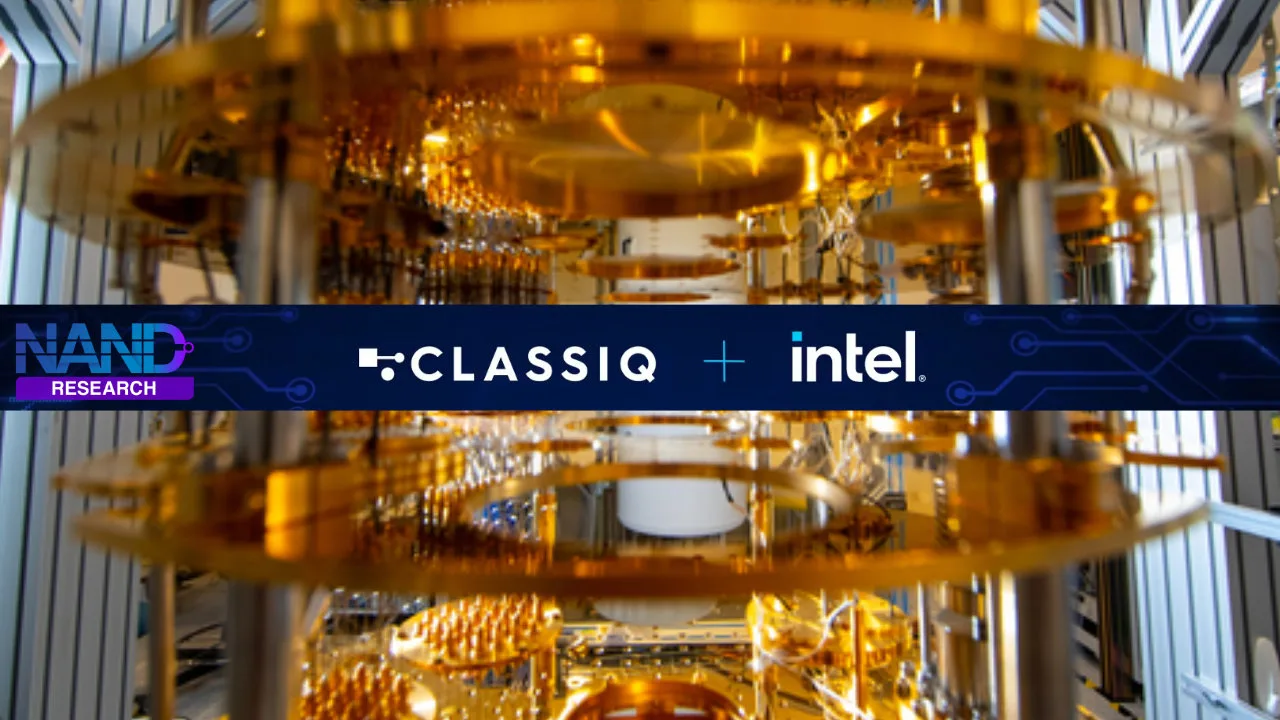
Intel announced it has signed a definitive agreement to acquire Classiq, the Tel Aviv-based company whose platform converts high-level descriptions of quantum algorithms into optimized circuits that run on most major quantum hardware.
While Intel did not disclose the financial terms, Calcalist reports a $2.3 billion cash-and-stock deal, making it the largest acquisition of a quantum computing company to date.
Here’s a quick snapshot of the deal:
- Structure and timing: Intel and Classiq signed a definitive agreement. Closing is expected in the first half of 2027, subject to regulatory approvals and customary conditions. The two companies will operate independently until then.
- Price: Calcalist reports a $2.3 billion deal in cash and shares, more than three times the roughly $600 million to $700 million valuation of Classiq’s 2025 funding round.
- Employee and founder payouts: Calcalist reports that employees own about 10 percent of Classiq, valued at around $230 million at the deal price; that Intel allocated more than $100 million in additional retention grants; and that each of the three founders expects between $80 million and $100 million.
- Related-party interest: Lip-Bu Tan personally invested in Classiq before taking the Intel CEO role. Sources close to Classiq told Calcalist that Tan did not participate in the negotiations, and that Intel board policies bar him from attending or voting on matters in which he has a conflict.
- Israel footprint: Calcalist describes the deal as Intel’s largest in Israel since its roughly $1 billion purchase of Moovit in 2020.
The deal gives Intel the software layer its quantum program has lacked. Intel has built silicon spin-qubit chips and cryogenic control electronics on its own manufacturing lines since 2015, though its most recent public quantum chip, the 12-qubit Tunnel Falls, dates from 2023.
Classiq brings enterprise customers, more than 60 filed patents, and integrations with the major quantum clouds and hardware vendors.
Classiq’s value depends on neutrality, yet its customers and investors, including AMD Ventures, Qualcomm Ventures, and IonQ, now rely on a platform owned by a company that builds competing quantum hardware.
While Intel says it will keep Classiq’s platform hardware-agnostic after closing, that’s something to watch as Intel expands its quantum hardware program.
Who Is Classiq?
Classiq is a quantum software company based in Tel Aviv and founded in 2020 by Nir Minerbi (CEO), Amir Naveh (Chief Product Officer), and Dr. Yehuda Naveh (CTO). Minerbi and Amir Naveh trained in the Israeli military’s Talpiot technology program, and Yehuda Naveh spent roughly two decades at IBM before joining them.
The Classiq platform lets developers use a high-level modeling language to specify what a quantum program must accomplish and the resource constraints it must adhere to. A synthesis engine then generates an optimized, hardware-ready circuit and can handle circuits with millions of gates.
Intel compares this role to EDA in chip design, where software abstracts the chip layout from the underlying process.
Classiq reports that dozens of global enterprises and hundreds of academic institutions use the platform. Named customers include BMW, Rolls-Royce, HSBC, Citi, Comcast, Toshiba, SoftBank, and Deloitte, and Bloomberg lists AT&T among its clients. The company also works with Microsoft, AWS, and NVIDIA.
Classiq has raised about $200 million. According to the company, its $110 million Series C, led by Entree Capital in May 2025, was the largest round on record for a quantum software company. A strategic round of roughly $30 million in November 2025 added AMD Ventures, Qualcomm Ventures, and IonQ.
Classiq at a Glance
| Item | Detail |
| Founded | 2020, Tel Aviv, Israel |
| Founders | Nir Minerbi (CEO), Amir Naveh (Chief Product Officer), Dr. Yehuda Naveh (CTO) |
| Employees | About 150 (Calcalist, October 2026) |
| Capital raised | About $200 million, including a $110 million Series C in May 2025 and a strategic round of roughly $30 million in November 2025 |
| Notable investors | Entree Capital, Team8, Norwest, NightDragon, HSBC, Samsung Next, SoftBank, AMD Ventures, Qualcomm Ventures, IonQ, and Lip-Bu Tan personally |
| Customers | BMW, Rolls-Royce, HSBC, Citi, Comcast, Toshiba, SoftBank, Deloitte, Mizuho |
| Revenue | Not disclosed. Reports range from $1 million to $10 million (CB Insights, 2025) to below $100 million (Calcalist) |
| Patents | More than 60 filed (company statement, May 2025) |
Details
The combined stack spans algorithm design at the top and qubit fabrication at the bottom. Classiq supplies the upper layers, Intel supplies the lower layers, and the two overlap only in the compiler and SDK tier where Intel’s own Quantum SDK sits.
Classiq Platform
The Classiq platform provides the following capabilities:
- Synthesis: The engine converts functional models into optimized circuits and scales to handle circuits with millions of gates.
- Hardware portability: Classiq offers direct integrations with IBM, IonQ, QuEra, Quantinuum, Oxford Quantum Circuits, AQT, Alice & Bob, and Rigetti, as well as cloud access via AWS Braket, Microsoft Azure Quantum, and Google Cloud.
- Simulation: Classiq supports leading simulators, including those from NVIDIA and Intel, and integrates with NVIDIA CUDA-Q.
- AI assistance: The platform includes AI agents and an AI coding feature that accelerate the development of optimized, hardware-ready quantum software.
- Benchmarking and optimization: The platform includes hardware benchmarking and cost and performance optimization across hardware platforms.
Strategic Rationale
Intel’s stated logic is that Classiq does for quantum computing what EDA software did for chips, and that the deal gives Intel a full-stack quantum business, with QPUs added to its CPU, GPU, and ASIC lines.
Five factors support that case
The Software Gap
Quantum hardware vendors win developers with software, and Qiskit shows the stakes. IBM says nearly 70 percent of quantum developers use it.
Intel’s spin-qubit program has produced research chips but has generated no license revenue. Classiq closes the software gap in one step and brings a customer base that pays for its platform today.
Build versus Buy
Intel’s own SDK slowed while Classiq grew, with Intel ending its open-source compiler work in early 2026. The acquisition of Classiq replaces a software effort Intel had stopped investing in with a team of about 150 people.
Heterogeneous Compute
Intel sells CPUs, GPUs, and accelerators, and hybrid quantum-classical workflows need orchestration across all of them.
Quantum middleware and orchestration is projected to grow about 27 percent annually through 2031, the fastest-growing segment of the quantum software platform market.
Manufacturing Narrative
Intel’s quantum story is manufacturability because spin qubits use transistor-like structures that Intel fabricates on standard 300-millimeter lines.
The EDA comparison extends that story because every scalable chip technology has required a design-automation layer.
Intel has neither announced quantum foundry services nor tied Classiq to Intel Foundry.
Leadership Conviction
Tan backed quantum companies as an investor, and Intel Capital invested in QuantWare and Q-Factor in 2026. Classiq adds an operating asset to that venture activity.
| Analyst Take Intel is paying a software-company price to close a hardware-company ecosystem gap. The investment pays off if Classiq stays the neutral layer that IBM, IonQ, Quantinuum, and others keep integrating, and if Intel’s silicon qubits mature on a schedule that supports the full-stack story. |
Analysis
The acquisition moves Intel from a hardware-focused research program with a thin software story to a vendor that owns one of the best-funded independent quantum software platforms.
For Classiq, Intel supplies capital, a manufacturing narrative, and enterprise relationships, and closes the SPAC route Classiq was pursuing.
This carries both markers and risks:
- Price benchmark: At a reported $2.3 billion, the price is well above D-Wave’s $550 million purchase of Quantum Circuits earlier this year and sets a high reference point for quantum software valuations.
- Revenue multiple: For any revenue figure in circulation, the reported price exceeds 20 times Classiq’s annual revenue, a multiple that Intel justifies solely on strategic value.
- Neutrality risk: Every hardware partner that integrates it must decide how far to trust Intel to keep the platform even-handed, especially as Intel matures its own quantum hardware efforts.
Competitive Impact
Classiq’s traditional competition falls into three groups:
- Service-led providers such as Zapata that build quantum applications manually for customers.
- Platform startups such as Horizon Quantum that build software development environments.
- Hardware vendors with their own software stacks, including IBM, NVIDIA, and Quantinuum (and now Intel).
Q-CTRL and a set of application specialists occupy adjacent ground.
The table summarizes the alternatives.
| Alternative | Model and Approach | Position and Traction | Compared to Combined Intel + Classiq |
| IBM Qiskit | Open-source SDK and compiler tied to IBM Quantum hardware, with support for other back ends | IBM states nearly 70 percent of quantum developers use Qiskit. Version 2.5 shipped in July 2026 w/ fault-tolerant compilation pipelines | Qiskit has far greater developer reach. Classiq works at the level of functional models while Qiskit centers on circuit construction and compilation |
| NVIDIA CUDA-Q | Open-source, hardware-agnostic platform for hybrid quantum-classical programming with GPU simulation | Anchors GPU-accelerated simulation and HPC integration. Classiq integrates with CUDA-Q and counts NVIDIA as a partner | NVIDIA leads in simulation and HPC. Intel and Classiq lead in circuit synthesis and own a qubit manufacturing path |
| Quantinuum (Guppy, Nexus, TKET) | Vertically integrated. Trapped-ion hardware, the Guppy language, the Selene emulator, and the Nexus cloud platform, which also reaches third-party hardware | Listed on Nasdaq (QNT). Q2 2026 revenue of $8 million, up 279 percent. | The closest full-stack peer to the new Intel model. Quantinuum ships hardware today while Intel’s spin qubits remain at research-chip stage. Classiq offers broader hardware neutrality |
| Horizon Quantum | Hardware-agnostic software infrastructure with the Triple Alpha development environment and a hardware testbed | Listed on Nasdaq (HQ) since March 2026 with ~$120 million in gross proceeds | The closest platform analog. Smaller capital base, and the deal hands it the independent-vendor message |
| Zapata Quantum | Service-led applications and workflow software. Restructured and relaunched after ceasing operations in October 2024 | Rebuilding. Small footprint and limited traction | The service-led model is a minor threat today. Zapata’s collapse shows the funding risk in this segment |
| Q-CTRL | Infrastructure software for error suppression and control (Fire Opal, Boulder Opal), integrated with IBM Quantum and other clouds | Raised $113 million in Series B funding by 2024. Sydney-based, founded 2017 | Adjacent and often complementary. Q-CTRL improves results on noisy hardware while Classiq designs the circuits that run on it |
| Application and orchestration specialists | Phasecraft, Multiverse Computing, 1QBit, and Strangeworks | Domain-focused or aggregator models with smaller scale | Compete for specific verticals and workflows. None matches Classiq’s synthesis depth or hardware integrations |
Intel and Classiq differentiate most strongly on synthesis automation, the breadth of hardware integrations, and Intel’s manufacturing base, a combination no listed competitor offers.
The weakest points are developer mindshare against Qiskit, GPU simulation and HPC integration against NVIDIA, and hardware maturity against Quantinuum and IBM, both of which ship systems that customers can use for research today.
The deal creates three competitive risks for Intel:
- Hardware vendors that integrate Classiq, including IBM, IonQ, and Quantinuum, now distribute a tool owned by a rival and have a reason to steer developers toward their own abstraction layers such as Qiskit and Guppy.
- Horizon Quantum gains a clear message as the independent hardware-agnostic alternative, backed by public-market funding.
- AMD and Qualcomm, which invested in Classiq in 2025, have less reason to support a platform that Intel owns.
Final Thoughts
Intel paid a premium for the asset that fills the largest gap in its quantum program. Classiq has customers, patents, partnerships with every major quantum cloud, and a team more than twice the size it had at its Series C. Intel brings capital, a fab, and a spin-qubit approach built on transistor manufacturing.
If Intel treats Classiq as it does its foundry business, maintaining its hardware agnostisity, then the deal could be a broad-based win for the company. If not, then it still serves to bolster Intel’s quantum ambitions, but at more muted level.
Ultimately, Intel now owns the software layer that every quantum hardware vendor must decide whether to trust. That trust, more than any qubit count, will determine whether the reported $2.3 billion buys an industry standard or a tool that competitors will route around.