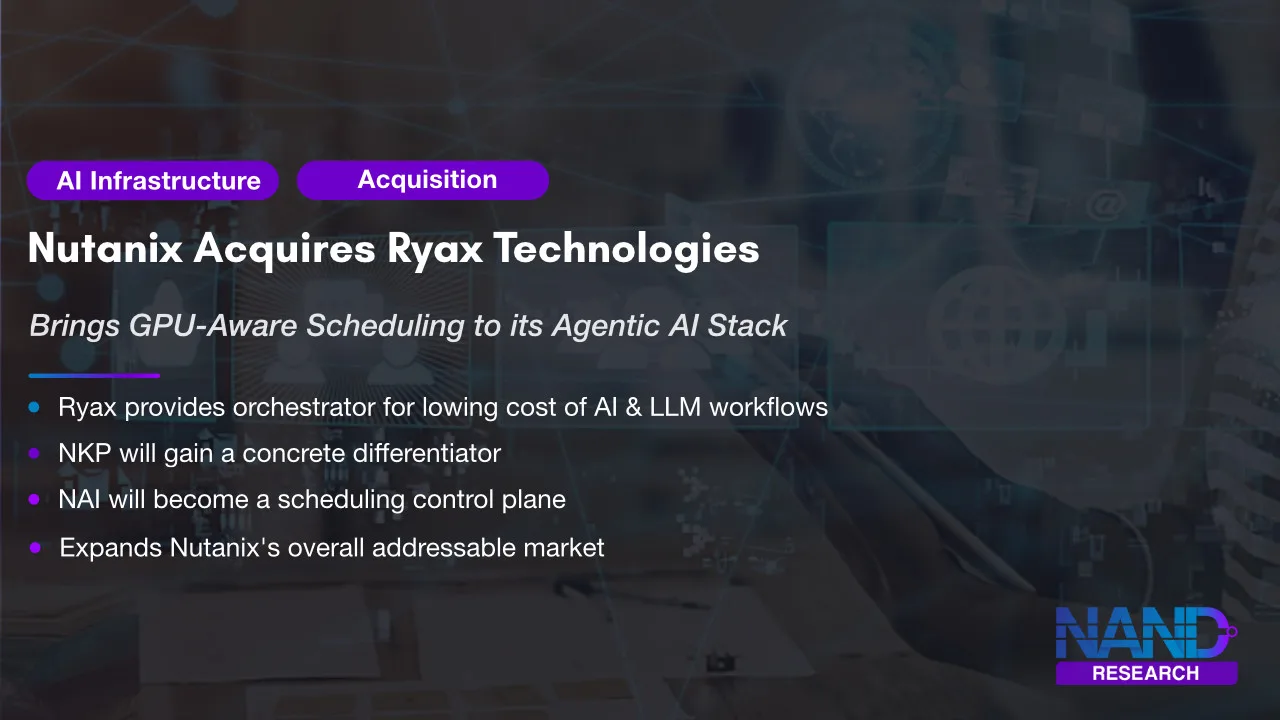
Nutanix announced its acquisition of Ryax Technologies, a French developer of AI-driven compute orchestration and workload-scheduling software, for an undisclosed amount. Nutanix plans to integrate Ryax’s GPU utilization and smart scheduling technologies into future releases of the Nutanix Kubernetes Platform (NKP) and Nutanix Enterprise AI (NAI).
The deal addresses a problem facing enterprise AI buyers. GPUs are scarce and expensive, AI workloads are distributed across private data centers, hyperscalers, neoclouds, and HPC clusters, and most Kubernetes environments still allocate accelerators via static, whole-device reservations.
Ryax brings telemetry-driven right-sizing, fractional GPU bin-packing, and cost-aware placement logic that spans all those environments.
For Nutanix, Ryax is a small tuck-in with outsized strategic relevance. It moves the company from operating AI infrastructure to deciding where and how AI workloads run, a control point that NVIDIA, Red Hat, and the hyperscalers are all contesting.
Who Is Ryax?
Ryax Technologies was founded in November 2017 in France’s Auvergne-Rhône-Alpes region by CEO Andry Razafinjatovo and CTO Yiannis Georgiou. Both founders spent more than a decade at Bull/Atos, where they led Slurm-related R&D. That HPC resource-management pedigree defines the company’s technology.
Ryax began as a data engineering platform that automated analytics workflows across hybrid edge and cloud infrastructure. Early projects focused on industrial, transportation, energy, and smart-city applications, and the company participated in the MIAI Grenoble Alpes AI institute.
As generative AI took hold, the company recast its product as an open-source hybrid IT workflow orchestrator focused on lowering the cost of running AI and LLM applications.
The Ryax Platform
The Ryax platform lets developers define a workflow as a sequence of triggers and containerized actions. The engine then handles packaging, deployment, scheduling, scaling, and monitoring, and runs the resulting application on public cloud, private infrastructure, edge, or HPC systems without code changes.
In its announcement, Nutanix highlighted the integration around two capabilities, Intelligent Resource Optimization and AI-Aware Smart Scheduling, which map primarily to NKP and NAI, respectively.
Resource Optimization in NKP
For NKP, Nutanix plans to replace fixed resource reservations with sizing decisions made for each execution:
- Dynamic sizing that uses historical telemetry to set CPU, memory, and GPU allocations for each execution, with automatic recovery from out-of-memory failures.
- Fractional GPU bin-packing via Ryax Intelliscale, which places multiple containerized workloads on a single accelerator using mechanisms such as NVIDIA Multi-Instance GPU (MIG).
- Serverless GPU allocation that assigns accelerators only during active execution and releases capacity upon job completion.
Smart Scheduling in NAI
For NAI, Ryax contributes a global workload scheduler that evaluates training, batch, and inference jobs against cost, performance, and energy objectives before selecting execution resources.
In its announcement, Nutanix describes the following scope:
- Placement across multi-cluster Kubernetes, public clouds, and existing Slurm HPC clusters.
- Scheduling across both NVIDIA and AMD accelerator fleets.
- History-based autoscaling of CPU, memory, and fractional GPU capacity.
- Energy-aware placement that incorporates hardware power models into scheduling decisions.
Strategic Rationale for the Acquisition
Nutanix has spent 2026 assembling an agentic AI stack layer by layer:
- AMD made a $250 million strategic investment in the company in February.
- Nutanix launched its Nutanix Agentic AI solution at NVIDIA GTC in March
- Shipped NAI 2.8 with a generally available MCP gateway in August.
- Announced NKP 2.19 with NKP Metal bare-metal Kubernetes and CNCF Kubernetes AI Conformance in August.
What Nutanix’s stack lacks is an intelligent resource layer. While NAI governs models and agents, and NKP runs containers, neither provides GPU workload orchestration. Ryax fills that gap, and several factors making the timing compelling:
- GPU economics gate enterprise AI: With supply constrained and Nutanix itself expecting server shortages to persist through fiscal 2027, extracting more work from installed accelerators is a measurable value proposition that resonates with finance leaders and platform teams.
- Hybrid placement operationalizes the Nutanix thesis: Nutanix sells a run-anywhere operating model. A scheduler that places workloads across on-premises, hyperscaler, neocloud, and HPC resources delivers that model at the workload level.
- Independent Slurm expertise is scarce. NVIDIA’s December 2025 acquisition of SchedMD placed the dominant HPC scheduler under the control of the dominant accelerator vendor. Ryax gives Nutanix a team fluent in both Slurm and Kubernetes and a bridge to the HPC clusters where much enterprise training work runs.
- AMD alignment: Scheduling across NVIDIA and AMD fleets reinforces the AMD partnership and gives customers an accelerator-neutral control plane.
Analysis
As noted, the acquisition touches three layers of the Nutanix portfolio, and its effect is greatest where Nutanix has the least differentiation today:
- NKP gains a concrete differentiator: Kubernetes distributions are largely commoditized. GPU-aware right-sizing and fractional sharing provide a measurable cost basis for choosing NKP for AI clusters, particularly on NKP Metal bare-metal GPU nodes.
- NAI becomes a scheduling control plane: NAI today focuses on model serving, the Agent Gateway, and governance. With Ryax, it also determines where inference, fine-tuning, and batch jobs run across a customer’s estate.
- NCP and NC2 benefit indirectly: Cross-environment placement increases the value of operating Nutanix Cloud Platform on-premises and Nutanix Cloud Clusters in the public cloud under a single operating model, reinforcing the dual-native VM and container architecture.
The integration also raises packaging questions. Nutanix sells its AI offering as a full-stack motion that includes NKP and adjacent services.
Whether Ryax capabilities ship as base features or as premium tiers determines whether they drive ARR uplift directly or primarily improve win rates. Nutanix hasn’t yet commented on its plans.
Impact on Nutanix’s Addressable Market
Ryax adds no new line item to Nutanix’s price list, and NAND Research expects no near-term change to Nutanix’s reported total addressable market. The deal’s larger effect is on the serviceable market Nutanix software can reach, in three ways:
- Reach beyond Nutanix-managed infrastructure: Ryax schedules workloads on public cloud, neocloud, and Slurm resources that Nutanix does not operate. That lets Nutanix software participate in AI spending that flows to GPU clouds and HPC clusters, a pool its HCI-centric products have historically missed.
- Entry into HPC and research computing: Slurm integration opens doors to conversations with research institutions, national labs, and enterprise engineering teams, segments where Nutanix has had historically limited presence.
- Higher software capture per AI deployment: Each GPU cluster that Nutanix wins strengthens the case for NKP and NAI subscriptions, increasing the software value captured per AI infrastructure dollar.
The expanded reach is technical before it is commercial. Revenue follows only when customers license NAI to govern resources outside Nutanix environments. Nutanix has not described how it will monetize placement on third-party infrastructure.
Against fiscal 2026 revenue of $2.85 billion and fiscal 2027 guidance of $3.18 billion to $3.23 billion, we expect Ryax’s contribution to appear in AI attach rates and competitive wins, where it will be difficult to isolate in reported results.
Competitive Impact
The resource scheduling layer for AI has become one of the most contested control points in the infrastructure stack. NVIDIA owns Run:ai and SchedMD, Red Hat builds on upstream Kubernetes scheduling projects, and each hyperscaler optimizes placement inside its own cloud.
Ryax gives Nutanix a credible entry, though it arrives later and at smaller scale than the leaders.
| Alternative | Model / Approach | Scope | Compared to Nutanix with Ryax |
| NVIDIA Run:ai and Slurm (SchedMD) | GPU orchestration and fractional GPU sharing for Kubernetes; Slurm for HPC; open-source KAI Scheduler | NVIDIA-centric, multi-environment | Most mature GPU scheduling and deepest hardware integration. Nutanix counters with accelerator neutrality, including AMD, and an integrated infrastructure platform underneath the scheduler. |
| Red Hat OpenShift AI (with IBM watsonx) | Kubernetes AI platform built on upstream schedulers such as Kueue and KubeRay plus GPU operators | Hybrid, broad infrastructure support | Closest architectural rival, with a larger Kubernetes installed base. Ryax gives Nutanix a purpose-built, cost-aware scheduler and a Slurm bridge that OpenShift assembles from upstream components. |
| Broadcom VMware Private AI Foundation with NVIDIA | VCF-based private AI with vGPU sharing | On-premises VCF estates | Strong inside existing VMware accounts, with no announced cross-cloud or Slurm placement. Ryax extends the Nutanix migration pitch to AI workloads. |
| Hyperscaler AI platforms (SageMaker HyperPod, Vertex AI, Azure ML) | Managed training and inference with native scheduling | Single cloud | Deep automation inside one cloud. Nutanix offers placement across on-premises, multiple clouds, and HPC, which no hyperscaler provides natively. |
| Open-source schedulers (Kueue, Volcano, KAI) | Do-it-yourself batch and GPU scheduling on Kubernetes | Any Kubernetes | Free and flexible, with significant integration and support burden. Nutanix packages comparable capabilities with enterprise support and governance. |
Nutanix’s differentiation is strongest in accelerator neutrality and in unifying VM, container, and HPC placement under one vendor, with its own infrastructure platform beneath.
It is weakest in maturity. Run:ai has years of production deployments, and NVIDIA’s ownership of SchedMD gives it influence over the scheduler that Ryax integrates with.
Final Thoughts
The Ryax acquisition is small in dollars but clear in intent. Nutanix identified the missing layer in its agentic AI stack, acquired a team with uncommon depth in HPC and Kubernetes scheduling for a fraction of a single quarter’s free cash flow, and directed it at the most expensive inefficiency in enterprise AI.
Questions remain. Nutanix has not set delivery dates, the headline efficiency figures come from Ryax’s own testing, and the commercial model for scheduling onto third-party clouds and HPC clusters is undefined. The competitors in this layer, NVIDIA in particular, are larger and further along.
Ultimately, this deal matters because it changes what Nutanix brings to an AI project. Nutanix now enters enterprise AI conversations with an accelerator-neutral answer to the challenge of managing GPU spend. Ryax gives Nutanix a seat at the layer where AI infrastructure loyalty will be decided, since the scheduler determines where every GPU-hour is spent.
This is a strong acquisition for Nutanix.