Nutanix recently released an open-source MCP server for the Nutanix Cloud Platform (NCP). The server sits between AI coding assistants and agent frameworks, including GitHub Copilot, Claude Code, Cursor, and the Nutanix Prism Central management plane, translating natural-language requests into calls to the Prism v4 REST API. It is now available as a free download.
The announcement addresses a problem enterprises face as they adopt AI coding and operations assistants: these tools can generate infrastructure commands quickly, but IT organizations have had no consistent way to constrain, audit, or throttle autonomous agents’ actions in production systems.
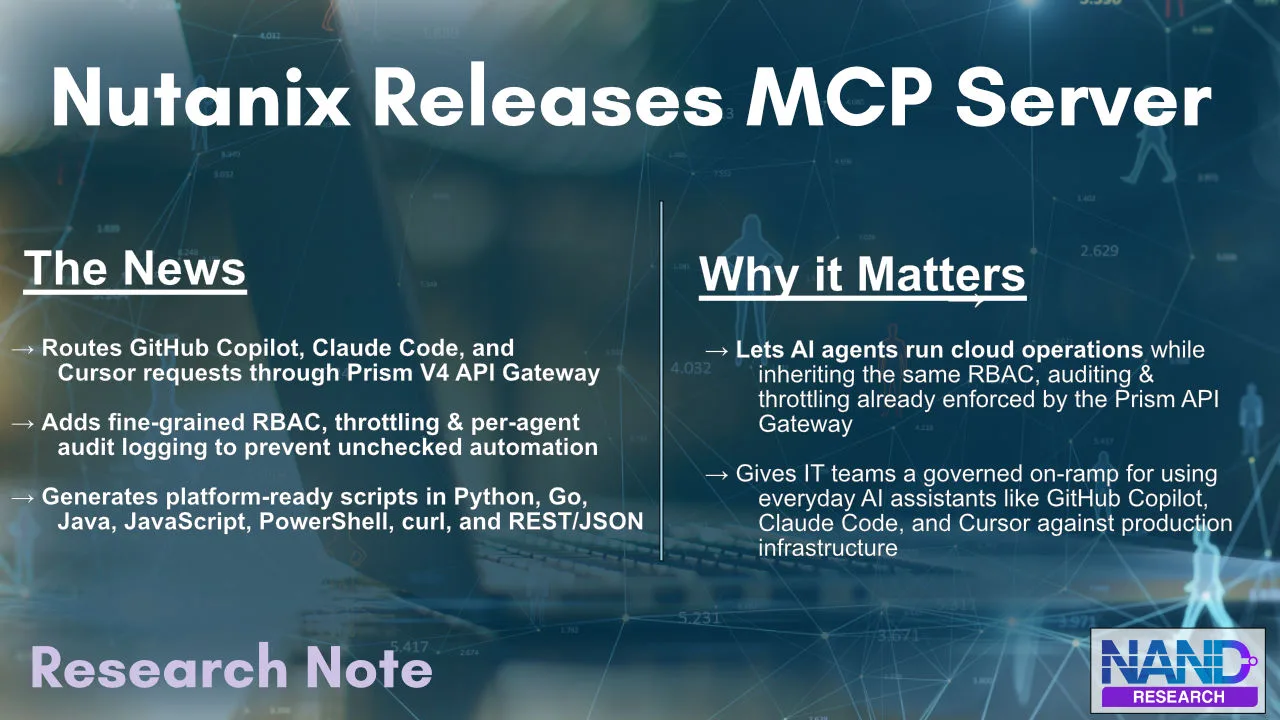
Nutanix routes all MCP traffic through the existing Prism V4 API Gateway, so agent activity inherits the same role-based access control, logging, and rate-limiting that govern human and scripted access to NCP. Rather than building a separate AI-specific security layer, Nutanix extends its existing management-plane controls to a new client class.
The release matters less for its novelty than for its timing and packaging. Community developers had already built unofficial MCP wrappers for the Nutanix API before this release, and comparable community projects exist for other infrastructure platforms, such as VMware vSphere.
Nutanix’s contribution is a first-party, open-source server backed by a named engineering roadmap and directly integrated into its governance stack, at a time when enterprise buyers are actively seeking ways to let AI agents touch infrastructure without losing control over what those agents can do.
Technical Details
The MCP server is a Python application that runs as a standalone process and connects outbound to a customer’s existing Prism Central deployment via the V4 API.
On startup, it discovers the API namespaces available on the connected Prism Central instance, so the toolset and AI assistant that an AI assistant sees reflect the specific NCP version and licensed modules in that environment.
The server exposes more than 1,000 V4 API operations, along with schemas, parameter details, and permission requirements that AI assistants can read directly rather than infer from documentation.
Capabilities include:
- Fine-grained role-based access control that maps AI agent sessions to existing Prism Central identities, ensuring an agent can call only the APIs the associated account is already authorized to use.
- Read-only enforcement by default: the server blocks non-GET operations until an administrator explicitly enables write access, a safeguard against unintended changes during early adoption.
- Throttling and metering on the gateway to limit request volume from any single agent or session, preventing runaway or looping agents from overwhelming Prism Central.
- Comprehensive audit logging that records which AI agent or session issued a given command, distinct from generic API logs that do not attribute actions to a specific automated caller.
- Asynchronous task management with progress tracking enables agents to initiate long-running operations, such as VM migrations or cluster expansions, and poll for completion rather than blocking.
- Human-in-the-loop gating that requires administrators to approve explicitly before an agent executes higher-risk operations.
- Code generation for platform-ready scripts in Python, Go, Java, JavaScript, PowerShell, curl, and REST/JSON, using the same system blueprints the MCP server exposes to AI assistants.
Deployment is self-hosted. Customers download and run the server themselves rather than using it as a Nutanix-hosted service. It operates against whatever hybrid footprint a customer’s Prism Central already manages, whether on-premises, at the edge, or through Nutanix Cloud Clusters on public cloud infrastructure.
Analysis
The MCP server pairs Nutanix’s hybrid-cloud platform with capabilities designed for AI workloads and AI-driven operations. While earlier moves, such as its GPT-in-a-Box packaging, focused on running AI models on NCP, this release focuses on using AI to manage NCP itself, broadening the company’s AI narrative from a workload story to an operations story.
Nutanix’s differentiation rests on making governance the default. By routing MCP traffic through the same Prism V4 API Gateway that already enforces RBAC and auditing for all other clients, the company avoids asking customers to trust a separate, purpose-built AI security layer. That aligns with how Nutanix positions itself around operational simplicity.
Practitioner Impact
The immediate audience is infrastructure and platform teams already running Nutanix Cloud Platform and using AI coding assistants in their daily workflows. For these teams, the server’s primary operational benefit is closing the gap between wanting to ask an assistant to “scale this cluster” or “list VMs with a snapshot older than 30 days” and having that request translate correctly into a supported API call, without an engineer hand-writing the script first.
That benefit is real but bounded by the preview label: teams evaluating the server today should expect to validate behavior carefully rather than treat it as a finished operations tool.
Competitive Impact
Nutanix is not the only infrastructure vendor whose platform can be accessed by AI agents, but it is among the first hyperconverged or hybrid cloud infrastructure vendors to ship a first-party, open-source MCP server with governance controls built into the same gateway used for all other API access.
The more common pattern elsewhere in the market is either community-built, unofficial MCP connectors or proprietary agent frameworks that hyperscalers operate natively within their own control planes rather than exposing them as a portable protocol server.
Independent community projects targeting the Nutanix API itself, built before this release, demonstrate that developer demand for this capability preceded the vendor’s response.
| Alternative | Model/Approach | How It Compares to Nutanix’s MCP Server |
| VMware/Broadcom ecosystem (community-built vSphere MCP connectors) | Third-party, community-maintained MCP wrappers around vSphere and vCenter APIs | Not officially sanctioned by Broadcom; governance, auditing, and rate control must be layered on separately rather than inherited from a native API gateway |
| Hyperscaler agent frameworks (AWS Bedrock Agents, Azure AI Foundry Agent Service) | Proprietary agent orchestration native to a single public cloud’s control plane | Deeper native integration within one cloud, but not a portable, open protocol usable across on-premises, edge, and multi-cloud estates the way Nutanix’s server is |
| Independent Nutanix community projects (ntnx-mcp, mcp-nutanix on GitHub) | Unofficial, developer-built API wrappers created ahead of the vendor’s own release | Proved developer demand for the capability but carried no vendor support, no tie-in to Prism’s RBAC and audit stack, and no roadmap commitment |
| Manual scripting and infrastructure-as-code (Terraform, Ansible, custom REST/CLI scripts) | Deterministic, human-authored automation against the same underlying APIs | More mature and predictable in production today, but requires manual coding rather than natural-language, agent-driven operations |
Differentiation is strongest where Nutanix can point to concrete, existing infrastructure that performs governance tasks. This includes RBAC, throttling, and audit logging inherited from a gateway that already secures the platform, rather than being bolted on specifically for AI use cases.
Final Thoughts
Nutanix has made a reasonable technical case for how enterprises should allow AI agents to access infrastructure, routing them through existing access controls rather than creating new ones. The architecture, anchored in the Prism V4 API Gateway with RBAC, read-only defaults, throttling, and per-agent audit trails, addresses the governance concerns that have kept many IT organizations cautious about agentic automation.
That the server is open source and works with third-party assistants such as GitHub Copilot and Cursor broadens its potential reach beyond a single vendor’s AI ecosystem.
For enterprises already standardized on Nutanix Cloud Platform, the practical takeaway is that AI-assisted infrastructure operations are now a supported direction for the platform rather than something customers must build themselves, and that they are delivered with a governance model substantive enough to warrant evaluation now.