MGX 1.2, open facility and grid standards, DSX software & new networking partnerships
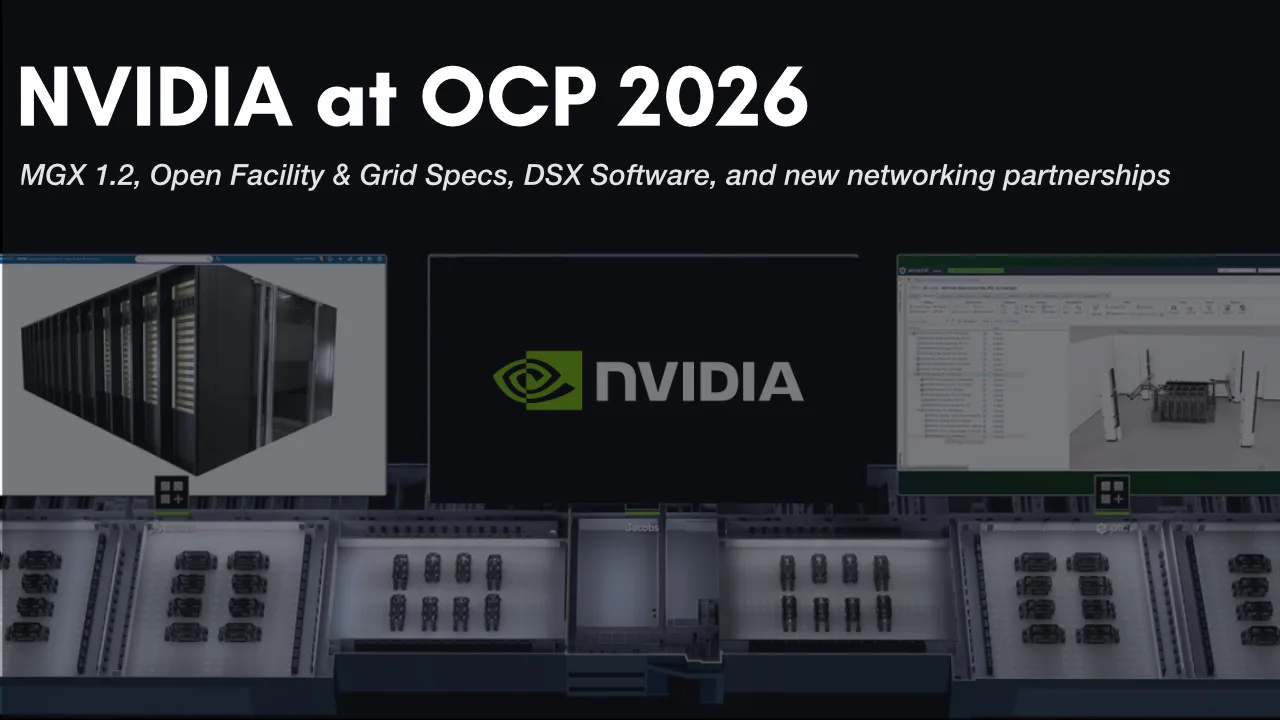
NVIDIA made a broad set of contributions and announcements at the 2026 OCP Global Summit, all designed to remove friction from large-scale deployments at hyperscalers, neoclouds, and large enterprises.
It contributed rack and compute-tray designs for its Vera Rubin platform to OCP through the MGX 1.2 specification, pairing these hardware contributions with:
- A Vera CPU rack specification for agentic AI workloads
- Four open-source components for its DSX AI Factory software layer.
- Co-authored the OCP Grid Resilience Specification (pdf link), which provides facility and grid standards, and published it with AMD, Google, Meta, and Microsoft.
- Co-authored the Open Data Center Specification (pdf link) with AMD, Google, and Meta, which provides facility-level guidelines for AI factories, including power architecture, cooling, and physical layout.
It also made a series of networking announcements that carry equal weight:
- Meta is adopting Spectrum-6 Ethernet switches for its Vera Rubin deployments.
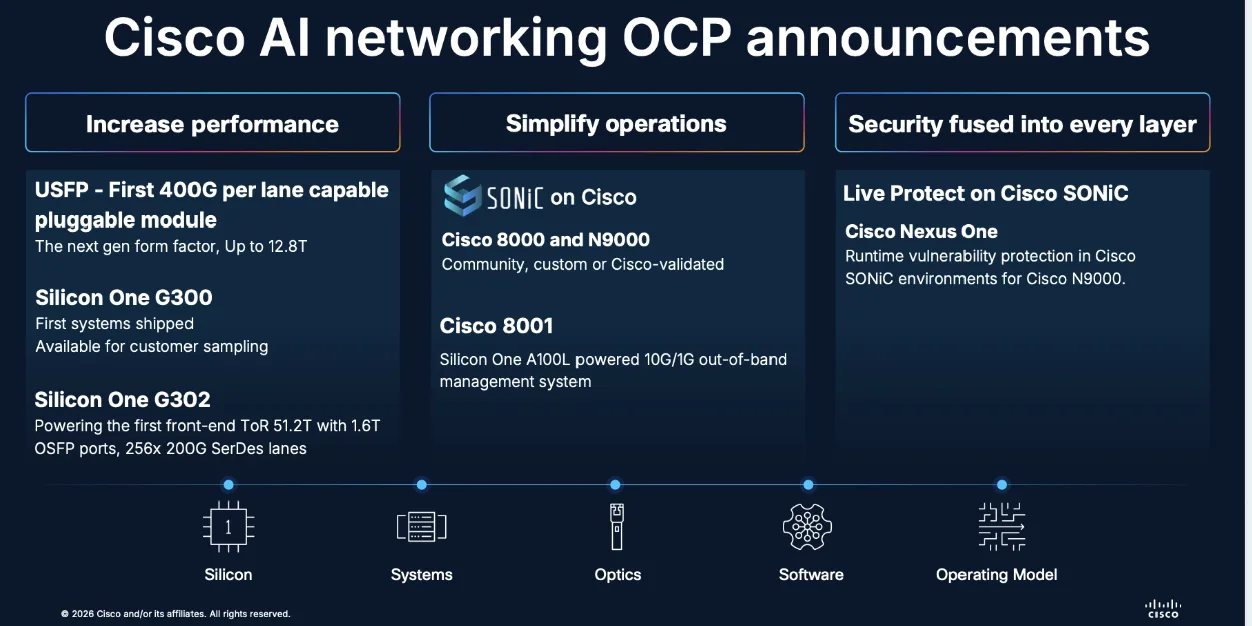
- NVIDIA and Cisco introduced the USFP pluggable optics form factor for 400Gb/s-per-lane fabrics.
- NVIDIA committed to supporting Google‘s Falcon transport on future ConnectX-10 SuperNICs and BlueField DPUs.
Taken together, the announcements show that NVIDIA’s influence extends from the rack outward to the data center facility and the utility interconnect.
NVIDIA opens the mechanical, power, and cooling layers so ODMs, cooling vendors, and facility builders can design to a common target while NVIDIA retains control of its processors, NVLink interconnect, and most of its software stack. This lowers the cost of building Vera Rubin capacity across the ecosystem and makes NVIDIA’s reference designs the default blueprint for the next generation of AI factories.
Announcement Details
The announcements span the layers of AI infrastructure:
- Rack-scale hardware contributed through MGX.
- Open-source operations software, facility and grid specifications.
- Ethernet networking components.
NVIDIA presented the package during a keynote by Ian Buck, the company’s vice president of hyperscale and high-performance computing.
MGX 1.2 and the Vera Rubin Rack
MGX 1.2 is the third-generation MGX reference design, delivered through OCP’s Open DC Initiative. It incorporates the Vera Rubin rack and compute tray designs and supports rack deployments up to 250kW.
The updated specification adds the following capabilities:
- Liquid cooling: Rack-scale blind-mate liquid cooling, fanless liquid-cooled compute trays, and two new compact couplers, MQD (MGX Quick Disconnect) and blind-mate MQDB.
- Power delivery: A liquid-cooled 5,000A busbar designed for higher-power AI systems, along with standardized power and cooling interfaces.
- Mechanical design: Configurable I/O bays, native support for 19-inch equipment, higher-density rack layouts, and interoperable rack-scale interconnect infrastructure.
- Serviceability: Faster assembly, testing, and field service.
NVIDIA also contributed a Vera CPU rack specification built on the same third-generation MGX architecture. The rack holds up to 256 Vera CPUs and targets the CPU-heavy portions of agentic AI, including tool calling, orchestration, and sandboxed code execution.
Vera Rubin NVL72 remains the platform for large-scale training and inference.
DSX AI Factory Software
NVIDIA expanded DSX OS, the operating layer of its DSX AI Factory platform, by adding four open-source components drawn from its experience operating DGX Cloud:
- Config Manager automates switch configuration and validation across AI factory network fabrics.
- Cluster Readiness Engine stress-tests GPU clusters using simulated workloads before training jobs begin.
- Rack Management Service treats the rack as the unit of hardware abstraction for firmware management at scale.
- Cluster API Provider for NVIDIA Infrastructure Controller handles bare-metal provisioning and tenant onboarding. NVIDIA claims it reduces cluster bring-up time from days to hours.
Facility and Grid Standards
NVIDIA co-authored two facility-level specifications:
- Open Data Center Specification v0.7, published with AMD, Google, and Meta, defines a common blueprint for AI factory power architecture, cooling infrastructure, and physical layout.
- OCP Grid Resilience Specification, published with Google, Meta, and Microsoft, defines how large AI sites behave during utility disturbances where facilities must remain connected, respond automatically, and return to near-full load in under two seconds.
NVIDIA said that its DSX reference design provides a deployable implementation of both specifications.
Networking
Three networking announcements round out the package, each with a different partner:
Spectrum-6 at Meta
Meta is adopting Spectrum-6 102.4Tb/s Ethernet switches, which double the switching capacity and per-lane bandwidth of Spectrum-4, which runs at 200G per lane.
Meta’s N-IceCube switch runs the open-source FBOSS network operating system and is installed in IcePack, Meta’s liquid-cooled 102.4T network rack.
Spectrum-X Multiplane, enabled by Spectrum-6 and ConnectX-9, distributes traffic across up to eight independent network planes, supporting clusters beyond 100,000 GPUs with fewer switch tiers.
USFP with Cisco
The Ultra-Dense Small Form Factor Pluggable module occupies roughly the same footprint as OSFP and provides a path to 400Gb/s per lane. It launches with 16 full-duplex lanes and a roadmap to 32. NVIDIA claims four times the bandwidth density of 200Gb/s-per-lane pluggables and roughly 1.3x better power efficiency.
TE Connectivity and Amphenol are developing cages, connectors, and modules, and the partners plan a multi-source agreement.
NAND Research took a deeper look at USFP in a recent Research Note.
Falcon with Google
Future ConnectX-10 SuperNICs and BlueField DPUs will implement Google’s Falcon transport through hardware acceleration and DOCA software.
NVIDIA and Google NICs will interoperate over a common transport while applications retain standard RDMA interfaces.
Analysis
NVIDIA continues the playbook it began with the original MGX contribution and expanded at OCP 2025, publishing the physical infrastructure as an open standard. This enables the ecosystem to absorb the engineering and manufacturing costs of scaling its platform, ultimately benefiting the entire community.
The 2026 announcements extend that reach beyond the rack. By co-authoring the data center and grid-resilience specifications with hyperscalers, NVIDIA places its reference architecture at the center of AI facility design and interaction with utilities.
This approach has clear strengths and some risks.
- Strength: Openness at the infrastructure layer accelerates Vera Rubin deployment without compromising NVIDIA’s control over GPUs, CPUs, NVLink, and the CUDA software stack.
- Strength: The Vera CPU rack gives NVIDIA a strong entry point into the general-purpose compute market that agentic workloads consume, a market currently served by x86 vendors and hyperscaler Arm designs.
- Risk: AMD co-authored the Open Data Center Specification. A neutral facility standard benefits all accelerator vendors, including NVIDIA’s direct competitors.
- Risk: Supporting Google’s Falcon and Meta’s FBOSS shows that NVIDIA accommodates hyperscaler-owned networking stacks, which reduces the lock-in value of its end-to-end Spectrum-X software.
Practitioner Impact
The primary audiences for OCP are the hyperscalers, neoclouds, ODMs, and colocation providers building Vera Rubin capacity, not the mainstream enterprise with on-site data centers.
MGX 1.2 provides system builders with a validated starting point for racks, trays, power, and cooling, shortening qualification cycles and reducing engineering work that previously required close coordination with NVIDIA for each design.
The open facility specification allows equipment makers to begin fabricating power and cooling infrastructure before a specific customer finalizes its requirements.
Competitive Impact
The announcements touch competitors at three levels:
- AMD and the hyperscaler custom silicon programs compete for accelerator sockets.
- Broadcom and the Ultra Ethernet ecosystem compete for the scale-out fabric.
- Co-packaged and linear-drive optics compete with pluggable form factors.
The table below summarizes the main alternatives:
| Alternative | Model or Approach | Compared to NVIDIA’s OCP Announcements | Net Assessment |
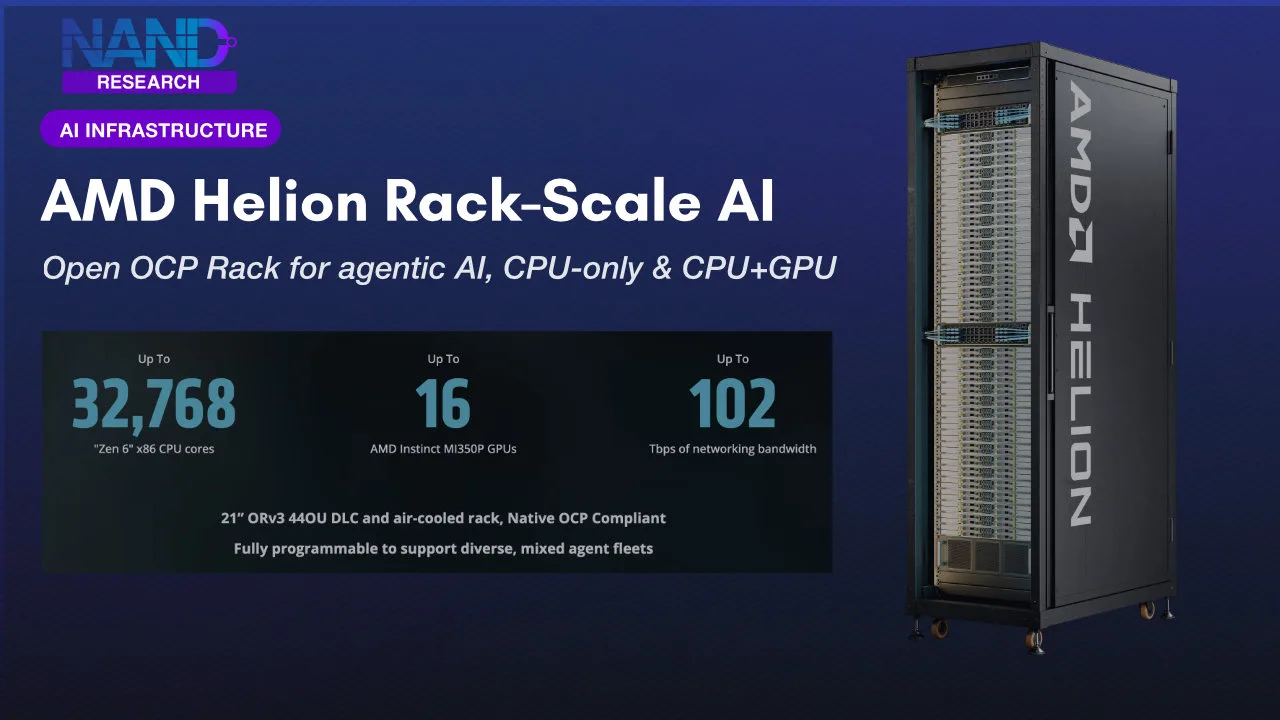
| AMD Helios / Instinct | Rack-scale MI-series platform on Meta’s double-wide Open Rack Wide design | AMD also builds to open OCP racks and co-authored the ODC spec. NVIDIA keeps a single-wide MGX form factor with a larger installed ecosystem. | NVIDIA leads on ecosystem depth |
| Hyperscaler custom silicon (Google TPU, AWS Trainium) | Vertically integrated racks and fabrics designed in-house | Hyperscalers control their own designs. Google and Meta still align with NVIDIA on facility, grid, and transport standards. | Parity at the facility layer |
| Broadcom Tomahawk 6 Ethernet | Merchant 102.4Tb/s switch silicon sold through many system vendors | Matches Spectrum-6 on capacity. Broadcom holds broader OEM reach, while Spectrum-X ties tightly to ConnectX and Multiplane. | Competitive, with Broadcom ahead on vendor choice |
| Ultra Ethernet Consortium transports | Industry-standard Ethernet transport for AI and HPC | Falcon support on ConnectX-10 adds an alternative hyperscaler transport. UEC retains broader multi-vendor backing. | Open question |
| Co-packaged and linear-drive optics | Optics integrated with or placed near the switch ASIC | CPO promises larger power savings. USFP preserves pluggable serviceability and a familiar supply chain. | USFP wins on operability, CPO on efficiency |
NVIDIA’s differentiation with these announcements is strongest at the rack and system level, where MGX benefits from a broad ODM base and a single architecture spanning GPU and CPU racks.
It is weakest in networking, where Broadcom’s merchant silicon, the Ultra Ethernet Consortium, and hyperscaler-designed transports give buyers credible alternatives.
The Falcon and FBOSS announcements show NVIDIA adapting to those alternatives so Spectrum-6 and ConnectX remain eligible for hyperscaler fabrics.
Final Thoughts
NVIDIA delivered a broad and technically substantive set of contributions at OCP 2026. MGX 1.2 and the Vera CPU rack provide the ecosystem with concrete specifications to build on; the DSX components open up operational tooling that previously lived inside DGX Cloud; and USFP offers a pragmatic path to 400G-per-lane optics.
Some questions remain about how much openness NVIDIA extends over time. The company opens the layers that commoditize its suppliers while keeping the layers that differentiate its own products closed.
It’s an approach that serves NVIDIA well today, but it also depends on hyperscaler partners continuing to view NVIDIA’s reference designs as a shared resource. Their parallel investment in custom silicon and proprietary fabrics shows that this level of support has limits.
Overall, NVIDIA delivered a broad and technically substantive set of contributions at OCP 2026. MGX 1.2 and the Vera CPU rack provide the ecosystem with concrete specifications to build against; the DSX components open operational tooling that previously lived inside DGX Cloud; and USFP offers a pragmatic path to 400G-per-lane optics.
| Analyst Take The most consequential announcements at OCP 2026 sit outside the rack. By co-authoring the Open Data Center and Grid Resilience specifications with the largest AI infrastructure buyers, NVIDIA moves its influence into facility design and utility interconnection. For customers planning AI capacity, those standards now define what an AI-ready data center looks like, and they were written around NVIDIA’s architecture. |