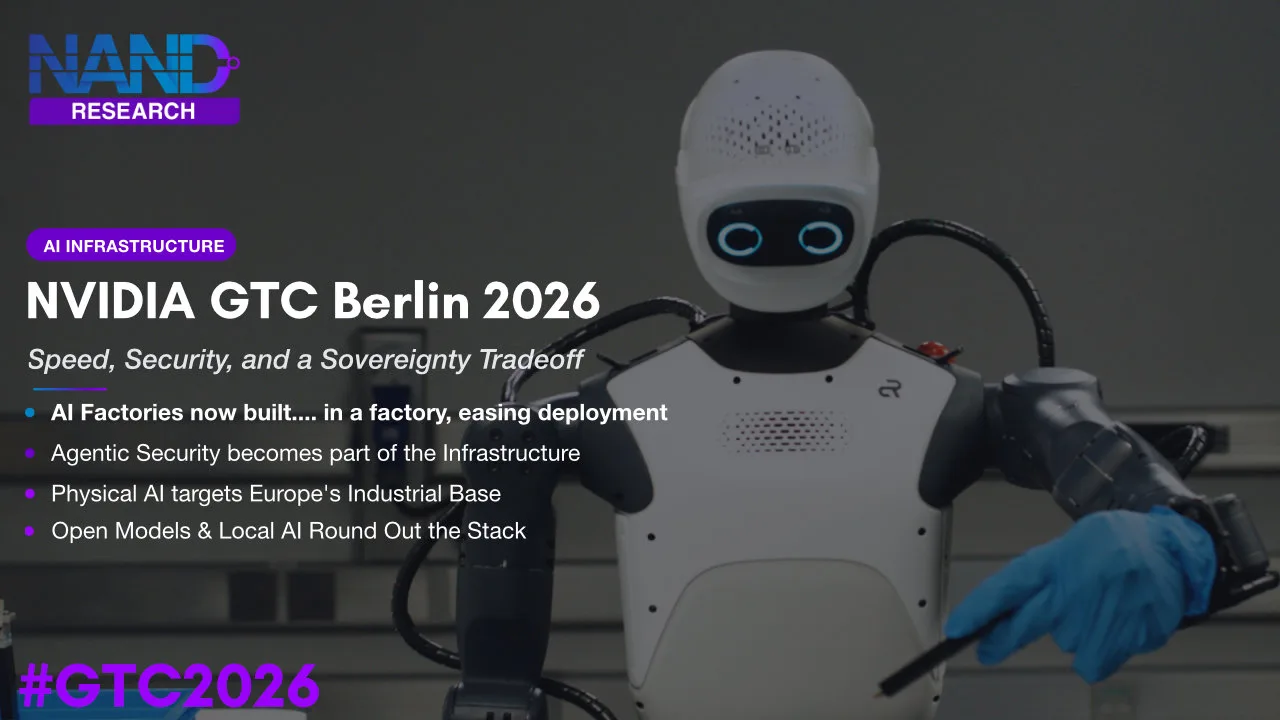
At GTC Berlin 2026, NVIDIA made an ambitious pitch to Europe to build regional AI infrastructure, develop sovereign intelligence, and accelerate industrial AI adoption on NVIDIA technology. The announcements spanned modular AI factories, agent security, robotics, autonomous vehicles, and open models.
AI Factories Ship as Finished Products
NVIDIA’s answer to the constraints of power, cooling, and construction is to shift more integration and validation from the data center site to the factory floor:
- NVIDIA DSX POD: A modular reference design for Vera Rubin AI factories, pre-integrated and validated by partners before delivery. NVIDIA says prepared sites could reduce on-site deployment time from six months to as little as 14 days. Bull, Dell Technologies, HPE, Lenovo, Schneider Electric, and Vertiv are among its partners; delivery is targeted for early 2027.
- Supply chain partners: NVIDIA said it plans to expand substrate capacity by 2.5x over three years. Amkor targets more than 300% growth in interposer wafer capacity by the end of 2028; SPIL targets a 15-fold increase in optical-engine capacity by mid-2027. NVIDIA also announced a $1.1 billion capacity advance to KYEC for US testing facilities. Not surprisingly, NVIDIA CEO Jensen Huang identified capacity as a central constraint on the buildout.
Expensive AI systems generate little value while awaiting commissioning. Standardized factory integration improves time to production and capital efficiency, but only if power, site readiness, and partner execution keep pace.
Strengthened European Cloud Partnerships
Generative AI has always been a cloud-first endeavor, and it remains so. At GTC Berlin, NVIDIA made multiple announcements showing the strengthening of its European cloud ecosystem:
- Google Cloud A5X: Google Cloud announced that Vera Rubin NVL72-based A5X instances are expected to reach general availability in November 2026, with European expansion planned. Google could scale to as many as 960,000 Rubin GPUs across sites. Ineffable Intelligence is the first identified customer.
- NVIDIA Cloud Partners: Nscale reported that NVIDIA DSX MaxLPS delivered 37% more GPUs and nearly 50% higher aggregate inference throughput within the same power budget during the GB300 NVL72 tests. Mistral plans to deliver Vera Rubin in 2027, and Nebius paired NVIDIA Groq 3 LPX with Vera Rubin NVL72 on its Token Factory.
Agent Security Moves into Infrastructure
In his keynote, Jensen described an agent as a model, a harness, a sandbox, and a set of knowledge and tools, and called agent security the most important problem to solve. He noted that an agent’s privileges change with each launch, so policy and monitoring must adapt to each run.
NVIDIA connected that argument to an infrastructure-level security architecture:
- NVIDIA OpenShell Reference Architecture: Available now, the reference architecture contains what NVIDIA calls “Confidential Bare Metal with NVIDIA Confidential Computing.” It combines Vera Rubin NVL72 for inference, Vera CPUs for agent harnesses, and BlueField-4 DPUs running NVIDIA Sentry for out-of-band monitoring and enforcement. NVIDIA claims Sentry can quarantine an agent that breaches its software boundary within milliseconds. The architecture also extends to RTX Spark, DGX Spark, and DGX Station at the edge.
- Security and software partners: CrowdStrike, Palo Alto Networks, Check Point, Cisco, and Zscaler are integrating the architecture into their agent-based security products, while BBVA and Santander are exploring it. ServiceNow also announced the general availability of ServiceNow Arc, a personal, long-running agent governed at runtime and enforced by OpenShell.
- NVIDIA Agent Knowledge Foundation: Models and libraries connect agents to enterprise data, including Nemotron tools for parsing documents, embedding queries, and reranking results, as well as new Kumo models for predictions on structured data. Huang demonstrated the expanded NVIDIA Agent Toolkit in action at Lila Sciences, Siemens‘ Erlangen factory, and Dassault Systèmes.
- Expanding Confidential Computing: NVIDIA announced that support for its Confidential Computing capabilities now extends to Grace Blackwell NVL72 (bringing CC to NVL72 rack-scale systems), as well as x86-based NVIDIA HGX Rubin NVL8 and DGX Rubin NVL8 systems. NVIDIA DGX OS, targeted at cloud providers and hyperscalers, will also support al NVIDIA Confidential Computing modes.
Physical AI Targets Europe’s Industrial Base
NVIDIA is promoting shared computing and development platforms for training, simulation, and deployment of increasingly autonomous systems that align with Europe’s strengths in manufacturing, automotive engineering, and industrial automation:
- Agile ONE SN and Isaac: Agile ONE SN is a reference humanoid built on Isaac GR00T, featuring a 31-degree-of-freedom body, expected in 2027. Its broader Isaac software ecosystem, including Isaac OS and Isaac Lab 3.0, is arguably more consequential because development and simulation workflows can drive lasting platform adoption across robot manufacturers.
- NVIDIA Factory Operations Blueprint (FOX): Currently in early access on GitHub, NVIDIA FOX brings together NVIDIA CUDA-X and Omniverse libraries, along with its Cosmos and Nemotron open models, to provide a blueprint for industrial agents to monitor and manage factory operations. Siemens is integrating FOX-based agents into Intelligence Center X, Siemens’ enterprise system for factory operations.
- NVIDIA Hyperion: Volvo Cars is adopting Hyperion and the Alpamayo Stack for automated driving. Bolt with Lucid, Mercedes-Benz, Volkswagen Commercial Vehicles, and Einride showcased use cases. Next-generation vehicles from Volkswagen’s van unit, JLR, Volvo, and Mercedes-Benz will be Hyperion-compatible.
- Telecom: NVIDIA and Nokia demonstrated what NVIDIA described as the first AI-RAN call on T-Mobile’s commercial network. Huang also pointed to telecom operators’ distributed sites and power capacity as potential AI infrastructure assets.
- Healthcare: Siemens Healthineers and NVIDIA are developing AI-enabled adaptive radiation therapy to track tumor changes during treatment.
Open Models and Local AI Round Out the Stack
NVIDIA is pairing its infrastructure with models organizations can customize using proprietary data, as well as devices capable of running agents locally:
- Open model families: NVIDIA expanded its family of open models at GTC Berlin, with Nemotron spanning language, Cosmos world models, GR00T humanoids, Alpamayo autonomous vehicles, Ising quantum-classical computing, and Earth-2 physics AI. Huang urged companies to fine-tune an open model on proprietary data to produce what he called “sovereign intelligence.”
- RTX Spark: The Windows laptops offer up to 1 petaflop of performance and up to 128GB of memory, echoing the headline capabilities NVIDIA delivered to OpenAI with the DGX-1 in 2016.
Open models can strengthen local control over data, language adaptation, and intellectual property. However, model openness does not automatically ensure infrastructure independence, especially when preferred training, inference, and deployment tools are tightly coupled with NVIDIA’s platform.
Analyst Perspective: Europe’s AI Ambitions Come with Tradeoffs
GTC Berlin underscored that NVIDIA’s ambitions now extend far beyond accelerated computing hardware. Its increasingly integrated platform spans AI factories, agent security, development tools, open models, and physical AI. The European strategy is to make that platform central to how the region builds and operates AI.
The proposition is compelling. Factory-built AI infrastructure could shorten deployment cycles and improve capital efficiency. DPU-based agent enforcement addresses a legitimate operational challenge, and NVIDIA’s industrial software and reference designs align with Europe’s manufacturing strengths. Yet many key milestones remain.
Power availability, site readiness, supply-chain capacity, security effectiveness, and partner execution will ultimately determine whether the promise translates into operational results.
The deeper tension concerns sovereignty. European enterprises and governments want greater control over infrastructure, data, and AI intellectual property. While NVIDIA offers a pathway to more regional capacity and customization, it also deepens dependence on its hardware and software ecosystem.
Sovereignty at the data and deployment layers does not guarantee independence at the technology layer. Europe’s buyers should measure NVIDIA’s promises against deployment speed, utilization, reliability, cost, and architectural flexibility.
The question is whether they can capture the benefits of NVIDIA’s integrated platform while preserving meaningful choice and negotiating leverage.