
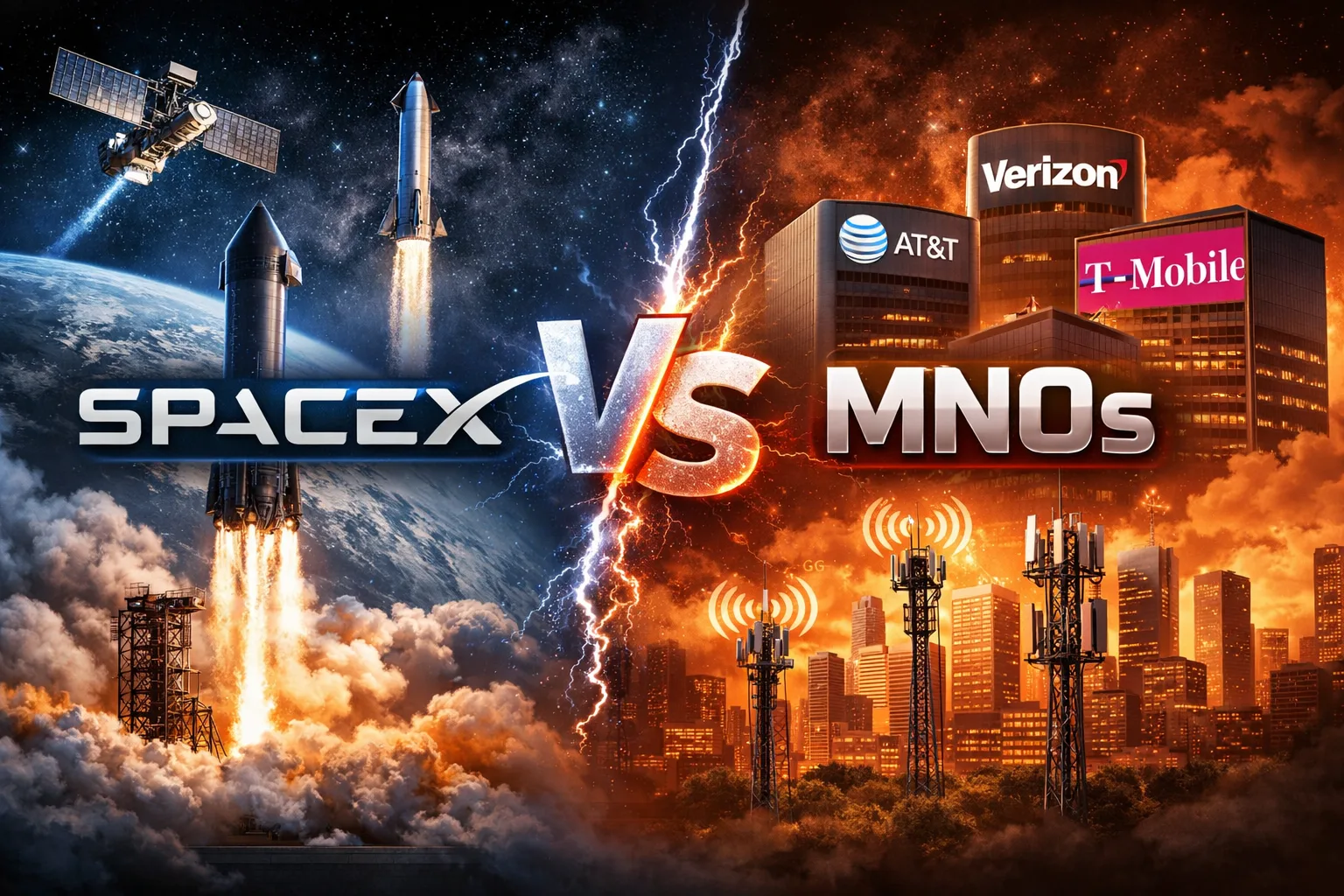
The wireless industry just blinked. When carriers AT&T, Verizon, and T‑Mobile suddenly decide to lock arms and announce a joint venture, it’s not because they’ve discovered a newfound love of collaboration. They are circling the wagons because something rattled them badly enough to forget they’re supposed to be competitors. That “something” is SpaceX.
As much as the wireless industry needs a bold vision of the future, this JV isn’t it. It’s a defensive maneuver. It’s the telecom equivalent of three rivals flipping the table and saying, “Fine, we’ll work together if it keeps the new kid from eating our lunch.”
And make no mistake: SpaceX is the one who forced their hand.
SpaceX is the clear leader in satellite connectivity. They have the largest LEO constellation, the fastest launch cadence, the broadest real‑world footprint, and the first meaningful direct‑to‑device (D2D) tests with unmodified phones. While the carriers were busy arguing over unlimited plans and whose 5G map looks the prettiest, SpaceX was launching another batch of satellites. At this point, SpaceX launches rockets the way most companies push software updates. They flew 165 missions in 2025 alone.
But the constellation isn’t what scared the carriers. The spectrum moves did.
Over the last year and a half, SpaceX has been quietly assembling the toolkit of a future mobile network operator. They’ve pursued 2 GHz and PCS G‑block spectrum, filed FCC petitions that would allow hybrid terrestrial‑satellite operations, negotiated access to licensed cellular bands for D2D trials, and pushed for rules that would let them deploy ground‑based repeaters. These aren’t the actions of a company content to stay in orbit. SpaceX has much more ground-based intentions. This is a player preparing to operate like a vertically integrated, space‑to‑ground MNO.
The carriers saw it coming and panicked, but even with SpaceX’s massive lead, satellite technology hits a brick wall of pure physics: signals simply do not penetrate indoors. They don’t get through warehouses, factories, office buildings, or your car’s coated glass. This is why the idea that satellite will “replace” terrestrial networks is pure fantasy. Satellite is an outdoor coverage layer, and terrestrial networks are the indoor and high‑density layer. The third layer is Private 5G bringing industrial reliability and low latency to the shop floor. Anyone selling a single‑layer future is selling a fairy tale.
So why did the carriers move now? Because SpaceX didn’t need to replace them to hurt them. It only needed to erode the one advantage they’ve always had: coverage. If SpaceX can offer nationwide outdoor coverage, emergency connectivity, rural broadband, and eventually terrestrial‑grade spectrum, then the carriers lose their monopoly on “we cover everywhere.” That’s precisely why this JV exists. It had nothing to do with innovation but everything to do with not wanting to be outflanked.
And while consumers will use this to text from a mountain, the real story is the industrial implications of a new model. Pipelines, grids, rail corridors, ports, mines, energy sites, disaster zones, these are the environments where terrestrial networks fail and satellite shines. But indoors? That is where satellite taps out and Private 5G steps in. That’s the new connectivity triangle: SpaceX for the sky, carriers for the streets, and Private 5G for the buildings.
Looking ahead, hybrid networks are going to become the default. SpaceX will keep pushing toward MNO status because the pieces are already on the table. And the carriers, whether they admit it or not, will be partnering more, not less, because they’ve finally realized they’re not invincible.
The bottom line is simple: this JV isn’t innovation. It’s survival. SpaceX forced the industry to evolve and the carriers responded with scale. Enterprises get resilience, and the next decade of connectivity will be defined by hybrid architectures.
The coverage war didn’t end. It just moved to orbit.