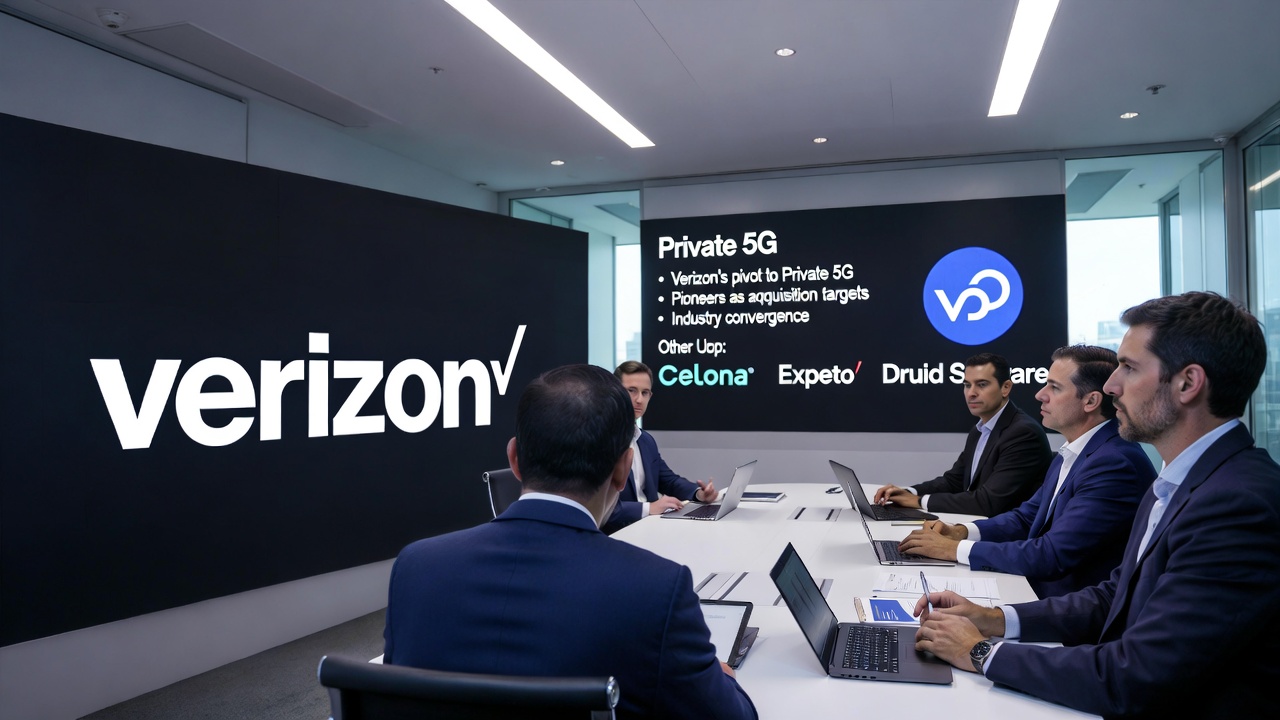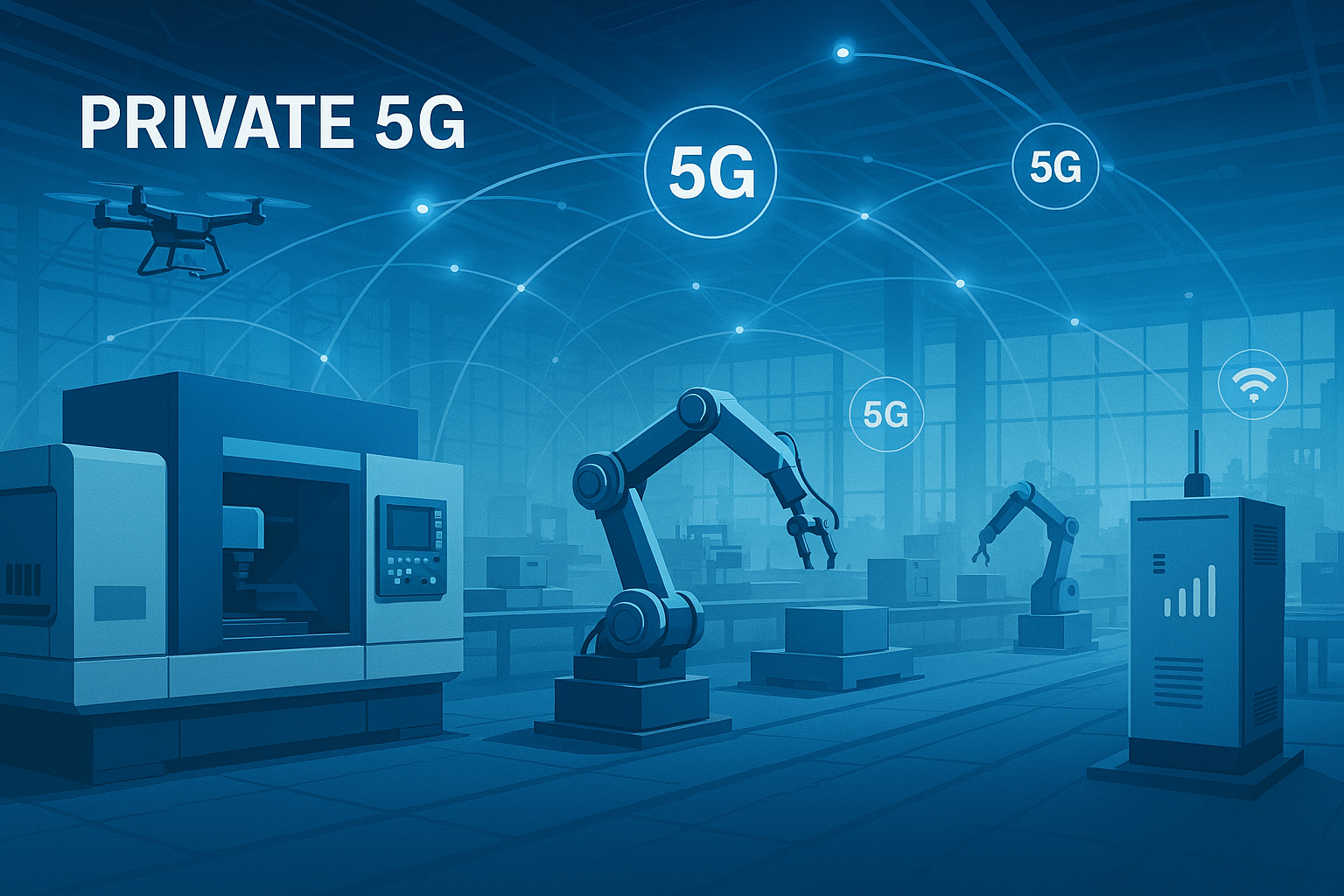
For years, carriers (Verizon, AT&T, T-Mobile) have been present in the Private 5G market, but their posture was cautious. They offered private wireless solutions, but rarely with conviction. Their enterprise motions were slow, their value propositions inconsistent, and their focus remained on public 5G monetization. In that vacuum, a generation of pioneering P5G companies (Celona, Federated Wireless, Betacom, Kajeet, and others) built the early market by delivering systems that enterprises could deploy without waiting for carrier alignment.
RCT Wireless’ coverage of Verizon’s remarks at PTC in Hawaii suggest that era is ending. What we’re seeing now is not a re‑entry, but a strategic pivot. Carriers are finally treating Private 5G as core infrastructure for the AI era.
This shift is not driven by regulatory pressure. It’s driven by something far more tangible (and, let’s be honest, a healthy dose of hype): AI inference at the enterprise edge
AI Is the Catalyst Carriers Have Been Waiting For
Verizon’s message at PTC was unusually clear: AI workloads are moving closer to where data is generated. Factories, hospitals, logistics hubs, campuses, all need real‑time inference, not round‑trips to distant cloud regions. That requirement changes the economics of connectivity. It elevates deterministic wireless from “nice to have” to “mission‑critical.”
Not too long ago dense metro fiber, P5G, and edge compute were all separate conversations. Verizon is recognizing that times are changing. Conversations that were previously disparate have now converged into a single architectural stack. And for the first time, a Tier‑1 carrier is publicly and explicitly articulating that stack as a unified strategy.
What stands out is Verizon’s insistence that this is not speculative infrastructure building. Unlike the dot‑com era, where fiber was laid in hopes that demand would materialize, today’s AI‑driven capacity needs are coming from paying customers with specific requirements. Verizon’s comment “this feels different” is a recognition that AI has created a real, revenue‑backed demand curve for private wireless and metro‑edge connectivity.
Carriers Are Moving Up the Stack
Historically, carriers excelled at macro networks, spectrum, and backhaul. Private 5G required something different: on‑prem systems, IT/OT integration, deterministic performance, and enterprise‑grade workflows. That’s where the pioneers thrived. They built turnkey systems that felt more like Wi‑Fi than telco infrastructure.
But Verizon’s PTC remarks show a shift in carrier posture. Their One Fiber initiative, originally a modernization project, has become an AI‑era asset. They’re deploying 1,600‑strand fiber routes in major metros, bringing more than half of their macro sites on‑net, and extending private‑line and wave services directly into enterprise buildings. This gives carriers something they lacked in the early P5G era: a physical, scalable, revenue‑aligned foundation for enterprise edge compute.
This is not a carrier trying to replicate what the pioneers built. It’s a carrier leaning into the part of the stack only they can own.
What This Means for the P5G Pioneers
The pioneers still hold meaningful advantages. They move faster. They design for enterprise workflows. They integrate cleanly with existing LAN/WAN architectures. They deliver predictable QoS in OT environments without the overhead of carrier processes. And they remain the most accessible path for mid‑market and distributed enterprises.
But the market is shifting toward hybrid ecosystems. Carriers bring national fiber footprints, metro‑edge compute, and large enterprise relationships. Pioneers bring simplicity, speed, and vertical‑specific innovation. The next phase of Private 5G won’t be a battle between these groups. It will be a convergence.
The Convergence Era Has Arrived
Verizon’s clear-eyed remarks at PTC mark the start of a true convergence in Private 5G. Carriers like Verizon are investing in the physical foundations (dense metro fiber, on-net macro sites, enterprise-building extensions) that only they can scale at national levels. Meanwhile, the pioneers like Celona, Federated Wireless, Betacom, Kajeet, and others, retain decisive edges in speed, enterprise-native design, and OT integration.
The result won’t be winner-takes-all, but a hybrid ecosystem where these strengths combine to meet surging AI-driven demand.Manufacturing, with its need for ultra-deterministic, low-latency wireless for real-time inference, machine vision, and automation, stands as the clearest proving ground. With more than 6,500 private LTE/5G deployments worldwide by the end of 2025 (Berg Insight), the market has clearly moved beyond early pilots. While Wi-Fi 8 addresses congestion for general mobility, Private 5G is emerging as the indispensable fabric for industrial AI workloads. This is exactly what Verizon articulated.
For enterprises, the message is that the infrastructure is arriving faster than expected, backed by paying customers rather than hype. The pioneers who built the early market now have partners with unprecedented scale. The next phase of P5G belongs to those who move quickest to converge these capabilities by turning edge AI from promise into production reality.