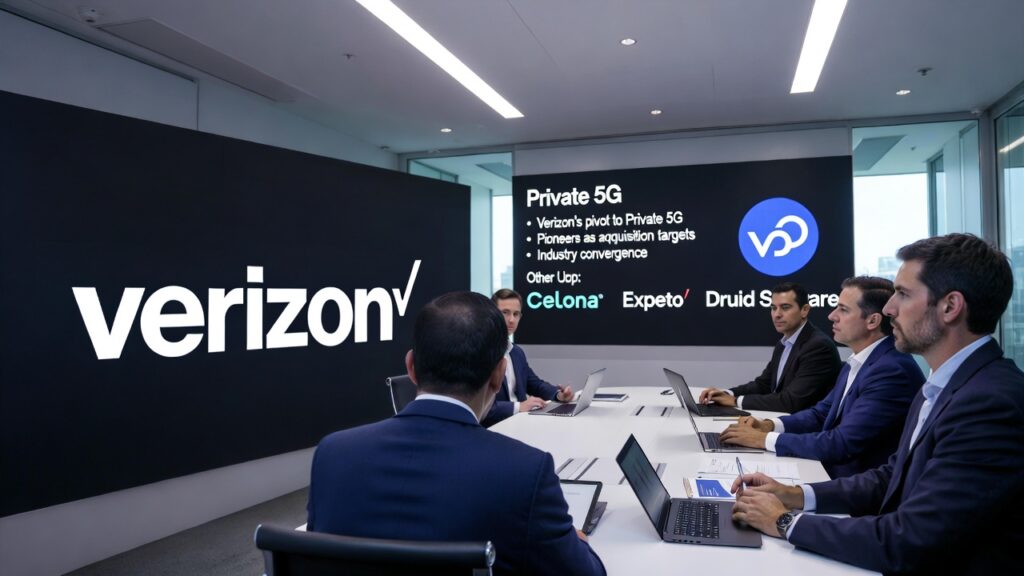
In my last post, I laid out Verizon’s clear pivot at PTC’26: the carrier is no longer just dabbling in Private 5G and how it’s treating it as foundational infrastructure for the AI era. Real, paying customers are driving demand for edge inference in manufacturing and logistics, and Verizon is backing that with One Fiber (dense metro routes, 1,600-strand builds, more than half its macro sites on-net). Carriers like Verizon still trail in the fast, enterprise-native deployment style that has defined the early market. That’s exactly why the pioneers (Celona, Federated Wireless, Betacom, Kajeet, and others) could become compelling acquisition targets in 2026.
The Gap Carriers Still Face
Verizon is strong where carriers traditionally dominate: national scale, spectrum ownership, and backhaul. Their PTC line, “this feels different”, captures the shift from speculative fiber builds to AI-driven, revenue-backed demand for deterministic wireless. Yet the market has already reached over 6,500 global Private LTE/5G deployments by the end of 2025 (Berg Insight), and a large share of those came from Private 5G pioneers who prioritize speed and simplicity.
Celona and Betacom, for example, deliver turnkey systems that plug cleanly into existing LAN/WAN environments, guarantee predictable QoS in OT settings, and serve mid-market enterprises without the long procurement cycles carriers often impose. Carriers, meanwhile, continue to wrestle with slower enterprise motions, inconsistent value propositions, and a lingering focus on public 5G monetization. As AI inference pushes deeper into the edge, where factories require ultra-low latency for machine vision and automation, the pioneers’ structural advantages become harder to ignore.
Do Carriers Actually Buy Hardware Vendors?
Historically, no. Carrier M&A has centered on other carriers, fiber assets, spectrum, and cloud/software capabilities. When they expand, they acquire networks, not the radio access, edge, or device vendors that run them. Most carriers will shy away from hardware because they can’t handle the supply chain headache. That precedent matters. If Verizon or another Tier-1 carrier were to acquire a Private 5G pioneer, it would mark a genuine departure from past behavior. It would be driven by the urgency of the AI era rather than traditional telecom logic.
Why Acquisition Makes Sense — and Who Might Move
The Private 5G market is moving from pilots to production. Valued at roughly $2.4 billion in 2025 (Berg Insight), it’s poised to accelerate sharply as industrial AI takes hold. Convergence is economic. For carriers like Verizon, buying a pioneer delivers immediate enterprise-ready capabilities that complement their metro-edge compute and fiber footprint.
A counter-signal came from Nokia’s November 2025 Capital Markets Day. The company shifted its Enterprise Campus Edge unit (which includes much of its Private 5G portfolio, such as MXIE and Digital Automation Cloud) into a non-core “Portfolio Businesses” segment. A formal review is underway, with decisions expected by the end of 2026—likely leading to divestiture, sale, or carve-out. Nokia remains committed to mission-critical RAN, but this deprioritization by a major incumbent creates additional M&A fuel in a market that is increasingly hungry for AI-ready Private 5G scale.
NTT stands out as a particularly interesting buyer. With a full carrier operation in Japan, a global systems-integration arm, and an established Private 5G managed-services business, NTT understands both carrier economics and enterprise workflows better than most. A software-dominant pioneer would slot cleanly into their portfolio and scale globally.
T-Mobile has also been vocal about Private 5G and has shown a willingness to move quickly in enterprise wireless. A software-only acquisition would give them a turnkey platform without heavy integration risk. AT&T, by contrast, has leaned more toward partnerships and has been quieter on acquisitions, but AI urgency could still bring them into the conversation.
Who Are the Prime Targets?
To be clear, this list isn’t based on financials or balance‑sheet speculation. It’s grounded entirely in the technical attractiveness and architectural maturity of each vendor.
Most acquirable: software-only or software-dominant vendors
These companies are lightweight, cloud-native, and avoid the supply-chain and lifecycle burdens of hardware. They align with the pattern carriers already understand—software that drops cleanly into existing workflows.
– Expeto — cloud-native core with deep enterprise integration
– Druid Software — lightweight, flexible EPC built for IT workflows
– Athonet — proven mobile core and likely in strategic review under HPE
– Celona — software-heavy architecture with LAN-like orchestration (even though they offer high- performance access points)
Strategic but harder to absorb: full-stack pioneers
– Federated Wireless — CBRS and shared-spectrum expertise
– Betacom — managed P5G with DAS heritage
– Kajeet — distributed/education vertical strength
Many of these companies were built precisely to avoid the slow-moving gravity of carrier culture. Still, when a 100-pound gorilla decides it needs enterprise-native capability fast, even reluctant pioneers must weigh independence against strategic and competitive pressure.
Looking Ahead
I’ll be on the ground at MWC Barcelona next month, listening to how carriers, pioneers, and integrators are positioning themselves. If PTC’26 was the opening signal, MWC may reveal who’s preparing to make the next move.