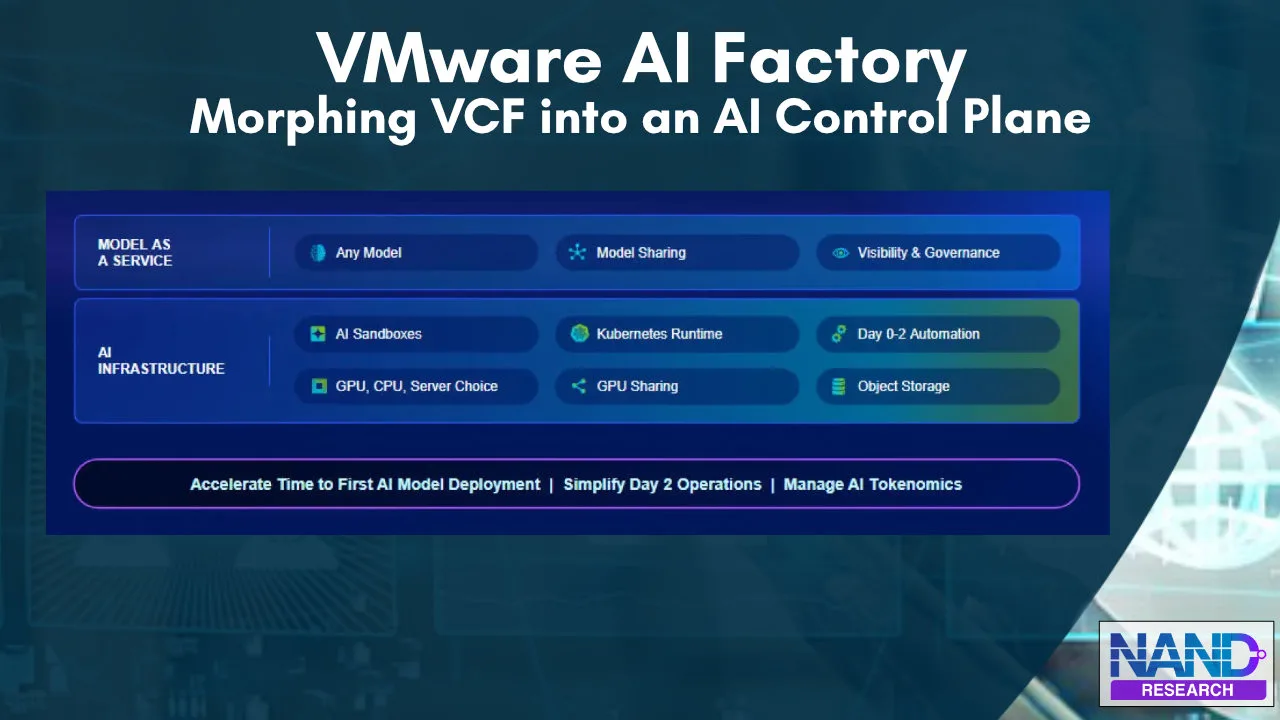
Broadcom introduced its new VMware AI Factory at VMware Explore 2026. The offering bundles software services built on VMware Cloud Foundation (VCF) to take an enterprise from bare-metal infrastructure to a running production AI model. It combines infrastructure provisioning, GPU pooling, multi-tenant model sharing, and governance tooling into a single operational layer for enterprises that want to run AI workloads on infrastructure they own and control.
VMware AI Factory pairs VCF with certified AI ReadyNodes from hardware partners, including Cisco, Dell Technologies, Lenovo, and Supermicro, and adds a new bare-metal automation integration with MetalSoft. It ships alongside a broader set of Explore 2026 announcements, including an AI Assistant for VCF, an agent-governance framework called AgentMinder, and updates to Tanzu Platform, all aimed at making AI a standard, governed workload within VMware’s private cloud.
The launch occurs in an environment where Broadcom continues to face significant friction with the VMware customer base over pricing and licensing changes since the acquisition closed nearly three years ago. That friction will shape how the market reads this announcement.
Broadcom is asking enterprises already weighing whether to continue paying for VCF to also trust VCF as the foundation of their AI strategy, at a time when trust in Broadcom’s stewardship of the platform is not uniformly high.
Details
VMware AI Factory bundles several services layered on VMware Cloud Foundation, aimed at reducing the manual integration work typically required to move from unconfigured hardware to a served AI model.
The stack spans infrastructure orchestration, GPU resource management, and AI-specific governance and security controls.
Capabilities include:
- Zero-touch orchestration of vSphere, vSAN, Kubernetes, and GPU operators.
- A new integration with MetalSoft extends VCF’s operational workflows down to the physical layer. Broadcom and MetalSoft state this cuts bare-metal provisioning time from weeks to minutes, treating physical servers as programmable infrastructure managed through code.
- Multi-tenant model sharing uses isolated namespaces, enabling multiple teams or business units to share deployed models securely without duplicating GPU capacity per tenant.
- The AI Gateway is a unified governance layer spanning on-premises and cloud deployments, handling intelligent prompt routing and token rate limiting to help organizations control token costs.
- Secure AI Sandboxes are isolated container environments where AI agents can execute generated code under validation controls before it reaches production systems.
- GPU pooling shares accelerator resources across the organization, enabling multiple models to run on shared hardware and reducing the dedicated GPU capacity each project would otherwise require.
The platform supports more than 150 open-source and commercial models, including Nemotron 3, Gemma 4, Qwen 3.7-Max, and GLM 5.2, and Broadcom paired the launch with an AMD collaboration covering GPU and ROCm software integration, giving customers a validated infrastructure path without per-token pricing.
Broadcom has not disclosed pricing or licensing terms for VMware AI Factory, an omission that matters given how central licensing has been to VMware’s recent history under Broadcom.
Analysis
VMware AI Factory extends Broadcom’s argument that VCF should be the default operating environment for enterprise infrastructure, now including AI alongside virtualization and general-purpose workloads.
Overall:
- Consolidating infrastructure automation, model governance, and agent security under a single VCF-anchored umbrella reinforces the subscription model Broadcom has built, giving customers an incentive to include AI infrastructure spend in their existing VCF subscription.
- The offering aligns well with genuine enterprise pain points around GPU underutilization and slow AI project timelines, areas where a unified operational model has real appeal.
- It also deepens customer dependence on VCF at a time when a meaningful share of the installed base is actively evaluating alternatives due to pricing changes, so the strategy carries retention risk alongside its expansion opportunity.
Practitioner Impact
Infrastructure and platform teams already standardized on VCF gain the most immediate benefit, as VMware AI Factory extends the tooling they already use to AI workloads rather than requiring a separately managed GPU stack.
That said, the automation claims assume favorable conditions. GPU capacity planning, storage performance tuning for model serving, and integration with existing identity and data governance systems still require deliberate architectural work; VMware AI Factory gives teams a common console for those decisions without removing the underlying design effort.
IT teams should consider:
- Teams need to add AI and ML operational literacy to their existing virtualization skills because GPU scheduling, model versioning, and inference performance tuning are new disciplines for many VMware administrators.
- Meeting the fast-provisioning timeline Broadcom describes likely depends on having certified AI ReadyNodes and GPU supply already in place; the automation shortens configuration time, but hardware lead times, which remain constrained, are unaffected.
- Multi-tenant model sharing and the AI Gateway provide operational value for organizations with several business units on shared infrastructure, but they also introduce new components that platform teams must patch, monitor, and secure, including an agent sandbox, a token gateway, and a model registry.
Competitive Landscape
VMware AI Factory competes in a private AI infrastructure market that has filled quickly with vendor-specific stacks, each pairing virtualization or hyperconverged infrastructure with a curated AI software layer.
Dell Technologies, HPE, and Nutanix have all shipped comparable offerings in the past year, and hyperscalers continue to offer AI infrastructure and managed model services for customers unwilling to run AI on-prem at all.
Also note that, in addition to competing for AI factory solutions, these vendors (except Nutanix) will all provide VMware-based solutions. This is a market where customers continue to have choice.
| Alternative | Model/Approach | How It Compares to VMware AI Factory |
| Dell AI Factory with NVIDIA | Validated hardware stack pairing Dell PowerEdge servers, NVIDIA GPUs, and Dell networking and storage under one procurement relationship | Offers stronger infrastructure-layer validation and simpler single-vendor purchasing, but leaves model governance, multi-tenancy, and agent security to be assembled separately |
| HPE Private Cloud AI | Turnkey packaged system with engineered components for retrieval-augmented generation, inference, and fine-tuning, including air-gapped and sovereign deployment options | Faster out-of-box deployment for a defined set of AI patterns, though it still requires customer-driven decisions on data classification and tenant isolation |
| Nutanix Enterprise AI (GPT-in-a-Box) | Secure inference endpoints, model routing, and AI services built into the Nutanix hyperconverged platform | Comparable model-serving and governance ambitions on a smaller, HCI-native footprint, positioned by Nutanix partly as a landing zone for customers migrating away from VMware |
| Hyperscaler AI services (Azure, AWS, Google Cloud) | Managed AI infrastructure and model APIs delivered as a cloud service, with hardware and lifecycle management handled entirely by the provider | Removes hardware and lifecycle management for the customer, but does not satisfy the data sovereignty and on-premises control that VMware AI Factory is built around |
VMware AI Factory’s differentiation is strongest when it leverages the operational familiarity with an installed VCF base, enabling existing infrastructure teams to extend known workflows to AI using the skills they already have.
It is weakest against Nutanix, where GPT-in-a-Box and related AI services offer VMware customers who are already migrating away from Broadcom’s licensing terms a credible alternative that solves a similar problem without reinforcing VCF dependency.
Final Thoughts
Broadcom’s VMware AI Factory addresses a real and well-documented gap between enterprises acquiring GPU capacity and successfully running production AI on it. The technical scope, spanning bare-metal provisioning, GPU pooling, multi-tenant model sharing, and agent governance, is broader than most single-vendor private AI announcements this year. The hardware and model-provider partnerships give it more built-in optionality than a narrower, single-stack offering would.
The open questions are less about the technology and more about adoption conditions Broadcom does not fully control:
- The timeline claims depend on GPU and hardware availability, which remains constrained across the industry.
- Pricing and licensing for the new services have not been disclosed.
- The offering asks customers to deepen their VCF commitment at a time when a portion of that customer base is being actively priced out of alternatives.
None of that invalidates the technical work VMware’s engineering teams have done, but the announcement’s ultimate impact depends on factors beyond the product itself.
For enterprises already committed to VCF, VMware AI Factory is a credible and reasonably complete solution to the operational mess of private AI deployment, and it will likely accelerate AI projects for that audience.
For everyone else, it is a capable product wrapped in a business relationship that a significant share of the market is still deciding whether to keep. That business relationship, not the feature set, will determine how much of the private AI market VMware AI Factory captures.