WEKA has announced two related products: NeuralMesh 6, the sixth generation of its core software platform, and WEKApod 3, a third-generation family of storage appliances built on WEKA-designed hardware.
The two announcements arrive together and are intended to be evaluated as a single system. NeuralMesh 6 remains deployable on customer-selected hardware, while WEKApod 3 is WEKA’s turnkey platform, shipping with the software preinstalled.
WEKA’s value prop for the new offerings is focused on density and inference economics, for example:
- WEKApod Prime Max delivers 1.1 exabytes of effective capacity in a single 56-unit rack, the first time any single-rack system has exceeded one exabyte.
- NeuralMesh 6 adds native multi-tenancy, a unified file-and-object protocol stack, metadata-first data replication, always-on data reduction with a contractual performance guarantee, a Kubernetes operator, and a hosted observability service.
The announcement is WEKA’s response to a shift already underway in AI infrastructure spending, away from training-focused buildouts toward production inference at scale.
Details
NeuralMesh 6 and WEKApod 3 are designed to operate together, with the hardware’s density enabled specifically by software features introduced in the same release. The announcement spans chassis architecture, networking and thermal design, tenancy, protocol support, data mobility, and operations tooling:
WEKApod 3
WEKApod 3 ships in three configurations:
- WEKApod Nitro: a two-rack-unit, four-node chassis with 56 TLC drives and dual-port NVIDIA ConnectX networking rated at 800 Gb/s, designed for throughput-bound workloads.
- WEKApod Prime uses a mixed TLC and QLC drive configuration within the same four-node chassis.
- WEKApod Prime Max packs 70 NVMe drives, including Micron’s 245.76 TB 6600 ION SSDs, into a two-node, two-rack-unit chassis and is the configuration WEKA cites for its 1.1 exabyte and 10.2 TB/s per-rack figures.
All three replace a shared backplane with individually cabled drive connections, isolating a drive failure to a single device rather than a shared bus.
The chassis uses a PCIe Gen 6 internal fabric to give each drive independent full-bandwidth access, and NVIDIA ConnectX SuperNIC networking for Spectrum-X Ethernet connectivity.
WEKA rates the thermal design for operation at ambient temperatures up to 35°C and says NeuralMesh throttles NVMe power under thermal stress rather than triggering a shutdown.
NeuralMesh 6
NeuralMesh is WEKA’s software operating environment. The latest release adds substantial benefits for inference workloads and addresses the operational needs of AI service providers.
Multi-tenancy
NeuralMesh 6 introduces two tiers of tenant isolation:
- Composable Clusters allocate dedicated CPU, memory, and storage drives per tenant.
- Virtual Multi-Tenancy adds network-level isolation through WEKA’s Virtualized RDMA Data Fabric, supporting private VLANs, per-tenant encryption with independent key management, and independent authentication.
The two tiers can be combined to support up to 50,000 logically isolated tenants on a single physical cluster.
Unified protocol stack
NeuralMesh 6 implements a native S3 layer that allows the same physical data blocks to be addressed through S3 and POSIX simultaneously, without a traditional translation gateway. WEKA says the design supports 2,000 to 5,000 concurrent S3 connections per node and zero-copy transfers into GPU memory over RDMA.
Data mobility and reduction
The release adds asynchronous, metadata-first replication and remote caching, which WEKA describes as an early step toward a global namespace across sites. Data reduction (including fingerprinting, similarity hashing, deduplication, and compression) is enabled by default and comes with a contractual guarantee covering both the reduction ratio and performance impact.
WEKA notes that NeuralMesh now claims less than 5 percent write overhead and up to 6x capacity savings on training data.
Operations and management
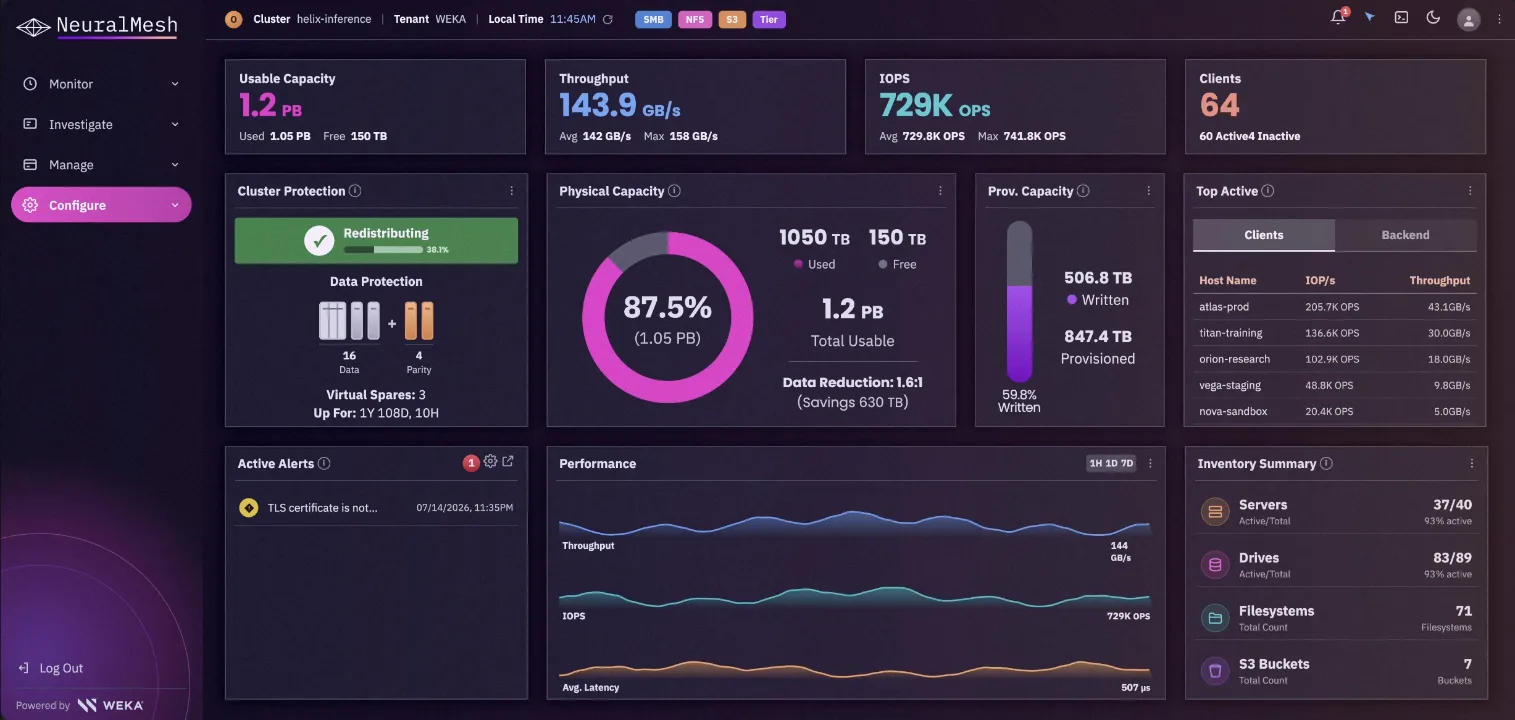
NeuralMesh Observe, a new Kubernetes Operator to automate cluster deployment, is included with every deployment at no additional cost. This provides multi-cluster dashboards, client-level diagnostics, and alert routing to Slack, PagerDuty, or email.
Inference memory extension
WEKA’s Augmented Memory Grid extends effective GPU memory by accelerating access to persistent KV cache on NeuralMesh-managed NVMe storage. WEKA says the technology is already in production on Oracle Cloud Infrastructure, where it has delivered 10x higher token throughput, 10x more concurrent users, and 7x more tokens served per GPU on H100 infrastructure.
Availability
NeuralMesh 6 is expected to reach general availability in the second half of 2026, with existing customers eligible for a no-cost upgrade. WEKApod Nitro, Prime, and Prime Max are available to order now through WEKA’s distributor and reseller network, with delivery beginning in fall 2026.
Analysis
The announcement marks WEKA’s evolution from a software-only vendor to a supplier that also controls hardware design, continuing a shift the company has been working toward for the past three years. Owning the platform allows WEKA to optimize density and thermal behavior beyond what it could achieve with OEM hardware alone, while giving the company more direct control over component sourcing amid NAND supply constraints.
For infrastructure teams operating AI clouds, frontier-model training environments, or large enterprise inference deployments, the practical benefit is a reduction in the number of separate systems required to support production AI storage.
Competitive Landscape
WEKA’s most direct competitors in AI-optimized storage are VAST Data, Everpure (formerly Pure Storage), and NetApp, each pursuing a different combination of density, architecture, and enterprise integration.
The table below provides a high-level comparison of the four vendors across the capabilities targeted by NeuralMesh 6:
| Vendor | Multi-tenancy | Unified file/object | Data reduction | Inference-memory extension |
| WEKA | Native two-tier model (hardware plus logical isolation); scales to 50,000 tenants per cluster | Native S3 and POSIX on the same physical blocks, no gateway | Always-on by default; contractual guarantee on ratio and performance impact | Augmented Memory Grid; production deployment on Oracle Cloud Infrastructure |
| VAST Data | Native to DASE architecture; namespace-level tenant isolation offered for several years | Native S3, file, and object addressing with inline global deduplication | Global deduplication, similarity reduction, and compression across all protocols | Shared persistent KV-cache tier for NVIDIA Dynamo, LMCache, and related frameworks; published validation results |
| Everpure (Pure Storage) | Secure multi-tenancy; more established on FlashArray than on FlashBlade | NFS, SMB, and S3 on one operating system without gateways on FlashBlade//S | Compression and global erasure coding; no public performance guarantee | Pure Key-Value Accelerator on FlashBlade; distributed storage-backed KV cache with RDMA injection |
| NetApp | Storage Virtual Machines; longest production track record of the four vendors | Native S3 support on ONTAP with established multi-protocol access | Deduplication, compression, and compaction; long-standing feature set | Inference Context Memory Storage with NVIDIA BlueField-4; announced, not yet shipping |
Against this group, WEKA’s clearest differentiation lies in hardware density, integrated product design, and demonstrated inference-memory performance:
- Single-rack exabyte density: WEKApod Prime Max’s 1.1 exabytes of effective capacity and 10.2 TB/s of aggregate throughput per rack stand out. Competitors publish large capacity and performance figures, but not a directly comparable single-rack configuration.
- Packaged, production-validated inference-memory extension: VAST Data and Everpure also support storage-backed KV-cache offload, while NetApp has announced an Inference Context Memory Storage platform. WEKA’s distinction is the way Augmented Memory Grid is packaged as an integrated NeuralMesh capability and backed by disclosed production results on Oracle Cloud Infrastructure.
- Contractual data reduction guarantee: WEKA publicly commits to both a reduction ratio and a ceiling on performance impact as contractual terms, adding commercial accountability to the underlying capability.
- Closing competitive gaps: NeuralMesh 6 brings WEKA closer to feature parity with VAST Data, Everpure, and NetApp in multi-tenancy, unified protocol support, data reduction, and Kubernetes integration.
Final Thoughts
WEKA has spent more than a decade building storage to meet the requirements of accelerated computing and AI; this isn’t a company retrofitting traditional enterprise storage after the fact. That long history as an “AI-native” storage platform is important. NeuralMesh 6 and WEKApod 3 extend an architecture already shaped by parallelism, low latency, GPU data paths, and software-defined deployment.
The announcements also show a more complete WEKA emerging:
- NeuralMesh 6 closes meaningful enterprise gaps in multi-tenancy, protocol support, replication, data reduction, Kubernetes operations, and observability.
- WEKApod 3 gives WEKA control over the hardware variables that increasingly determine AI infrastructure economics, including rack density, power, cooling, networking, and component selection.
- Augmented Memory Grid then connects those strengths directly to inference by turning persistent flash into a practical extension of scarce GPU memory.
WEKA’s overall advantage is the coherence of the full platform. WEKA is delivering mature AI-focused software, purpose-designed dense hardware, contractual performance commitments, and production evidence for KV-cache acceleration.
For enterprises and AI cloud operators, WEKA’s momentum is best read as evidence that storage vendors are now competing on GPU-adjacent economics rather than storage specifications alone. This is a shift that will make rack-level density and token-level cost comparisons the metrics that determine which vendor wins the next generation of AI infrastructure contracts.
Few companies understand this dynamic as well as WEKA. NeuralMesh 6 and WEKApod 3 simply reinforce the company’s position as one of the industry’s most capable and credible AI-native storage platforms for the inference era.