Last week, Quantinuum released its first earnings report since its IPO earlier this summer. The interesting parts of the call weren’t its financial highlights, but rather what we can infer about the state of quantum commercialization from what was said.
Before looking at that, let’s take a quick look at the overall highlights:
- Quantinuum reported $8 million in second-quarter revenue, up 279% year over year, and guided to $28 million to $32 million in fiscal 2026 revenue. The company held $2.1 billion in cash, cash equivalents, and short-term investments at quarter-end.
- Management reported approximately $81 million in year-to-date bookings, including deals signed after quarter-end, and expects at least $120 million in fiscal 2026 bookings. These figures reflect prospective demand, while conversion timing and revenue-recognition conditions remain important.
- Quantinuum and Oracle announced a multiyear partnership under which a Helios system will be deployed in a U.S. Oracle Cloud Infrastructure data center. Public disclosures do not specify the system’s ownership or the transaction’s financial terms.
- Evidence of early commercial activity through reported bookings, technical progress, manufacturing partnerships, developer adoption, and a physical cloud deployment.
Momentum
The quarter showed evidence of growing platform depth and expanding deployment flexibility:
- More than 180 organizations are now building on Quantinuum Nexus, up from roughly 150 around the company’s June IPO. Quantinuum said both the number of organizations and the depth of their usage are growing.
- Guppy, Quantinuum’s quantum programming language, is becoming more accessible through a browser-based Guppy Playground environment. The company has also integrated Qama’s error-suppression and mitigation technology into its platform.
- Demand for on-premises Helios installations is growing, prompting Quantinuum to reconsider an earlier assumption that Sol would be primarily a cloud-access system.
- Sovereign and regional quantum infrastructure needs are emerging as a distinct use case, with implications for procurement timelines and for system access among government and regulated-industry users.
- Customers are already engaging with Quantinuum on Sol and Apollo, and some relationships are explicitly multigenerational.
The Oracle Cloud Deal
Quantinuum announced a multiyear agreement with Oracle, including a Helios deployment on OCI infrastructure:
- Oracle is purchasing a Quantinuum Helios system outright. This isn’t simply OCI reselling API access to a Quantinuum-hosted machine.
- The Helios system will be physically installed in an Oracle Cloud Infrastructure data center in the U.S.
- According to Quantinuum, this will be the first Helios deployed in a U.S. data center outside Quantinuum’s own facility.
- Another Helios is already planned for Singapore, making Oracle part of the platform’s early physical deployment footprint.
- Quantinuum isn’t disclosing the purchase price or broader financial terms.
- Quantinuum will recognize some initial cloud-related revenue in 2026, but management said on the call that the larger revenue contribution comes later (associated with delivery of the system).
- That timing is one reason the Oracle transaction contributes more to Quantinuum’s 2027 revenue visibility than to its 2026 revenue.
The Helios system planned for OCI is expected to use Quantinuum’s standard QCCD trapped-ion architecture, featuring all-to-all qubit connectivity, control electronics incorporating NVIDIA Grace Hopper technology, and support for cloud and on-premises deployment.
Quantinuum’s Roadmap
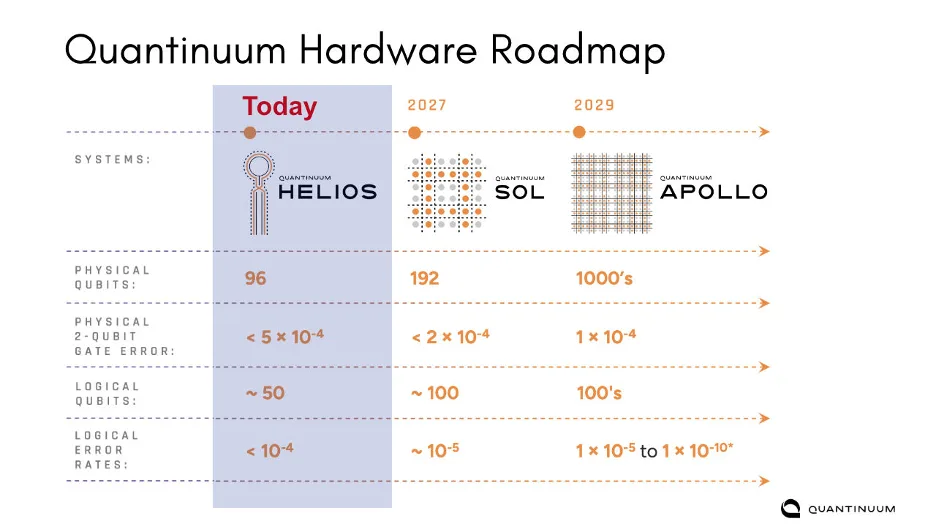
On the earnings call, the company provided an update on its overall roadmap:
| Roadmap | Details | Learnings from the Call |
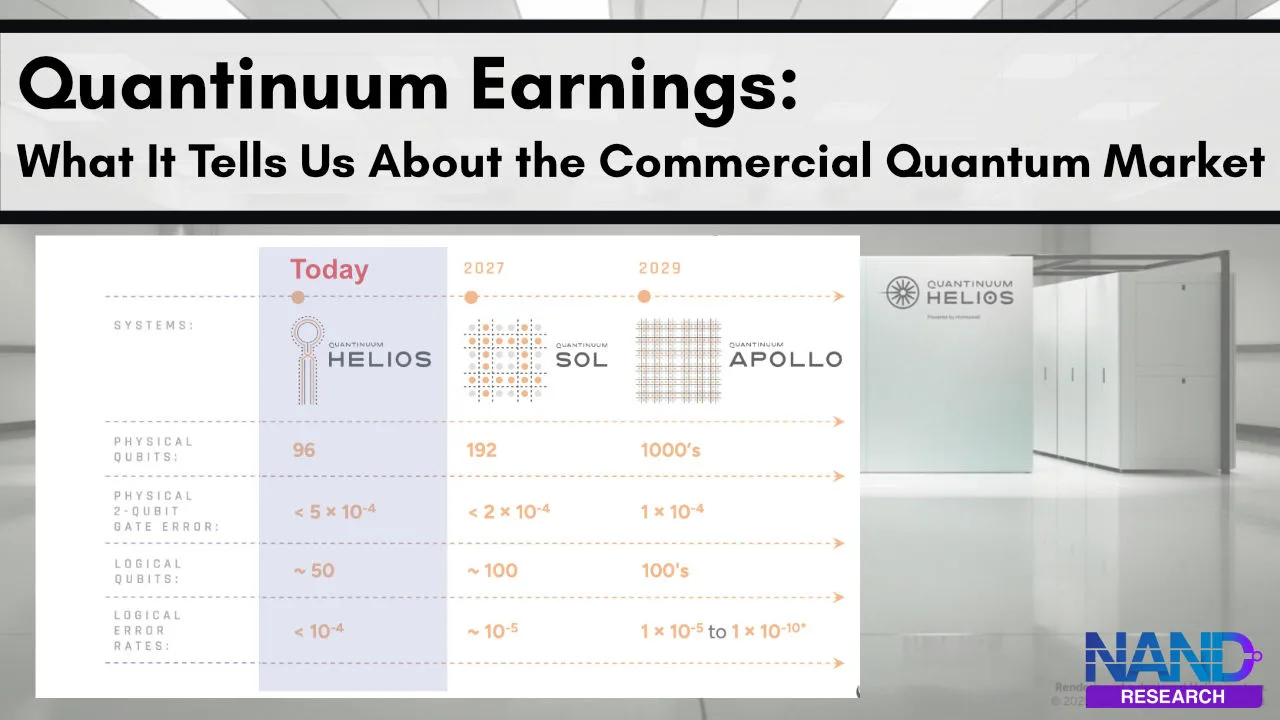
| Helios | Current-generation trapped-ion system, has 98 fully connected physical qubits. | Quantinuum reports several logical-qubit demonstrations: 94 error-detected logical qubits, 50 error-detected logical qubits in a magnetism simulation, and 48 error-corrected logical qubits. The company claims 99.9975% single-qubit gate fidelity and 99.921% two-qubit gate fidelity. |
| Sol | Targeted for 2H 2027 | The first production-candidate 2D QCCD ion traps for Sol have returned from fabrication and are undergoing validation, with no showstoppers identified to date. |
| Apollo | Targeted for 2029; Intended as Quantinuum’s universal, fully fault-tolerant system. | Apollo’s design is essentially complete, and that subsystem prototyping and test-bed work are underway. |
Quantinuum is also conducting preliminary derisking work on Lumos, the generation it expects to follow Apollo.
Error Correction
Quantinuum reported logical fidelity approaching 99.999% on its current hardware, corresponding to an error rate of roughly 10⁻⁵, using a new family of error-correction codes on Helios.
The approach trades logical-qubit capacity for a lower error rate and, according to Quantinuum, is designed to scale to Sol and Apollo as additional physical qubits become available for error correction.
The company also reported a fault-tolerant T-gate demonstration, a building block for universal fault-tolerant computation. Quantinuum separately cited a published Helios result that it says exceeds practical classical-simulation capabilities.
Manufacturing
Quantinuum said it signed a letter of intent with the U.S. Department of Commerce‘s CHIPS R&D Office for up to $100 million to support domestic trapped-ion manufacturing and supply chain development.
The company identified relationships with GlobalFoundries and Monarch Quantum in the original announcement and later cited Infineon and Honeywell Aerospace as additional component partners.
The company also said it has signed a joint development agreement with an unnamed global electronics manufacturer focused on data-center-scale production and system economics.
Analyst’s Take
The four critical takeaways from Quantinuum’s first earnings call as a public company are:
- Commercial momentum is running well ahead of reported revenue: While Q2 revenue was only $8M, YTD bookings have reached ~$81M, and management expects at least $120M for FY26. Quantinuum also described a pipeline valued at billions of dollars and expects >100% revenue growth in 2027. The business remains small in terms of revenue, but customers are making commitments well ahead of revenue recognition.
- Oracle validates the idea of quantum as data-center infrastructure by buying a Helios system and integrating it into OCI. The broader implication is architectural, that quantum could become another accelerator, alongside CPUs, GPUs, networking, and storage, for hybrid AI + HPC + quantum workflows. The Oracle deal is one of the clearest commercial validations of that model so far.
- The technology roadmap increasingly looks like an engineering and scaling challenge: Quantinuum demonstrated near-99.999 % logical fidelity on Helios, Sol’s production-candidate 2D QCCD traps are undergoing validation, and Apollo has progressed to subsystem prototyping. Quantinuum is deliberately using each generation to derisk the next: Helios → Sol in 2027 → Apollo in 2029 → Lumos. Helios itself has already demonstrated performance beyond practical classical simulation in published work.
- Quantinuum is building the market ahead of fault tolerance: Customers are discussing Helios, Sol, and even Apollo today; Nexus has more than 180 organizations using it; sovereign/on-prem demand is growing; and Quantinuum is expanding manufacturing and supply chain capacity while strengthening relationships with the Oracle/HPE ecosystem.
Quantinuum’s near-term strategy is centered on convergence, with the most direct near-term impact expected to come through integration with AI and HPC infrastructure.
The company also emphasized a mixed distribution model, selling systems directly, offering capacity from its own cloud, and now embedding systems within partner infrastructure, including Oracle Cloud Infrastructure and its existing relationship with Hewlett Packard Enterprise.
What it all means:
- The mixed go-to-market model spreads commercial exposure across direct system sales, Quantinuum’s cloud, and partner infrastructure. This will likely keep revenue uneven because system-sale revenue is typically tied to delivery timing.
- The strategy assumes quantum processors will create value as accelerators within heterogeneous compute environments. This aligns with current enterprise investment in AI and HPC infrastructure.
- Helios and Sol can build the installed base, customer relationships, and developer ecosystem before Apollo’s targeted 2029 launch, providing resilience if the fault-tolerance roadmap slips.
Quantinuum, along with the entire quantum computing industry, still faces enormous technical and execution challenges, and the company is doing everything we want to see at this stage.
The bottom line is that the company is executing its hardware roadmap, proving error correction, establishing a manufacturing supply chain, cultivating developers, integrating with AI/HPC infrastructure, and signing customers into long-term relationships – great progress, and precisely what we want to see at this stage.