For two decades, change control has been the one process meeting that no one would miss. The sacred weekly ritual of enterprise IT. Weekly CAB meetings, RFC templates, approval workflows, and lets not forget the strict maintenance windows. All of this is built on the assumption that humans make changes, humans approve changes, humans control the pace of change, and of course humans make the mistakes.
AI networking is breaking that model, and most organizations haven’t realized it yet.
The networks powering GPU clusters and AI factories don’t wait for CAB meetings. They can’t. They’re constantly rerouting traffic, adjusting QoS, rebalancing congestion, remediating failures, and tuning paths in real time. These aren’t the typical network engineer-led “events.” They’re changes. Thousands of them are happening faster than any human process can review or approve.
That’s a truth we can no longer ignore: AI networking moves at machine speed, but change control is still built for human speed.
The Tech is Happening Now
AI workloads are hypersensitive to micro-instability. A tiny jitter spike can tank GPU utilization. A brief congestion event can drop training efficiency double digits. To keep AI pipelines healthy, the network has to optimize continuously, not in scheduled windows.
At the same time, modern networking platforms have become agentic. If you’re looking at platforms like Mist or Cisco’s latest control planes, you have moved beyond dashboards. You’re looking at engines designed to take swift action. They reason across billions of telemetry points, identify root causes, and remediate issues autonomously. No human can process that volume of data or react at that pace.
AI driven network management has a simple consequence: the network is ready for autonomous operations; the process is not.
We have a Bottleneck
Traditional change control assumes changes are infrequent, discrete, human-initiated, reviewable, and schedulable. AI networking violates every one of those assumptions. The network is now a living system, constantly adjusting itself to maintain performance for workloads that cannot tolerate drift.
We have a simple risk: Enterprises that cling to legacy change control processes will throttle their own AI performance long before they hit GPU limits.
The New Model
The shift is redefining governance. It is not about elimination.
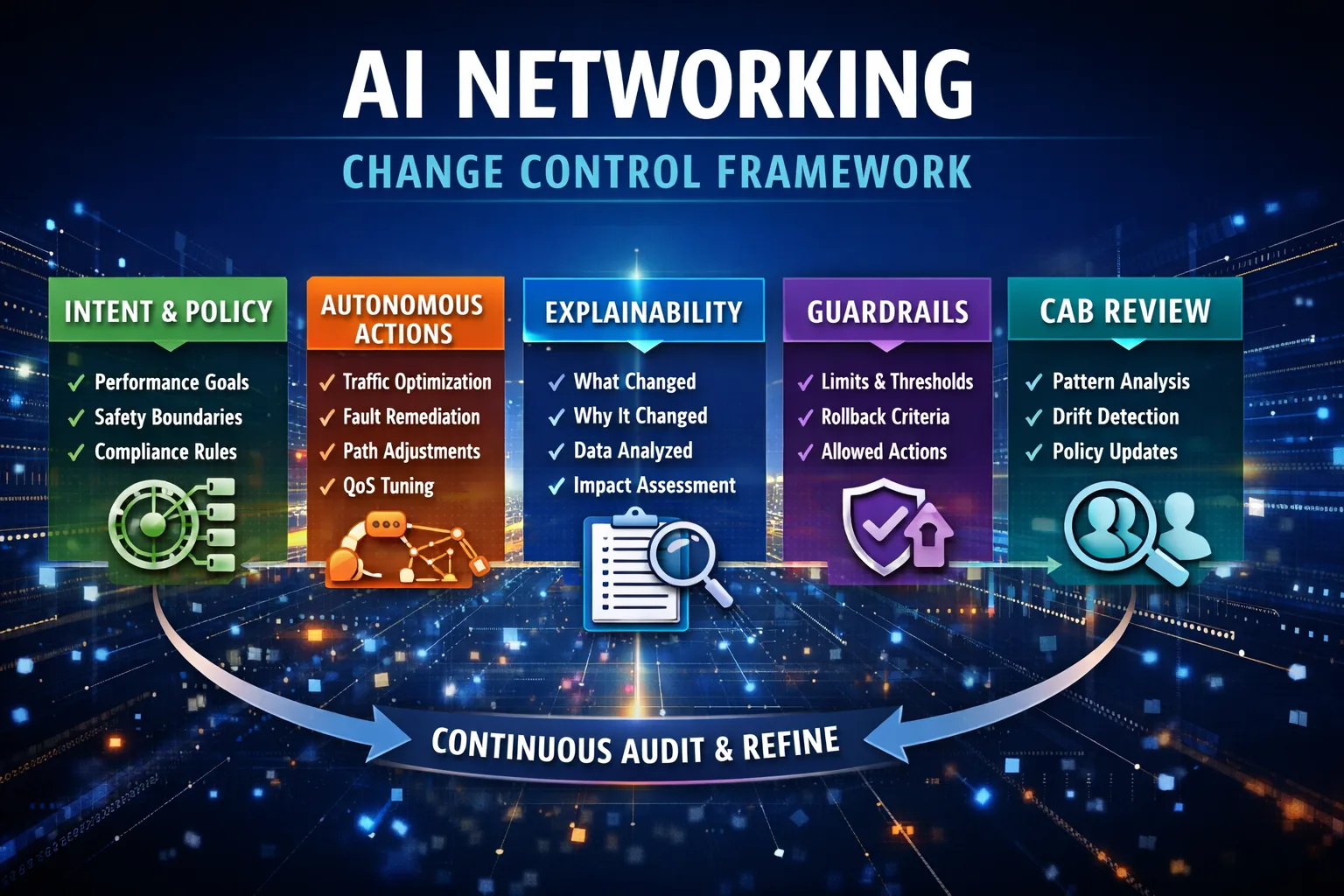
Instead of approving individual changes, networking teams define intent (the outcomes the network must maintain). They set boundaries, safety thresholds, and rollback logic. The network operates autonomously inside those guardrails, and humans review patterns after the fact rather than approving each action beforehand.
This flips CAB from a gatekeeper into an auditor. It also introduces a new requirement: explainability. If the network makes a change, it must be able to articulate what it did, why it did it, and what data informed the decision. That becomes the foundation of governance in an autonomous environment.
How Should Enterprises Respond
Most organizations aren’t ready for this shift. Their processes assume a world where humans control every change. That world is gone.
The path forward is to retire CAB as the primary control point for network changes, move toward continuous change with automated guardrails, adopt intent‑based governance, and require explainability from AI‑driven networking platforms. Change control becomes less about approvals and more about boundaries, observability, and trust in the system’s reasoning.
The Strategic Takeaway
AI networking is the first technology in decades that fundamentally breaks the assumptions behind traditional change control. It’s the autonomous functionality that is driving the change. The network is now self-healing and self-optimizing in ways a human operator couldn’t replicate in a weekend, let alone a maintenance window. Organizations that adapt their processes will unlock the full performance of their AI investments.
The ones that don’t will spend the next decade wondering why their GPUs are sitting idle.