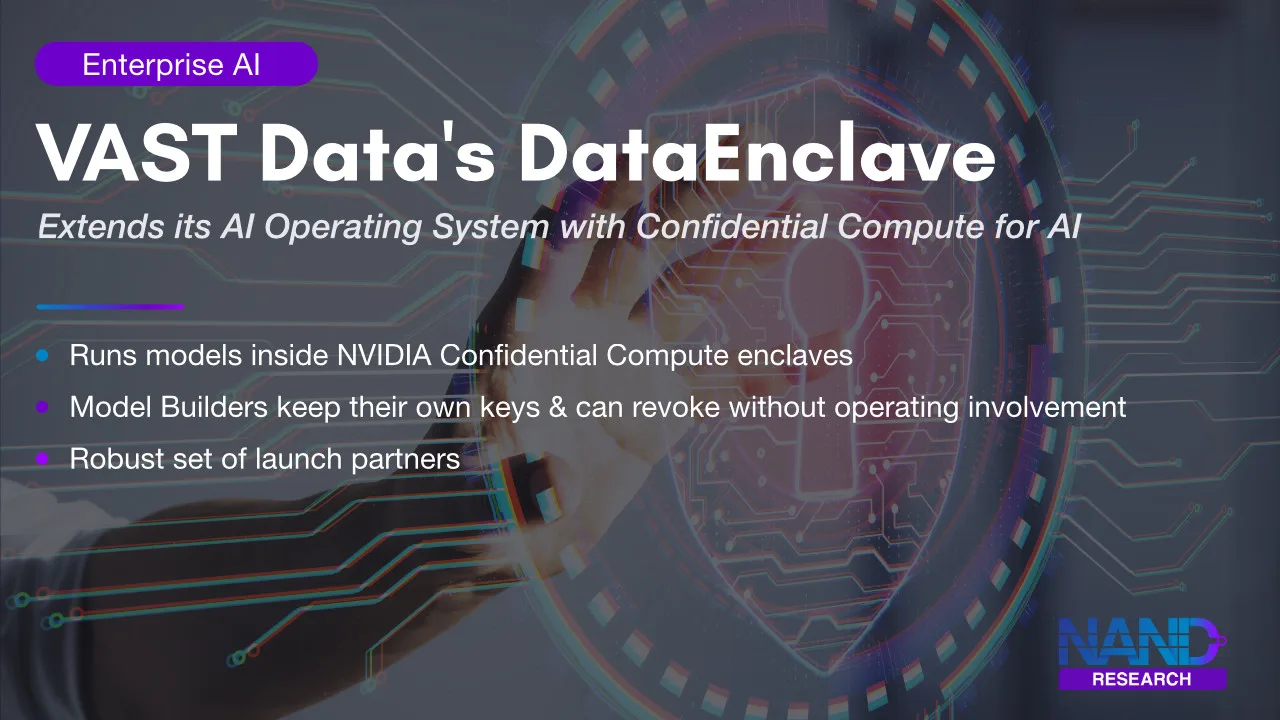

Cloudera and VAST Data have announced a strategic partnership to deliver a unified “AI factory” architecture that combines Cloudera’s containerized data services with the VAST AI Operating System.
The partnership pairs Cloudera’s lakehouse-based data engineering, governance, and AI services with VAST’s Disaggregated Shared Everything storage architecture, built on the NVIDIA AI Data Platform reference design. The joint offering addresses GPU starvation, in which expensive accelerator clusters sit idle because data pipelines cannot feed them fast enough to sustain training and inference workloads.
The companies describe the combined offering as a full silicon-to-application stack for enterprises building production AI systems across on-premises data centers, private cloud, and public cloud environments.
The solution is available immediately through both companies’ enterprise sales teams and partner ecosystems, with additional reference architectures and industry-specific deployment patterns planned through the remainder of 2026.
Details
The collaboration divides responsibility along established architectural lines: VAST provides the underlying storage and data infrastructure layer, while Cloudera provides the data engineering, analytics, governance, and AI services layer that runs on top of it.
VAST’s AI Operating System converts latent enterprise data into what the companies call pric“AI-ready” data, while Cloudera’s lakehouse services consume and act on that data throughout the AI lifecycle:
- VAST’s Disaggregated Shared Everything (DASE) architecture unifies high-performance storage, database, and global namespace capabilities at exabyte scale and integrates vector database services with NVIDIA cuVS to enable GPU-accelerated vector indexing and search.
- Cloudera’s containerized lakehouse services, spanning data engineering, streaming, analytics, machine learning, and AI, deploy consistently across hybrid and multi-cloud environments, eliminating the need for separate implementations per environment.
- The Cloudera AI Inference Service, accelerated by NVIDIA NIM microservices, lets customers deploy and scale models, including NVIDIA’s Nemotron open models, on top of the joint data platform.
- Apache Spark workloads in Cloudera Data Engineering can be accelerated through NVIDIA cuDF, allowing Spark jobs to draw on VAST’s high-throughput, GPU-accelerated data services.
- The data-platform layer is built on the NVIDIA AI Data Platform reference design, tying the joint architecture to NVIDIA’s broader accelerated-computing roadmap.
Cloudera and VAST position the offering to support private and sovereign AI deployments by combining NVIDIA AI infrastructure and NVIDIA AI Enterprise software with VAST’s data platform and Cloudera’s data and AI services.
Analysis
For Cloudera, the partnership reinforces its stated positioning as a hybrid data and AI platform that brings AI to data across on-premises, cloud, and edge environments, rather than requiring customers to centralize data with a single hyperscaler.
For VAST, the partnership continues a pattern of pairing its AI Operating System with data-platform and infrastructure providers, following earlier announcements involving CoreWeave, Google Cloud, Microsoft, and Megaport:
- The private and sovereign AI capabilities target regulated industries and government customers, where data residency and governance requirements limit reliance on public hyperscaler AI stacks. Cloudera already has an established customer base in this area.
- Alignment with the NVIDIA AI Data Platform reference design lends the architecture credibility, but it could also constrain differentiation as competing vendors adopt similar NVIDIA-aligned designs.
- The announcement includes no named customer deployments of the joint architecture, so the collaboration is currently supported only by executive statements.
Practitioner Impact
The target market for VAST and Cloudera is data engineering and machine learning platform teams, particularly in large, regulated enterprises that already operate Cloudera or VAST in production and are trying to move generative and agentic AI projects from pilot to production scale.
For these teams, the partnership reduces the integration burden of pairing a lakehouse platform with a high-performance storage layer, since the vendors have done at least the initial reference-architecture work themselves:
- Organizations already running Cloudera or VAST individually stand to gain the most, since they avoid re-platforming and can extend existing investments rather than replacing them.
- Cloudera and VAST claim the joint architecture “eliminates” GPU starvation and improves compute utilization, though the announcement provides no benchmark data or other proof points to substantiate the magnitude of that improvement.
- Teams without experience in both platforms face a steep learning curve, and the full silicon-to-application stack, spanning NVIDIA infrastructure, VAST storage, and Cloudera services, adds operational complexity even where the vendors have pre-integrated components.
Competitive Landscape
The data layer for AI has become a crowded segment, with Databricks, Snowflake, WEKA, and Everpure each pursuing similar strategies to position their platforms as the data foundation for enterprise AI factories. At the same time, several storage and server vendors have NVIDIA-aligned reference architectures in the market.
- Cloudera’s genuine differentiation lies in its data governance and lakehouse heritage in large, regulated on-premises environments, an area where Databricks and Snowflake have historically been stronger in cloud-native deployments than in hybrid, on-premises settings.
- VAST’s DASE architecture and its existing relationships with CoreWeave, Google Cloud, and Microsoft lend it credibility in raw storage performance and scale, but competitors, including WEKA and Everpure, make comparable performance claims for GPU-fed data pipelines.
Final Thoughts
The Cloudera-VAST partnership addresses a real and well-documented problem: enterprises have invested heavily in GPU infrastructure without the data pipelines needed to keep those accelerators fully utilized.
The division of labor between the two companies, with VAST handling high-performance storage and data infrastructure and Cloudera handling data engineering, governance, and AI services, is coherent and directly leverages each vendor’s established strengths.
What the announcement does not yet provide is proof. There are no named customer deployments, independently verified performance data, or pricing details. Moreover, the offering’s reliance on the NVIDIA AI Data Platform reference design places it in the same broad architectural category as several competing vendor offerings. The sovereignty and private AI framing is the most distinctive element of the collaboration.
For enterprises currently running Cloudera or VAST and evaluating how to scale AI workloads without re-platforming, this partnership offers a lower-friction path than adopting an entirely new data stack.