Dell recently expanded its Dell Private Cloud offering to support Nutanix AHV as a third hypervisor option, alongside existing support for VMware vSphere and Red Hat OpenShift Virtualization:
- The announcement builds on the Dell–Nutanix partnership formed in June 2024 and the August 2024 introduction of XC Plus HCI appliances with Nutanix AHV and PowerFlex external storage support.
- Dell PowerFlex storage is supported at general availability; Dell PowerStore integration is targeted for summer 2025.
- Dell’s disaggregated architecture allows compute and storage to scale independently—a structural advantage over fixed-ratio HCI appliances for environments with uneven growth patterns.
- Organizations with existing Nutanix AHV deployments can retain the Nutanix Prism management interface and familiar operational workflows while running on Dell PowerEdge compute and Dell storage.
- Dell’s solution-level support model, spanning automation, compute, storage, and hypervisor, simplifies the support structure compared to independently assembled multi-vendor stacks.
Executive Summary
Dell Technologies recently announced the expansion of its Dell Private Cloud offering to support Nutanix AHV as a third hypervisor option, complementing existing support for VMware vSphere and Red Hat OpenShift Virtualization.
Dell Private Cloud now supports three distinct hypervisor platforms across its PowerEdge compute infrastructure, with storage options initially limited to Dell PowerFlex at general availability, and Dell PowerStore integration scheduled for summer 2025.
The move directly addresses market pressure stemming from Broadcom’s 2023 acquisition of VMware, which introduced substantial licensing changes and price increases, prompting enterprise IT organizations to evaluate hypervisor alternatives at scale.
Details
Dell Private Cloud is Dell’s disaggregated infrastructure platform that separates compute and storage scaling, in contrast to traditional HCI designs that bundle CPU, memory, and storage within the same nodes.
The platform runs on Dell PowerEdge servers and integrates with Dell storage arrays through the Dell Automation Platform, which handles Day 0 deployment configuration, Day 1 operational administration, and Day 2 lifecycle management including upgrades, patching, and health monitoring.
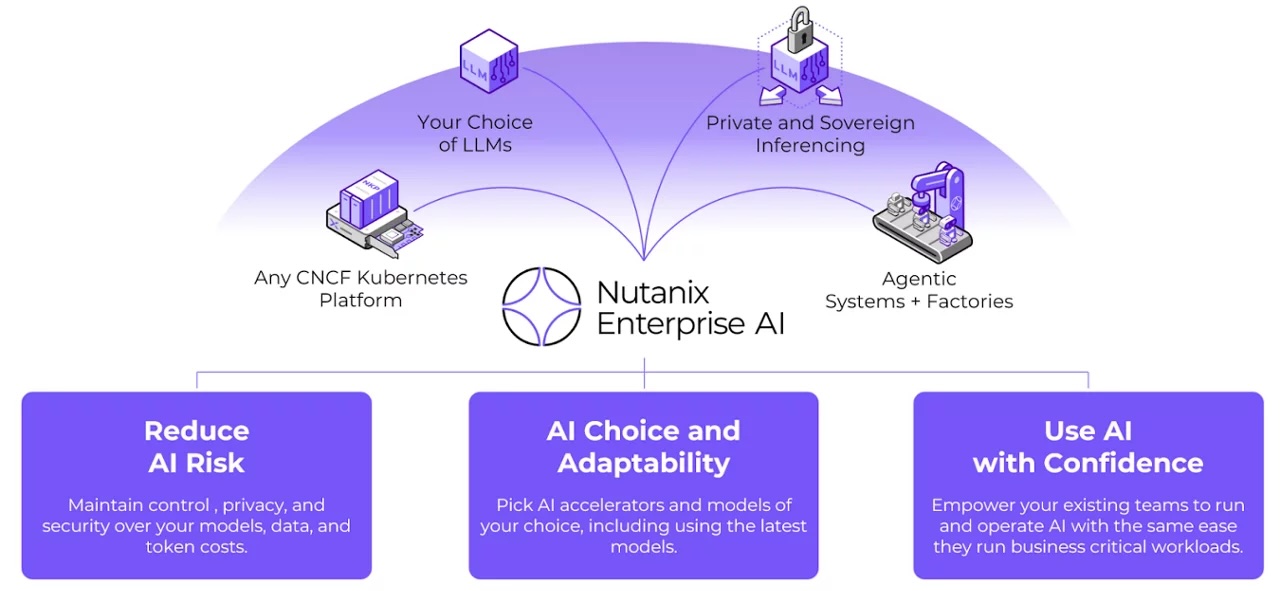
The Nutanix integration adds Nutanix AHV (Nutanix’s native hypervisor) as a supported virtualization layer within this stack. AHV is included at no additional hypervisor licensing cost within Nutanix software subscriptions and has been gaining adoption as a VMware alternative due to its tight integration with the Nutanix Prism management interface.
The following components comprise the integration:
- Compute layer: Dell PowerEdge servers serve as the physical compute substrate. Organizations can scale compute nodes independently of storage, a structural departure from traditional HCI designs such as Dell’s XC Plus appliances.
- Hypervisor: Nutanix AHV, a KVM-based hypervisor managed natively through Nutanix Prism. Prism Central and Prism Element UI remain the primary management interfaces for virtualization operations, preserving operational workflows familiar to existing Nutanix customers.
- Storage today: Dell PowerFlex, a software-defined block storage platform deployed across x86 nodes using TCP-based networking. PowerFlex supports scale-out configurations and is well-suited for workloads that require flexible block storage with independent scaling from compute.
- Storage planned: Dell PowerStore integration is scheduled for summer 2025. PowerStore is a dual-controller, all-flash unified storage array supporting both file and block protocols. This expansion will provide customers with a higher-performance, enterprise-grade storage option for latency-sensitive or mixed-protocol workloads.
- Automation layer: Dell Automation Platform provides the solution-level orchestration, delivering a consistent deployment and management experience across compute, storage, and hypervisor components. Dell’s automation spans full lifecycle management, including initial deployment configuration and ongoing operational tasks.
- Support model: Dell offers solution-level support across the integrated stack, covering the automation platform, compute hardware, storage hardware, and hypervisor layer. This single-vendor support structure is positioned as a differentiator versus independently assembled multi-vendor stacks.
It’s important to distinguish Dell Private Cloud from Nutanix, and from Dell’s XC Plus product line. XC Plus appliances are purpose-built Nutanix HCI offerings in a traditional converged node form factor, where compute and storage are co-located.
In contrast, Dell Private Cloud with Nutanix provides a disaggregated model in which compute and storage scale independently. This suits environments with unequal compute and storage growth rates but introduces more configuration complexity than a standard HCI appliance deployment.
Impact on IT Buyers
For IT organizations already running Nutanix AHV in their environment, or actively evaluating AHV as a VMware replacement, Dell Private Cloud adds a procurement and operational integration option that did not previously exist at this level of formalization.
The practical implications for day-to-day operations fall into several categories:
- Management continuity: Administrators familiar with Nutanix Prism (both Prism Element for cluster-level management and Prism Central for multi-cluster visibility) retain their existing management workflow. Dell claims no disruption to these interfaces, which reduces retraining requirements and operational risk for teams transitioning from VMware or expanding existing Nutanix environments.
- Independent scaling economics: The disaggregated architecture allows compute and storage capacity to be added independently. In workload environments where compute demand grows faster than storage (or vice versa), this prevents over-provisioning that is a common cost driver in fixed-ratio HCI deployments.
- Hardware investment protection: Organizations with existing Dell PowerEdge infrastructure can potentially reuse that hardware within the Dell Private Cloud framework, avoiding full hardware replacement cycles. The extent to which existing hardware is compatible with the current supported configurations should be verified with Dell, as not all PowerEdge generations may be validated for this use case.
- Lifecycle management automation: Dell Automation Platform’s Day 0 through Day 2 management claims to reduce manual operational overhead.
There are also real operational costs and risks to consider before committing to this architecture:
- Storage constraint at GA: GA currently supports only PowerFlex for storage. Organizations that prefer or require PowerStore’s unified file/block capabilities, lower latency all-flash performance characteristics, or simpler dual-controller management will be constrained until summer 2025. Deploying on PowerFlex now with a planned migration to PowerStore introduces additional operational steps and potential downtime windows.
- Organizational skill requirements: Running a disaggregated private cloud with Nutanix AHV requires competency across Dell infrastructure management, Nutanix AHV administration, and PowerFlex storage operations. Organizations without existing depth in one or more of these areas should factor in training and potential professional services costs when calculating their total cost of ownership.
- Vendor dependency consolidation: While the architecture addresses hypervisor lock-in concerns, it simultaneously deepens dependency on Dell for the full infrastructure stack. Organizations should assess whether trading hypervisor flexibility for greater reliance on Dell infrastructure aligns with their broader vendor diversification strategy.
Analysis
Dell’s expansion of Private Cloud to support Nutanix AHV is a well-timed and coherent move. By formalizing Nutanix as a third hypervisor option within a single infrastructure platform (alongside VMware and Red Hat) Dell responds directly to documented market demand for reduced hypervisor dependency, without requiring customers to change their hardware or management automation approach. Dell is now a hardware-agnostic infrastructure platform provider, rather than a platform vendor tied to a single software stack.
This is a deliberate strategic pivot away from its historical association with VMware through the VxRail product line, which was built exclusively around VMware vSphere and was directly affected by the Broadcom acquisition dynamics.
Its multi-hypervisor strategy gives Dell a differentiated message in a market where competitors either offer single-hypervisor solutions or require customers to commit to proprietary hardware ecosystems. That competitive boost includes:
- Openness as a differentiator: Dell’s ability to mix hypervisors across a common hardware and automation platform is a hedge against future vendor pricing changes. This will resonate well amid the ongoing market anxiety stemming from Broadcom’s VMware strategy. However, ‘openness’ in this context remains bounded, as customers still depend on Dell hardware, Dell automation tooling, and Dell storage.
- Disaggregation as architectural differentiation: Independent compute and storage scaling separates Dell Private Cloud from traditional HCI vendors, including Nutanix itself in its native appliance form factor. Dell is effectively enabling Nutanix software on a more flexible underlying infrastructure model than Nutanix’s own standard appliance offering.
- Single-vendor support simplification: Dell’s solution-level support across the full stack (including automation, compute, storage, and hypervisor) addresses a real operational pain point in multi-vendor environments. For organizations that value support simplicity, this is a tangible differentiator over independently assembled stacks.
- Existing customer base leverage: Dell has an extensive PowerEdge installed base across enterprise and mid-market accounts. The ability to deploy Nutanix AHV on existing PowerEdge hardware enables Dell to participate in VMware replacement cycles at accounts it already serves, without requiring those customers to change their hardware vendor.
The announcement is not without limitations, however. The current general availability supports only PowerFlex storage, leaving PowerStore-dependent workloads in a holding pattern until summer 2025. The disaggregated private cloud model introduces more operational complexity than purpose-built HCI appliances, and the integration’s production maturity at scale has not yet been independently validated.
Organizations with existing Nutanix AHV investments should also carefully evaluate whether the Dell Private Cloud model offers net-new capabilities versus simply formalizing a deployment pattern that was already achievable through manual integration.
That said, the broader signal of this announcement is significant: one of the world’s largest infrastructure vendors is explicitly building its private cloud strategy around software flexibility rather than hardware or hypervisor lock-in.
For IT decision-makers evaluating long-term private cloud architectures, the ability to run VMware, Nutanix, or Red Hat workloads on common Dell hardware, with common lifecycle automation and a single support relationship, allows a meaningfully reduced commitment risk compared to infrastructure platforms that require workload-to-platform alignment at the time of purchase.
For organizations facing VMware licensing pressure or planning a multi-hypervisor environment, Dell Private Cloud with Nutanix AHV provides a credible, production-viable path that combines the operational familiarity of Nutanix Prism with the infrastructure depth and supply chain scale that Dell brings to enterprise deployments globally.
Competitive Impact & Advice to IT Buyers
The competitive landscape for this announcement spans several overlapping segments: purpose-built HCI vendors, private cloud software vendors, and traditional server OEMs. Each presents distinct competitive dynamics…
These sections are only available to NAND Research clients and IT Advisory Members. Please reach out to [email protected] to learn more.