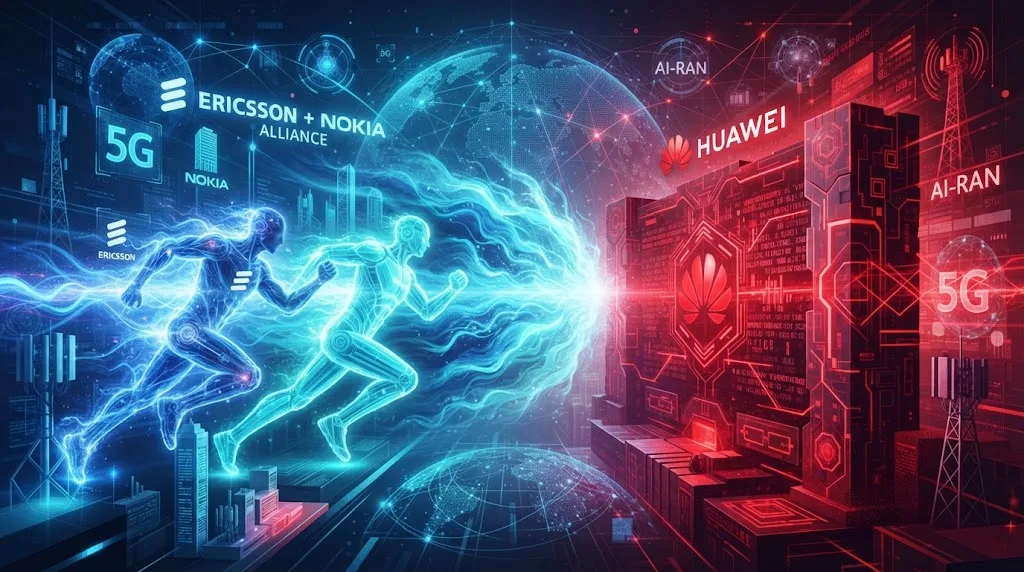
For more than a decade, the global cellular infrastructure market has been defined by three dominant players: Huawei, Ericsson, and Nokia. Each has carved out its own identity. Huawei with deep vertical integration, Ericsson with high‑performance and portable RAN software, and Nokia with cloud‑native architectures and GPU‑accelerated AI‑RAN. But as 5G matures and AI‑RAN becomes the next battleground, a question is resurfacing across operators, analysts, and policymakers:
Does the cellular market need a merger, specifically between Ericsson and Nokia, to remain competitive?
It’s a provocative idea, but not an unreasonable one. Yet when you examine the technical, commercial, and geopolitical forces shaping the industry, the answer becomes far more nuanced than a simple yes or no. Especially once you factor in the massive regulatory hurdles and engineering friction such a deal would entail.
The Market Reality: Huawei Is REALLY strong
Huawei’s approach to AI‑RAN is fundamentally different from its Western competitors. Instead of relying on portable Layer‑1 software or GPU acceleration, Huawei has built a vertically integrated, AI‑native RAN anchored by telecom foundation models, RAN digital twins, tightly coupled radios and basebands, and closed‑loop intent‑driven optimization.
When the radio, baseband, scheduler, and AI model are all designed together, optimization cycles shrink from months to minutes. Huawei’s RAN Agent, UBBPi basebands, and MetaAAU radios form a tightly integrated stack that modular, multi‑vendor ecosystems struggle to touch. Nokia and Ericsson, meanwhile, went down completely different roads. Nokia leaning into NVIDIA’s CUDA platform for GPU-accelerated Layer-1, and Ericsson doubling down on portable L1 software meant to run across a mix of silicon vendors. Strong approaches, sure, but hopelessly fragmented compared to Shenzhen’s steamroller.
Would a Nokia–Ericsson Merger Change the Game?
A combined Nokia+Ericsson entity would instantly become the largest non‑Chinese RAN vendor in the world. But looking past the sheer market share numbers, would their combined technology stack actually mirror Huawei’s?
Technically, the answer is directionally yes. A merged company could theoretically unify Nokia’s GPU-accelerated AI-RAN, Ericsson’s portable L1, a shared cloud-native architecture, and a unified Open RAN roadmap to create a hybrid AI-RAN that runs on multiple silicon types.
However, this is where the fantasy hits a brick wall: Engineering friction. Let me be blunt for a second. Fusing Ericsson’s heavy reliance on custom silicon with Nokia’s pivot toward merchant accelerators and GPUs is not a plug-and-play exercise. It would be a multi-year, multi-billion-dollar architectural nightmare. Rather than instantly matching Huawei, a merged company would likely spend years untangling, rationalizing, and scrapping conflicting baseband and silicon roadmaps. And honestly, I get why people roll their eyes at the merger idea. On paper it sounds clean. In reality, it’s anything but.
Would It Impact Huawei’s Market Share?
If a merged entity could survive the internal engineering chaos, the market share impact would be uneven:
- Europe: A merged champion would become the default vendor for nearly every major European operator, causing Huawei’s share to fall sharply. That said, European antitrust regulators would likely step in with severe scrutiny, viewing a merger of the continent’s final two telecom anchors as an unacceptable reduction of carrier choice. And honestly, I’m not convinced regulators would even let this happen without carving the companies into pieces first.
- Latin America: Operators would gain a unified Western alternative with a clearer roadmap, eating into Huawei’s share in countries like Brazil and Chile.
- Middle East: Huawei would face pressure as operators weigh AI‑RAN performance and energy efficiency more heavily.
- North America: Huawei has no future in North America, so the merger would not affect its footprint here, though it would reinforce Western vendor stability.
- China, Africa, Southeast Asia: Huawei’s position would remain largely untouched due to financing models, political alignment, and deep-rooted relationships.
A unified portfolio would slow Huawei’s growth in enterprise and private 5G by offering a single industrial roadmap and edge strategy. But navigating the regulatory gauntlet to get there would be a political marathon. And that is where the fantasy falls apart.
So… Does the Market Need a Merger?
Here’s what I think:
If the ultimate goal is to create a Western RAN vendor capable of matching Huawei’s AI-native architecture, a Nokia+Ericsson merger could theoretically strengthen long-term competitiveness.
But here is where things get uncomfortable. A merger wouldn’t solve Western competitiveness issues overnight. Instead, it would trigger a grueling internal engineering headache and a massive regulatory battle in Europe. Furthermore, by reducing competition between Western vendors, it risks slowing the very pace of RAN innovation and openness that carriers rely on.
Ultimately, the cellular market doesn’t need a merger, it needs execution. While a combination would undeniably reshape the competitive landscape, the cost of an internal engineering and regulatory nightmare far outweighs the quick-fix fantasy of taking on Huawei on day one.